Saturday, 29 April 2006

Earth’s “biggest heat bucket.”

Coral reefs, octopi, eels, offshore oil rigs, El Niño, La Niña, the birthplace of life, tasty seafood, even assorted bottom feeders.

All these things come to mind when we think of the world’s ocean. Researchers at NASA’s Jet Propulsion Laboratory and Goddard Institute for Space Studies have learned to think of the ocean as something else, something that might not occur to the rest of us.

The ocean, they say, is Earth’s “biggest heat bucket.” And like a bucket placed under an overflowing sink, the ocean is filling up with the heat that increasing levels of greenhouse gases are preventing from escaping to space.


Read more...

Friday, 28 April 2006

Wind farm fight on two fronts

The Age, Page: 3
Friday, 28 April 2006

THE Federal Government faces two court challenges over its controversial decision to veto a $220 million wind farm in South Gippsland. Victorian Planning Minister Rob Hulls said yesterday the State Government would lodge an appeal against that decision in the Federal Court on Monday, vowing to spend ''whatever it costs'' on the battle. The Age believes the company proposing the Bald Hills wind farm, Wind Power, will lodge a separate Federal Court appeal on Monday. The Federal Government halted the project to protect the endangered orange-bellied parrot from harm by wind turbines despite its own consultants saying the wind farm was not a high risk to the birds.

Environment Minister Ian Campbell invoked a rarely used environmental law to block the wind farm, saying there was too great a risk to the parrot. There are only about 200 left. Mr Hulls said the State Government's lawyers would argue that Senator Campbell had made a biased decision to placate antiwind farm campaigners. ''We think it's important to appeal this decision because we don't believe any company that wants to invest in infrastructure anywhere in Australia, let alone Victoria, can have certainty while this decision stands, '' he said.

But even if the State Government wins its appeal, the Federal Court has no power to overturn Senator Campbell's decision and allow the wind farm to be built, and could only order the minister to reconsider his decision. Yesterday, Senator Campbell dismissed the court action as a political stunt, maintaining his decision was justified by a consultant's report on the risk to migratory birds from wind farms across south-eastern Australia. ''I have published onmy website the detail of my report that was the basis ofmy decision, and I am happy for people to read that and to debate it, '' Senator Campbell said. Yet, according to the government-commissioned report by Biosis Research, the risk of parrots being killed at Bald Hills was extremely low, because the parrots usually migrate over south-western Victoria rather than South Gippsland, and there have been no recorded sightings of the parrots at the site.

According to the report's risk analysis - which the Federal Government has not disputed - even if parrots did migrate past Bald Hills, the predicted worst-case scenario would result in one being killed every 667 years. In the best-case scenario, that would fall to one being killed every 1097 years. Speaking publicly about the report for the first time, Biosis Research chief executive Charles Meredith stressed that the report was mainly about the combined risk from all the wind farms, but stood by its analysis for the Bald Hills site. ''It's clear in the report that Bald Hills didn't have a high collision risk, '' he said.

But Dr Meredith refused to comment on whether the report's findings justified Senator Campbell's decision: ''We did the report for the Federal Government and it's for them to interpret it. ''

• A rare wedge-tailed eagle has died after hitting a wind turbine at the Woolnorth wind farm in Tasmania.

Court call on parrot

Herald Sun, Page: 15
Friday, 28 April 2006

A JUDGE will decide if Canberra must rethink a ban imposed on a South Gippsland wind farm over the orange-bellied parrot. The State Government will lodge an appeal in the Federal Court next week, which could force Federal Environment Minister Ian Campbell to reconsider. State Planning Minister Rob Hulls said Senator Campbell had made a biased decision by blocking the 52-turbine Bald Hills wind farm. ''The orange-bellied parrot was a really a pretext for what was clearly a political decision, '' Mr Hulls said.

The report says there have been few sightings of the orange-bellied parrot in the area in recent years. A win for the State Government would mean Senator Campbell would have to make a decision again. The State Government argues that Senator Campbell made the decision to bolster the Coalition's position in McMillan, the local federal electorate. Senator Campbell yesterday stood by his decision and said the State Government's action was a stunt.

Thursday, 27 April 2006

Environment: Sweden to be Oil Free

The Ballan News, Page: 8
Thursday, 20 April 2006

SWEDEN has moved to the forefront of the world's 'green' nations by setting an ambitious goal to achieve a completely oil-free economy by 2020 - all without building more nuclear power plants. Motivated by global warming and rising oil prices, the Swedish government says it intends to replace all fossil fuels with renewable alternatives before climate change undermines national economies worldwide and diminishing oil supplies force astronomical price increases. They probably don't have any orange bellied parrots and yellow bellied pathetic Liberal politicians. "Our dependency on oil should be broken by 2020," said Mona Sahlin, minister of sustainable development, in an interview with The Guardian newspaper.

"There shall always be better alternatives to oil, which means no house should need oil for heating, and no driver should need to turn solely to gasoline. "Not everyone believes Sweden's goal to free itself from oil by 2020 is achievable, but even critics applaud the country for setting such a compelling and motivating goal. which could also inspire other nations to make dramatic efforts to reduce their dependency on fossil fuels. The Swedish government is serious about the goal.

According to the energy committee of the Royal Swedish Academy of Sciences, there is growing concern among nations worldwide that global oil supplies are peaking and will soon begin to become scarce, causing the price of oil to skyrocket. Committee members predict that a global economic recession could result, and Sweden is taking action to make its economy less vulnerable. According to Sahlin, international oil dependency is one of the world's biggest problems, and she believes Sweden must act now to prepare for the worst. "A Sweden free of fossil fuels would give us enormous advantages, not least by reducing the impact from fluctuations in oil prices," she said.

"The price of oil has tripled since 1996." There is no question the goal is extremely ambitious, but this nation of 9 million people has a track record on energy issues that should inspire confidence. In 1970, 77 percent of Sweden's energy came from oil, but by 2003 that figure had fallen to 32 percent. Renewable sources account for an average 6 percent of energy consumed by nations in the European Union while renewable sources supply 26 percent of Sweden's energy needs.

Roughly a third of Sweden's energy comes from nuclear power, although a 1980 referendum declared that nuclear power should he phased out. Sweden has built wind power and water power plants along its coastlines, including a large new wind farm that is scheduled to start producing energy in 2009. And the country has more forest per capita than any other country in the EU, which provides a steady supply of biomass. Sweden also sponsors innovative programs to promote the use of alternate fuels for everything from home heating to transportation.

Many neighborhoods in Sweden use a central furnace that consumes biological fuels to provide hot water for all of the nearby homes. Thousands of individual homeowners have replaced their oil furnaces with boilers that use wood-based pellets, which has dramatically reduced Sweden's dependence on oil for home heating. According to the Swedish Petroleum Institute, heating oil sales have fallen by 85 percent in recent years, and today only 8 percent of Swedish homes are heated by oil. Sweden uses tax breaks and other financial incentives, such as exemption from tolls and parking fees, to encourage citizens to drive cars that use renewable fuels.

Tax incentives also make it possible for Swedish drivers to fill their tanks with ethanol-based fuel for about a third less money than it would cost for ordinary gasoline, even though ethanol costs about 40 percent more to produce. A Commitment to Environmental Leadership When Swedish Prime Minister Goran Persson heard that U. S. President George W.

Bush had declared in his 2006 State of the Union address that America is addicted to oil, he said he was relieved to learn that "at last there's one more who understands the problem." Unfortunately, President Bush's proposed budget, which came out a week after his speech, either underfunded or reduced funding for many conservation and renewable energy programs that could help lessen America's addiction. The people of Sweden not only understand the problem, they are pioneering solutions and setting an example for the rest of the world to follow.

What does Ian Campbell have against wind farms?

The Australian: Editorial
Wed, Apr 26, 2006

WHEN federal Environment Minister Ian Campbell used a vastly overstated threat to a rare parrot to block a Gippsland wind farm, some critics accused him of having been fully co-opted by the greens in his ministry. Others suggested that the real reason behind the spiking of the project was politics: Senator Campbell fulfilled a promise to local voters opposed to the wind farm, who delivered a large Liberal swing in the marginal seat of McMillan at the last election. Now, Senator Campbell is again playing politics with wind farms – and this time, he hasn't even bothered finding an endangered species with which to cover himself. On Monday, Senator Campbell announced he had written to Regional Services Minister Warren Truss, asking him to block any further funding for the Denmark wind farm in Western Australia. This after the wind farm's backers had received a government grant of up to $240,000 to build the renewable energy development.

Last year, Senator Campbell announced his intention to wrest control over wind farms to Canberra, claiming state Labor governments were forcing turbines on an unwilling populace. It's not hard to see why wind farms can be unpopular. Beyond their supposed threat to parrots and other wild animals, local residents often resent their views being blocked by acres of spinning turbines and feel wind farms hurt their property values. The Denmark wind farm was opposed by 60 families, some of whom reportedly do not live in the area of the site. And again, backyard interests and local politics collided to kill the project, which was to be built not just in Senator Campbell's home state but in the electorate of fellow Liberal Wilson Tuckey.

While Senator Campbell has often – and deservedly – been criticised for having gone too green on some issues, when it comes to wind farms, he is not green enough. Killing the Bald Hills wind farm on scanty evidence of a parrot's presence was bad enough, especially when Senator Campbell's office looks set to give the tick to a Pilbara iron ore mine where three rare night parrots were allegedly seen last year. Any human project is going to have consequences, be it a wind farm or a highway or a nuclear power plant. But so far, wind farms seem like a pretty low-impact way to generate power while meeting mandatory renewable energy impacts.

Threats to wildlife appear to be overstated. And succumbing to not-in-my-backyard arguments is a dangerous road for politicians to go down. Even the economics of wind farms, which at first glance look unsustainable (they are more expensive than coal and require government subsidy) are more nuanced when one examines the details. Greenpeace estimates wind farms could create 3300 jobs, mostly in regional Australia, and pump billions of dollars into the states. Taken together, the nation's wind farms could eventually produce enough green power for hundreds of thousands of homes. But that won't happen as long as Senator Campbell keeps playing politics.

Tuesday, 25 April 2006

Big Shot

The Australian
Page: 20 Tuesday, 25 April 2006

AUSTRALIA'S membership in the Asia Pacific Climate Partnership is already paying off, with one solar company negotiating contracts worth more than $1 billion. Solar Systems chief Dave Holland, an industry delegate on the renewableenergy taskforce-one of eight established under the climate alliance known as AP6-said the meeting in California last week had exceeded all expectations. Mr Holland, pictured, will lead a solar energy industry delegation to China at the invitation of government officials. The small Melbourne-based company also looks likely to clinch a lucrative deal to roll out 150 megawatt solar power stations in China, India and the US.

Details of the deal were discussed during bilateral side talks between Australian renewable energy industry delegates and the Chinese government delegation. ''We had some reasonably detailed discussions with the Chinese government delegation about what that would involve, '' Mr Holland said. ''We expect the projects across the regions to be worth more than $1 billion in solar power infrastructure. ''In Australia, coal-fired power is so cheap it is difficult for solar power to compete because of more expensive production costs.

But in China, a new tariff system requiring all electricity retailers to buy a certain amount of renewable energy at a set price is encouraging greater take-up of clean energy. China will acquire an additional 2000 megawatts of renewable electricity every year. The Solar Systems deal is likely to involve manufacturing the photovoltaic panels in China. The bilateral talks with China are also expected to lead to lucrative contracts for the wind and hydro energy industries.

Pacific Hydro chief executive officer Rob Grant said Chinese officials expressed an interest in greater foreign investment, to build up their budding wind energy industry. ''I think it's fair to say that the potential in that market for wind and hydro is enormous, '' Mr Grant said. The AP6 taskforces have agreed to complete action plans identifying suitable markets across member nations for deploying low emission and clean energy technology by August. The alliance between Japan, Australia, the US, India, South Korea and China was forged last year and has been touted as an alternative to the Kyoto Protocol.

Cleaner power to people

Community PowerMORELAND has long prided itself on its sustainability and is going one step further with Community Power. Residents who sign up to Community Power by May 15 go into a draw to win a $300 sustainability pack from the Moreland Energy Foundation. Community Power is a program set up Darebin, Melbourne, Yarra and Banyule cities and the energy foundation to make switching to green power cheaper and easier for residents.

The program has struck a deal with AGL so residents can switch at no extra cost to 20 per cent green power: renewable electricity generated from the sun, wind, water and waste.

To join Community Power, call AGL 1300 762 254 or visit www.communitypower.org then phone Rachel on 9381 1733 to enter the draw.

Minister freezes wind farm funds

The Australian
April 25, 2006

FEDERAL Environment Minister Ian Campbell infuriated another state government yesterday by overriding plans to build a wind farm. Less than a month after he blocked a wind farm in Victoria to "save" the orange-bellied parrot, Senator Campbell froze funding yesterday for a similar project near Denmark on the south coast of Western Australia.

The minister said he had written to Regional Services Minister Warren Truss asking him to refuse further requests for funding for the project. "Senator Campbell strongly opposes further funding for the Denmark Community Windfarm group until the expressed wishes of the local community are taken into account through the introduction of a national wind farm code," Senator Campbell's spokeswoman said.

Earlier this month, the minister set off a war between Canberra and Victoria when he invoked rarely used federal powers to block the $220 million Bald Hills wind farm in Gippsland on the grounds it could kill one rare orange-bellied parrot a year. The Victorian Government has demanded he reconsider. Last night, West Australian Planning Minister Alannah MacTiernan described Senator Campbell's latest decision as tragic.

"It is a joke that at a time when we have got some really hard issues to deal with, we've got an environment minister who has no interest in sustainability, that at a national level we are not only getting zero leadership, we're getting minus zero leadership," she said. "These are big issues. We need leadership at a national level and Campbell is as much a joke as (Denmark area MP) Wilson Tuckey is as an environment minister. Other than going around and doing a bit of bashing of the Japanese on whales, he hasn't shown any capacity to deal whatsoever with the big issues we are facing."

Ms MacTiernan has been accused of ignoring advice from a state government planning committee that voted three to two against the proposed wind farm. But she said a departmental report prepared on the project was "substandard and flawed". The report excluded information from Western Power recommending the wind farm site, and ignored advice from its own department that the farm was not visually obtrusive, she said. "This has got nothing to do with this report, because Campbell, well before he had ever seen this report, had been down there (at the proposed site) with Wilson Tuckey trying to stir the possum," she said.

She said the project was formally opposed by only about 60 families, including many who did not live at Denmark. Senator Campbell will also have the final say in the development of a new iron ore mine in northern Western Australia, which yesterday won state government approval despite the possible presence of a bird even rarer than the orange-bellied parrot - the night parrot.

The West Australian Government gave its final environmental approval for Fortescue Metals Group's iron ore mine at Cloud Break in the Pilbara, part of a $1.8billion development stalled by sightings last year of three night parrots, which were once thought to have been extinct. State Environment Minister Mark McGowan was critical yesterday of Senator Campbell's decision to block the Bald Hills wind farm on environmental grounds, saying it had been possible to approve the Pilbara mine by imposing strict conditions.

"I would be surprised if Senator Campbell was to knock back this (iron ore mine). I'm positive he won't knock it back. His decision in Victoria was based on it being a marginal seat - it was not environmental," he said.

Sunday, 23 April 2006

Turbine's Got Watt It Takes

Macedon Ranges Telegraph, Page: 5
Tuesday, 18 April 2006

HUME Council is set to embark on a 12-month trial of a micro-wind turbine at Sunbury. The trial, the first of its kind with such a device, will have the turbine set up in an open space and monitored with a computer. It's believed the mini wind turbine could revolutionise household energy. The trial model is a metre wide and can produce up to six kilowatts a day.

The council will measure energy production and fluctuation. Inventor Arthur O'Connor's turbine was reported in the Telegraph in November. Mr O'Connor said his device had the potential to halve residential electricity bills. Mayor Adem Atmaca said the trial was aimed at determining the visual impact and noise levels of the 'micro' turbine on a domestic environment.

"If successful, it would give Victorian householders the opportunity to produce up to half their average daily electricity requirements from greenhouse-friendly renewable energy -for approximately half the cost of installing a solar power system of similar capacity." Cr Atmaca said.

Green Power Brings The Tick Of Approval

Green Power Brings The Tick Of Approval
Lithgow Mercury, Page: 8
Saturday, 15 April 2006

The Blue Mountains are turning green with the launch of a Green Power information campaign in Council libraries and sports centres. Local Member and Minister for the Environment Bob Debus and Blue Mountains Mayor Jim Angel are encouraging local residents and businesses to embrace Green Power and help reduce greenhouse emissions. "Green Power is a clean green energy alternative and you can choose to make some or all of your energy green. By switching even a fraction of your energy needs green, you can help reduce greenhouse gases," Mr Debus said.

"The Green Power Scheme was established in NSW 1997 and launched nationally in 2000 and is one of the first Green Power accreditation schemes in the world." The Green Power tick of approval means that the energy you are buying from your supplier must come from renewable and environmentally friendly power sources. "At the moment at least 80 per cent of that energy must come from 'new' generation plants - or generators which have been built after January 11997." After July this year that will increase to 100 per cent of the energy.

"Green energy is generated from renewable sources such as the sun, wind, water or biomass rather than from burning coal which releases large quantities of greenhouse gas emissions into the atmosphere," Mr Debus said. "The average household in Australia emits over eight tonnes of greenhouse gas emissions each year. "In the past five years, Green Power customers have contributed to reducing greenhouse gas emissions equivalent to taking 1.4 million cars off the road for 12 months," Mr Debus said.

Mayor Jim Angel said Council was reviewing its energy contracts to look at Green Power and had introduced ways to reduce its energy consumption and green house gas emissions over the past few years. "Blue Mountains World Heritage Institute, in conjunction with the Lawson Chamber of Commerce and Industry, Council and Integral Energy, are working to achieve energy efficiencies and long-term energy savings for the residents of Lawson," Cr Angel said "Over 500 residents in South Lawson have been contacted to take part in a survey which will assist the Institute and the Council in achieving energy efficiency for all of Lawson. "We want to apply the findings of Lawson to reduce the costs for both households and businesses throughout the wider Blue Mountains region. "Over the past two years Council has significantly cut down energy consumption, and therefore greenhouse gas emissions, in Council buildings.

"In the first year of our Energy Performance Contract project we achieved an annual 40 per cent energy saving in lighting and since then we have reduced 136 tonnes of CO2 greenhouse gas emission each year (the equivalent of removing 30 cars from the road) and have saved Council approximately $15, 000 per annum in energy consumption and maintenance costs," Cr Angel said. As part of the project Council has installed solar panels at Katoomba and Glenbrook pools which will be used to help heat the indoor and outdoor pools. The project is being undertaken at no cost to Council. Energy Conservation Systems undertake the capital improvements at their cost and are paid from the financial savings Blue Mountains City Council achieves through the reduction of energy costs.

Council is also reducing the energy consumption of streetlights by switching to T5 lights which give the same level of directed illumination as 80 watt globes but use only one third of the power. "For every 100 streetlights we change over, we stop around 14 tonnes of CO2 from being released into the atmosphere," Cr Angel said. Cr Angel said Council is changing its car fleet to four cylinders rather than six and looking at ways to increase use of public and alternate transport. More information can be found on the
Green Power website: http://www.greenpower.com.au

Thursday, 20 April 2006

Pacific Hydro Funds Sustfund

The Stawell Times-News, Page: 2
Tuesday, 18 April 2006

ARARAT -Pacific Hydro made the first payments to Ararat and district recipients under its ground breaking Sustainable Communities Fund at a reception held in Ararat. Launched in late 2005 the fund is a long term commitment by Pacific Hydro to make annual payments to organisations within the local communities in which it operates. In this inaugural round over $40.000 has been provided to 10 organisations supporting activities such as sporting club initiatives, health and community cohesion programs, education assistance and several cultural activities.

The organisations which will receive funding are the East Grampians Health Service Centre of Community Health and Ararat community group. St Andrew's Cricket Club. Ararat Community College. Ararat City Band, Ararat YMCA. St Mary's Parish Primary School. Lake Bolac Eel Festival. Buangor Primary School and Ararat Golden Gateway Festival. "We are delighted to make this money available to local organisations that are pursuing very worthwhile projects in their community."

Pacific Hydro executive manager corporate affairs and marketing Andrew Richards said. "This will be the first of many annual payments Pacific Hydro will make over the operational life of our Challicum Hills wind farm and we look forward to being a constructive member of the local community for many years to come." More than 60 organisations from the Ararat region applied for first round funding totalling in excess of $2.5 million dollars.

"We were quite overwhelmed with the response to the fund. All the applications put forward were worthy of funding and choosing these initial recipients was a difficult task. In this regard we would like to thank the Rural City of Ararat for their guidance, advice and support." Mr Richards said.

Requests for proposals for the 2006 round of funding will be released in the second half of this year. A similar fund has been set up for the Port Fairy region where Pacific Hydro has two operating wind farms at Codrington and Yambuk.

Coal Takes Heavy Human Toll:

Some 25,100 U.S. Deaths from Coal Use Largely Preventable
by Janet Larsen

Startling new research shows that one out of every six women of childbearing age in the United States may have blood mercury concentrations high enough to damage a developing fetus.

This means that 630,000 of the 4 million babies born in the country each year are at risk of neurological damage because of exposure to dangerous mercury levels in the womb.

Fetuses, infants, and young children are most at risk for mercury damage to their nervous systems. New studies show that mercury exposure may also damage cardiovascular, immune, and reproductive systems.

Chronic low-level exposure prenatally or in the early years of life can delay development and hamper performance in tests of attention, fine motor skills, language, visual spatial skills, and verbal memory. At high concentrations, mercury can cause mental retardation, cerebral palsy, deafness, blindness, and even death.


Read more..

Wednesday, 19 April 2006

Record Year For Wind Energy:

Global Wind Power Market Increased By 43% In 2005

Continued political efforts can give even stronger impetus for 2006 The global wind energy sector experienced another record year in 2005. According to the figures released today by the Global Wind Energy Council (GWEC), the year saw the installation of 11,769 megawatts (MW), which represents a 43.4% increase in annual additions to the global market, up from 8,207 MW in the previous year. The total value of new generating equipment installed was over €12 billion, or US$14 billion.

The total installed wind power capacity now stands at 59,322 MW worldwide, an increase of 25% compared to 2004.

“The overall picture confirms that the right political framework is crucial to sustain the growth of wind power around the world and to open new markets. Some 48 governments have already introduced laws and regulations to support the development of renewable energies, but this effort needs to be increased if the benefits of wind energy are to be reaped around the world,” said Arthouros Zervos, Chairman of GWEC.


Read more..

Tuesday, 18 April 2006

Pacific action urged on clean energy plan

The Australian
Amanda Hodge
April 18, 2006

THE Howard Government's Asia Pacific climate partnership must begin rolling out clean energy projects across the six-nation membership within 12 months or risk losing crucial industry support. The warning comes as all eight taskforces established under the AP6 - the name of the greenhouse technology alliance - prepare to meet for the first time in California today to flesh out action plans.

Australian industry representatives attending the meeting told The Australian they would be pushing to set genuine progress benchmarks that lead to pilot technology projects and greater access to new markets.

Asia Pacific climate partners Japan, the US, Australia, South Korea, China and India met for the first time in Sydney in January to set directions for the alliance, but this week's meeting will be the first time the taskforces meet. Each taskforce has been given six months to draw up plans identifying suitable markets across member nations for deploying low-emission technology and demonstration projects.

The eight groups - which operate under the banners of renewable and distributed energy, cleaner fossil energy, power generation and transmission, steel, coalmining, aluminium, cement and buildings and appliances - consist of four government and industry representatives from each country.

Solar Systems managing director Dave Holland, an Australian delegate on the renewable energy taskforce, said his priority this week would be to identify opportunities and barriers to establishing large-scale renewable energy projects in all six markets.

"For business to take technologies into markets you need real and specific opportunities, and that's different from a government just saying, 'We welcome people in', because all these markets are looking for low-cost technology."

He, however, warned that industry groups, whether in the renewable energy or low-emissions sectors, would not tolerate such demands on their time unless measurable progress was achieved. "What's important for industry is if we don't get real traction for real projects in 12 months it's going to be hard for industry to stay focused," he said. "So we have to target some things that are real."

A Future Without Oil?

By Elizabeth Douglass, L.A. Times Staff Writer
April 16, 2006

Proponents of alternative fuels are seeing a rare convergence of technology, money, political will and motivated motorists.

Jon Spallino drives a $1-million car to work. Banish any thought of a flashy red Ferrari. Since June, the Redondo Beach resident has been tooling around in a rather pedestrian-looking, two-door Honda FCX. What matters is on the inside: hope for a future without oil. The Honda runs on electricity from a hydrogen-powered fuel cell tucked under the seats.

"I was sure I would be giving up something in terms of utility or comfort or performance," Spallino said. "As it turns out, I haven't given up anything." Spallino is part of an accelerating push toward alternative forms of energy. Researchers and investors — and President Bush — are talking hopefully about powering cars and trucks with hydrogen and fuels made from corn, prairie grass, even French fry grease. Despite scientific advances, increased investment and unprecedented political backing, plenty of potholes remain.

The most daunting of those is the magnitude of the task. Cars, trucks, trains, planes and other vehicles account for 7 of every 10 barrels of oil consumed in the U.S. With such a deep reliance on oil, the transportation world has been nearly impervious to change. Electric-hybrid vehicles are barely a blip, alternative fuels have made only tiny inroads, and a push for more fuel-efficient cars has stalled under the Bush administration.

"In the transportation sector, we've essentially made no progress in the last 25 years," said Daniel Sperling, director of the Institute of Transportation Studies at UC Davis. Bush's Advanced Energy Initiative, which he promoted in a February tour of research sites, would inject badly needed money into alternative-fuel programs.

Critics say the commitment is paltry. Bush's fiscal 2007 budget seeks about $150 million for biofuels and $290 million for hydrogen-related research. By comparison, the government spends an estimated $150 million a day in Iraq. But proponents believe the decades of inertia could be broken by a rare convergence of technology, money, political will and motivated motorists.

"I see a broader base of interest and support now than ever before," said James Boyd, a member of the California Energy Commission. Even the president, a onetime oilman, shifted his stance by declaring in January's State of the Union speech that the country was "addicted to oil" and that it should "move beyond a petroleum-based economy."

Renewable fuels such as ethanol and biodiesel hold the greatest promise of immediately reducing oil consumption because they are available today for use in existing vehicles. Ethanol is made from organic material such as grain crops, wood chips and agricultural waste. A distillation and fermentation process, similar to what goes on in a brewery, converts corn kernels and the like into ethanol.

The fuel is made from renewable sources, boosts octane levels and pollutes the air less than gasoline does. Regular vehicles can run on gasoline blends of as much as 10% ethanol without changing anything, and the nation's more than 5 million so-called flex-fuel vehicles can use gasoline blends with as much as 85% ethanol.

Government subsidies help keep the cost of ethanol close to that of gasoline, and last year, oil companies blended ethanol into about one-third of the nation's car fuel. In California, ethanol has been widely used as a component of cleaner-burning gasoline since 2004, when the state banned the use of methyl tertiary butyl ether because it contaminates groundwater.

About 4 billion gallons of ethanol were used last year, replacing 170 million barrels of oil. Under a federal mandate, ethanol consumption could almost double by 2012. "It is the only option we have today in terms of a liquid fuel alternative to gasoline that can be used in the existing distribution system," said Neil Koehler, who has spent half of his 48 years pushing ethanol as a way to loosen crude oil's hold on cars.

Fresno-based Pacific Ethanol Inc., where Koehler is chief executive, recently won an $84-million pledge from Microsoft chief Bill Gates' investment firm. The company plans to open the first of five ethanol plants this year in Madera County.

Sunday, 16 April 2006

Bluff and bluster: The campaign against wind power

By Mark Diesendorf

Wind power is one of the fastest growing energy technologies in the world. Since the industry took off in Denmark the early 1980s, it has created tens of thousands of new jobs globally and the installed global capacity has passed 40,000 megawatts (MW), generating enough electricity to power over 10 million homes.

In Australia wind power capacity is over 250 MW and the industry is growing rapidly, at least until 2007 when the tiny Mandatory Renewable Energy Target is expected to be achieved. Yet Australia’s wind energy potential is large. The scenario study, A Clean Energy Future for Australia, proposes that 20 per cent of Australia’s electricity could be generated from wind power by 2040, the same percentage that was achieved in Denmark in 2003.

Wind turbines are best sited in prominent places such as on ridges, hill-tops and near the coast, where they can catch the wind. Although the numbers of people, identified in public surveys as being concerned about the visual effect of wind turbines is tiny, anti-wind groups are even being set up in areas of degraded farmland that are almost treeless and often extensively eroded. Anti-wind campaigners are succeeding in creating anxieties in rural communities by claiming that wind has major environmental impacts and technical limitations.
Read more...

Thursday, 13 April 2006

Licence to kill parrots: a wind farm anomaly

By Liz Minchin
The Age, Page: 3
Thursday, 13 April 2006

A TASMANIAN wind farm is operating with a licence to kill up to six endangered orange-bellied parrots every two years — the same birds that the Federal Government last week declared must be saved at all costs.

In 2001, then federal environment minister Robert Hill approved the Woolnorth wind farm in north-west Tasmania, along the main flight path for the parrot, with several conditions to protect migrating birds.

Among the conditions was that the wind farm developer had to notify the minister when orange-bellied parrot deaths from collisions with turbines exceeded six in two years.
Read more...

Wednesday, 12 April 2006

Xinjiang to build China's biggest wind farm

By People's Daily Online

China's largest wind power farm will be built in Xinjiang's Turpan, according to sources with China Huadian Corporation, one of China's five power companies.

Perhaps Turpan will not only be famous for its grapes, but also a windmill forest.
According to China Huadian, a contract for developing wind power has been signed by the power company and local administration in Turpan in late March.

China Huadian will invest a total of 15 billion yuan to set up a 2-million-kilowatt wind farm in Turpan. The project will proceed with the annual installation of 40,000 kilowatts. Some 1.5 billion yuan will be injected in the first five years to install 300,000 kilowatts.

Wind farm project revealed

By Liz Mckinnon
April 12, 2006

WIND tower turbines proposed for Hawkesdale and Ryans Corner will produce more than two-and-a-half times the energy capacity of the project's neighbouring Yambuk and Codrington farms, the developer said.

Gamesa Energy Australia held a community meeting at Hawkedale yesterday.
It unveiled proposed sites for 70 turbines at Ryans Corner, north west of Port Fairy, and 31 on the edge of Hawkesdale. The figure has been reduced from initial estimates.

Gamesa Energy Australia project manager Neil Weston said ongoing impact studies could change the figure again. The project would cover 12 properties at Ryans Corner and six at Hawkesdale. The proposed turbines will be 121.5 metres tall with a rotor diameter of 87 metres. The turbines will be almost a third bigger than those at Codrington
... Read more

Wind farm rejection creates industry concerns

A national wind farm industry body says South Australian projects are in jeopardy because of a Federal Government decision to block a wind farm in Victoria. The Government rejected the application for the farm because of a perceived threat to the endangered orange bellied parrot.

The chief executive officer of the Australian Wind Energy Association, Dominique La Fontaine, says the decision has already put the nail in the coffin for a farm in South Australia's south-east.

Ms La Fontaine says the renewable energy industry will not grow without more state and Federal Government support. "There is no further incentive and we are very concerned about the fact that at the moment there's no further development," she said. "The Federal Government could become involved by providing additional policy support and financial incentives and we'd like very much to talk about that as soon as possible."

Tuesday, 11 April 2006

Haywards' Wind Farm Expansion

The Examiner, Page: 20
Tuesday, 11 April 2006

Tasmanian company Haywards has completed a $3.5 million extension to its Breadalbane workshops to enable the manufacture of wind towers for the North West Coast and service company expansion into mainland markets. Managing director Steve Edmunds said Haywards would build 25 towers for Vestas Australian Wind Technologies as part of a $10 million project for the Roaring 40s wind farm at Studland Bay. The wind towers, weighing nearly 200 tonnes each and standing 80m tall, will be the largest fabricated in Australia.

The company has already constructed towers for the Woolnorth wind farm, as well as towers and foundation sections for wind farms in South Australia, Western Australia and King Island. Mr Edmunds said theextensions provided the company with an additional 3500sq. m of workshop area, bringing the total factory area to 8000sq. m and enhanced its ability to assist its clients with major expansion.

"The extensions enhance our ability to service our clients' requirements, and together with our continuous improvement in skills, technology, safety standards and capacity, will benefit Tasmanian development," Mr Edmunds said. He said the company, which has grown by 15 employees in the past year would take on 10 to 12 new employees, mainly apprentices, in the next six months. Premier Paul Lennon opened the extensions and said the Government was pleased to provide $700, 000 assistance to a company doing"exciting, groundbreaking work and helping to put Tasmania on the map".

Corporate greenery

The Sun
Saturday, 8 April 2006

If green credentials ever came in university degrees, it would surprise few if David Morgan had one with first class honours. The Westpac chief executive doesn't just talk the talk. The London School of Economics doctor has embedded the environment among a host of other corporate social responsibilities deep into the psyche of his $44billion charge.

Morgan has, literally, been out there pushing the barrow for a long time. To the point where Westpac has been voted the world's most "sustainable" bank by global media giant Dow Jones for the past four years. He learned a different side of the importance of the environment in the 1970s when he spent time in Sierra Leone and Liberia with the International Monetary Fund. Why, he was so committed, he even married a greenie former Hawke Government environment minister Ros Kelly.

"Indeed, having a close relationship with the federal environment minister had an influence on me," Morgan says. "But I was certainly very environmentally aware before (wife Ros had the ministry), including my earliest days at university (in Melbourne at La Trobe University and the London School of Economics) and indeed working with the International Monetary Fund."

It was no surprise, therefore, to see David Morgan front and centre this week when a group of business titans laid down their case for immediate action on greenhouse gases (GHGs). Morgan wasn't leading the charge, the council is a definite meeting of equals. But given his public profile on all corporate social responsibility issues, it might have been asked "who forgot to invite Morgan?" had he not been there.

"I think there just comes a time when you say 'enough's enough'. There is, on any reasonable basis in an uncertain world, enough evidence that we firstly have a reality where the world climate is warming (and) that it is caused by an excess of greenhouse emissions. "And that it is going to have unpredictable and deleterious effects on our climate, on our tourism industry, the Great Barrier Reef, our agricultural industry, the impact on our water that is available for grazing stock and the general use of the land.

"Westpac is part of the fabric of this nation. It is Australia's first bank. It is Australia's first company. And we are only as healthy as the community and the economy in which we operate." That's why Westpac is there. It concerns the future of the stakeholders of customer, employee, shareholder and community. At first glance, the Australian Business Roundtable on Climate Change seems an unusual alliance.

Its members are the chief executives of an insurer (Michael Hawker at Insurance Australia Group), a reinsurer (Keith Scott at Swiss Re), a power retailer and explorer (Grant King at Origin Energy), a global oil giant (Gerry Heuston at BP Australia), a packaging company (Harry Debney at Visy Industries) and a bank (Morgan at Westpac).

BP, a global oil giant, is there because it has an international ambition to be involved at the forefront of alternative fuels, but whose main business of oil production and refining is a lead GHG producer. IAG and reinsurer Swiss Re are there because they will be covering the environmental risks of the future, the loss of life and property from catastrophic events and it works for both them and their customers to minimise the risks of those events. It would keep premiums more affordable and, hopefully for all, lower claims.

Visy Industries is arguably the most obvious of the members. It has built a $3 billion business on environmentally friendly recycled paper and cardboard products. Origin Energy, also from an industry that is a lead GHG producer from coalfired power stations, is also strongly committed to renewable energy sources, including wind.

There is no obvious connecting link between the businesses or their chiefs. This is no old school tie binding them together. Apart from all being multibillion dollar businesses, there is no immediately upfront environmental reason for them getting together.

But listening to each of the six chief executives at Thursday morning's breakfast launch of their report, "The Business Case for Early Action", each in turn nodded and gestured as if to say: "We can't afford not to be here". They were there because they believed there was "no choice". Not "no choice" in the sense the Environment Protection Authority had a figurative gun to their heads. "No choice" in the sense that they felt that somebody had to do this. Now. But do what now?

The report is the first attempt by the Australian business community to put together a series of business costings on climate change. The Roundtable's argument is based on the old proverb of "A stitch in time saves nine", or potentially more accurately. "An ounce of prevention is worth a pound of cure".

THE Roundtable hired Allen Consulting Group to run the numbers based on going ahead with the current political will effectively having a carbon pricing system in place by 2022 and an "early action" model that had the carbon pricing mechanism in place by 2013 by agreeing to the broad framework by the end of 2007.

The premise of the report is that if early action is taken, a severe round of pain will be spared later, some time around 2030. By introducing a carbon pricing mechanism in 2013, instead of 2022, cuts of 60 per cent of GHG emissions could be achieved by 2050. The cuts could be achieved if they started later, but it would be incrementally harder the longer it is left. The costs from having started earlier would not have added too much, but would have laid a valuable foundation for change.

The Roundtable argues that the immediate action required is a carbon pricing mechanism, in some form. Those companies who produce carbon should have to pay for that carbon as a disincentive to producing more. That is, the fastest way to learn the cost of doing something in this case polluting is to have some form of cost associated with it. If it becomes too expensive to continue in that form of business, the business will learn quickly to stop producing so much carbon, or it will go broke.

BUT how is it charged? Does it come in the form of a tax? Or is it a credit/debit situation where businesses which, for example, plant trees can sell their credits to those who are in debit, like power companies?

BP and Origin Energy are, therefore very, very interested side parties to a carbon credit system. For those two in particular, arguing for a carbon tax or "pricing mechanism" would add disproportionately to their costs, in comparison to the banks or insurers. Origin's King argues that having some certainty for his business on costs is imperative. There are billions of dollars of investment money at stake. Right now he has to make early investment decisions for the years ahead.

And if a company is putting up those dollars for exploration assets that they hope will last a number of decades power stations are built to last lifetimes they don't want to get halfway through to find a government changing the rules. "If small early steps are taken, then it will be far less disruptive a few years later," King says.

"It would be much better to see a slow steady measure of change taking place ... than leaving it for future generations to have to deal with in a real hurry." The Roundtable accepts that it will come in for some for criticism from politicians and their business peers.

Bring it on, they say. If the report does nothing more than start a few arguments, well, at least it got people talking again and hopefully a little more focused on their belief that the problem, sooner rather than later, needs to be dealt with. When the inevitable criticism came from fellow business people this week, King was effortlessly able to turn those criticisms into yet another powerful argument for change.

Solar thermal energy research

Solar TowerBeing able to efficiently concentrate solar thermal energy has the potential to generate a practical, green source of energy for Australia.

These days most people are aware of the environmental benefits of solar energy, but to date solar generation has tended to focus on small scale, domestic and remote service units.

The Energy Transformed Flagship, utilising the capabilities of CSIRO Energy Technology and other industry and research partners, is working on a major research project to develop solar thermal technologies....
Read More

Bird Ban Excuse Selective

The Weekend Australian, Page: 9
Saturday, 8 April 2006

THE endangered orange-bellied parrot - used by the Howard Government to block a proposed wind farm in a Victorian marginal seat-proved no barrier to federal approval of four other wind farms in the bird's habitat. And as John Howard cautiously backed federal Environment Minister Ian Campbell's decision to scuttle the $220 million wind farm, he said he would take a close interest in a $400 million housing estate project in danger of being halted to save a moth. ''The moth sounds a little, how shall we put it, more far fetched, '' the Prime Minister said. Victorian Premier Steve Bracks suggested yesterday the wind farm decision might have been influenced by political donations from energy companies.

Official returns reveal two $4000 donations to the West Australian branch of the Liberal Party from Chevron Texaco and Griffen Coal, as well as $2000 from Woodside. Senator Campbell, described by Mr Bracks yesterday as wacky, promised to stop the locally unpopular wind farm in the 2004 election, helping wrest the seat of McMillan from Labor. This week, he rejected the project, although no orangebellied parrot has been seen within 50km of the site. Labor environment spokesman Anthony Albanese yesterday highlighted four wind farms that the federal Government had allowed in the parrot's territory.

He said the approval of the farms - at Woolnorth and Jims Plains in Tasmania, Portland in Victoria and Port MacDonnell in South Australia - showed the Bald Hills decision was ''all about politics and not about parrots''. Renewable energy company Roaring 40s, which operates the Woolnorth wind farm, said the federal Government cleared its project despite it being in the flight path of the parrots. The rare birds, thought to number less than 200, breed and nest at two sites in Tasmania's remote southwest from late spring to autumn. Roaring 40s general manager Mark Kelleher said he was amazed by the decision to block the Bald Hills wind farm and it raised concerns for the future of another wind farm due to be built on Tasmania's west coast.

He said modelling for the proposed $290 million Heemskirk project showed it was likely to cause the death of one orangebellied parrot every 20 years, compared with one mortality every 143 years projected for the Bald Hills wind farm. The minister's decision to block the Bald Hills wind farm, forecast to cut greenhouse gas emissions by 435, 000 tonnes, has been attacked by green groups and industry groups keen to foster renewable energy. Now Senator Campbell must rule on a $400 million housing estate west of Melbourne that has been halted by the discovery of a rare moth that lives for just four days. Senator Campbell yesterday accused Mr Bracks of defaming him by saying he was influenced by fossil fuel companies and said the Victorian Premier had approved an expansion of the dirtiest fossil-fuel power station in the industrialised world'' in Gippsland.

He said the federal Government would honour its legal requirement to create 9000 KW hours of renewable energy by 2010.

State Gives Power The Green Light

Herald Sun, Page: 22
Saturday, 8 April 2006

VICTORIA is the nation's green power capital. As a cloud hangs over future wind energy investment, new figures show the popularity of environmentally friendly power is soaring and Victorian households are leading the way. The number of Victorian homes using wind, solar, hydro and biomass energy doubled last year to almost 79, 000.With 3100 Victorian businesses also switched on, the state had a total 81, 842 green power customers.

Mt Waverley was the greenest suburb with 1236 green power users, followed by Glen Iris with 1041 customers. The audit of green power showed use around the nation jumped 62 per cent in the year to December, when 212, 302 homes and businesses were plugged in. Wind was the largest source of green power in the December quarter, accounting for about 56 per cent. But the State Government and the wind energy industry have said the future of wind power is in doubt after the Federal Government blocked a wind farm at Bald Hills in South Gippsland to protect an endangered parrot.

The audit showed Queenslanders were the second-biggest users of green power, with 65, 548 customers. New South Wales followed with 36, 958, and Western Australia had the fewest, at 1232.Victorian Environment Minister John Thwaites applauded Victorians for going green. ''These households will collectively cut greenhouse pollution by 117, 000 tonnes each year, the equivalent of removing 27, 042 cars from Victoria's roads, which is a fantastic result for the environment, '' he said.

The green power scheme allows households and businesses to get a percentage of their power from renewable sources. It costs between about $1 and $5 per week more than traditional power, depending on the proportion chosen. Though Victoria had the most customers, they did not use as much green power as NSW users.

Friday, 7 April 2006

Antarctic wind turbines are winners

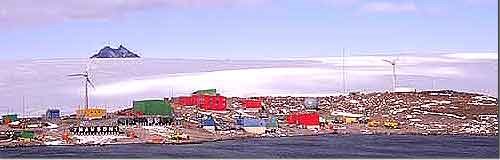
Mawson Antarctic BaseThe Australian Government’s wind turbine project at Mawson Station in Antarctica won a Tasmanian Engineering Excellence Award on Friday night in Hobart. The wind turbines are the first of their kind internationally to operate in the windiest and wildest parts of the world.

Parliamentary Secretary to the Minister for the Environment and Heritage, Dr Sharman Stone, said the project was a great engineering feat. “These turbines operate in the harshest Antarctic conditions with winds reaching up to 250 kilometres an hour,” Dr Stone said.

Situated on the edge of the Antarctic continent, the wind turbines are like two pieces of moving sculpture. Special cranes had to be acquired to assemble them and particular gearing installed so that they could withstand the strongest winds that the Antarctic blizzards throw their way.

“The fact that we have been able to harness this power and convert it to energy is not only an amazing engineering achievement but a tremendous bonus for the environment. An energy source like the wind is not only highly efficient but clean.”

Dr Stone said the energy created by these turbines should reduce the amount of diesel fuel required by the Australian Antarctic Division by over two thirds, from 600,000 litres a year to less than 200,000 litres. “We’re not only creating environmentally sound energy but we’re significantly reducing the amount of diesel fuel that has to be shipped into Antarctica.”

The Australian Government renewable energy projects are seeing wind farms and solar energy pop up in some of the remotest part of the Australian continent. With the Antarctic stations now using renewable energy the Australian Government is demonstrating its commitment to achieving its Kyoto greenhouse gas emission reduction targets.

The wind turbine project cost approximately $6.5 million and involved four full-time engineers. The Australian Antarctic Division worked with Northern Territory based company Powercorp on the project. The wind turbine project was one of three winners out of 19 entries in Tasmania. The project is now through to the National Engineering finals to be held in Canberra in November.

Thursday, 6 April 2006

Minister Windy About Parrots

Herald Sun, Page: 25
Thursday, 6 April 2006

A PROPOSED $220 million wind farm has been rejected because it may kill one endangered bird a year. Federal Environment Minister Ian Campbell said yesterday a 52-turbine installation at Bald Hills, near Foster in South Gippsland, posed an unreasonable risk to the endangered orange-bellied parrot. After the release yesterday of the Wind farm collision risk for birds report, the minister said between 99 and 200 of the parrots were left and most of them lived near the coast, where wind farms were most effective. "While the report found that the impact of wind turbine collisions on the parrot may be small - up to one bird death per year - it concluded almost any negative impact on the species could be sufficient to tip the balance against its continued existence," he said.

The minister's decision comes two days before a Federal Court hearing on the matter, which was instigated by developers Wind Power. "Clearly this process sends a strong message to businesses considering investing in regional and rural Australia and that message is 'you are not welcome'," Wind Power spokesman Tim Fawcett said. State Planning Minister Rob Hulls said Mr Campbell's decision was "a cynical political decision pandering to his mates in the fossil fuel lobby". "There has been no scientific evidence of the orange-bellied parrot on the Bald Hills wind farm site," Mr Hulls said.

The following is the final paragraph of the bird impact report.

"Given that the orange-bellied parrot is predicted to have an extremely high probability of extinction in its current situation, almost any negative impact on the species could be sufficient to tip the balance against its continued existence. In this context it may be argued that any avoidable deleterious effect - even the very minor predicted impacts of turbine collisions - should be prevented. Our analyses suggest that such action will have extremely limited beneficial value to conservation of the parrot without addressing very much greater adverse effects that are currently operating against it."


Which prompts the question... Why should Bald Hills pose a danger to the orange-bellied parrot when the Toora and Wonthaggi windfarms, either side of Bald Hills do not appear to be affecting them?

If you wish to contact Mr Campbell or Mr Broadbent...

Senator the Hon. Ian Campbell
Minister for the Environment and Heritage
Senator for Western Australia
Parliament House, Canberra, ACT 2600
Tel: (02) 6277 7640
Fax: (02) 6273 6101
Email: senator.ian.campbell@aph.gov.au
Media Contacts:
Renae Stoikos 02 6277 7640
or 0418 568 434


Mr Russell Broadbent MP
PO Box 6022
House of Representatives
Parliament House
Canberra ACT 2600
Tel: (02) 6277 4233
Fax: (02) 6277 8485
Email: Russell.Broadbent.MP@aph.gov.au
Electorate Office Contact
Warragul Office:
Location/Postal Address:
10A Napier Street
Warragul Vic 3820
Tel: (03) 5623 2064
Fax: (03) 5623 2509

Corning Winds Up Wind

Electrical World, Page: 5
Friday, 31 March 2006

OWEN Corning has announced a breakthrough in the wind energy market with a better blade composite called WindStrand. WindStrand, reportedly will push the wind energy market to take another step forward in competing against other alternative energy sources by reducing the cost per kilowatt-hour (kwh). The company claims the product will allow turbine manufacturers to increase blade lengths by as much as six per cent and deliver up to 12 per cent more power - for up to 20 per cent less cost than any competing carbon-glass hybrid solution on the market. "In addition to the cost and performance benefits of WindStrand, the product also provides manufacturers with the traditional processability of glass, combined with the stiffness strength and weight of other high performance materials," Corning claims.

Other product highlights compared to conventional E-glass include up to 35 per cent higher tensile strengths; up to 17 per cent higher stiffness (modulus) and enhanced fatigue, impact, aging, corrosion, and temperature resistance. The product is expected to be available later this year. This is the first application using the Owens Corning high-performance reinforcement platform, HiPer-tex, which is the result of a revolution in glass melting, fiberising and sizing technology. The new reinforcement will be produced using the Owens Corning next-generation fiberglass manufacturing process, which reportedly has a significantly smaller environmental footprint than other technologies in use. The performance statistics for WindStrand are based on the company's beta testing in the field, and design blade optimisation by an independent research establishment based in the Netherlands Composite Technology Centre (CTC).

CTC studied the effects of replacing traditional E-glass with WindStrand for several components in a 44-meter long rotor or blade, suitable for a 2.5MW wind turbine. "For 67 years, since the original invention of fiberglass, we've delivered sustainable, energy saving solutions that truly transform markets and enhance lives," Chuck Dana, Owens Corning composites solutions business president. "To continue that pioneering history with the introduction of a new product for wind energy, which is key to our collective ability to meet the rising demand for energy and to safeguard the security of energy supplies, is absolutely at the heart of our corporate purpose and our spirit of true innovation."

Wind's Prospect Get Consent

Electrical World, Page: 3
Friday, 31 March 2006

CONCEIVED, designed and developed by the Wind Prospect Pty Ltd, the 94.5MW Hallett Wind Farm has finally received development consent. As with all South Australian wind energy projects, construction of the 45 turbine wind farm was delayed while a review of generation licences by the Essential Services Commission of South Australia (ESCOSA) was undertaken. The site was identified by Wind Prospect in 2002 as one of the windiest in South Australia.

It was not only selected for its wind resource, but also its environmental suitability, outstanding local support and its location adjacent to an AGL gas fired power station. AGL is the partner in the development. Wind Prospect prepared a comprehensive Environmental Statement, secured the land and optimised the design of the wind farm in the light of all the relevant environmental and operational considerations. Speaking from Wind Prospect's office at Christies Beach near Adelaide, managing director Michael Vawser said "Hallett is the third and by far the largest of our developments in Australia to reach construction, following Mount Millar (70MW) and Canunda (46MW).

In total we have achieved 630MW of development consents to date in South Australia, making us the most successful wind energy developer in the southern hemisphere; a tribute to our highly dedicated and professional team. "Wind Prospect Pty Limited is a subsidiary of the Wind Prospect Group. Founded in 1995 and owned by its staff, Wind Prospect develops, constructs and operates wind energy projects and provides expert advisory services in the UK, Ireland, Australia, New Zealand, Hong Kong and China. To date, Wind Prospect has developed 270MW of wind farms in the UK and 630 in Australia.

Its engineering group has been involved in the construction of 343MW in the UK & Ireland, and the Australian arm recently acted as owner's engineer during the construction of the 46MW Canunda wind farm. Wind Prospect's first Australian project to reach construction was the 70MW Mount Millar project on the Eyre Peninsula with partner Tarong Energy (now under construction), followed by the 46MW Canunda development in the south east of SA with partner International Power, completed in March last year. Set up in 2000, Wind Prospect Pty Limited is based at Christies Beach near Adelaide, with a further office in Brisbane. With a team of only eight professional staff, it continues to be Australia's most successful wind energy developer.

Wednesday, 5 April 2006

Wind Power For Burnside

Eastern Courier Messenger, Page: 7
Wednesday, 5 April 2006

WIND turbines will be built in Burnside -the first such development in the Adelaide suburbs. Burnside Council approved plans last week to place two 1.8m spinning blades on homes being built at Glen St, Burnside, between the council depot and CFS station. Architect Arthur Grammatopoulos had been hoping for years to incorporate the turbines into a new development.

"I've actually had discussions with an Adelaide company that deals with alternative power over the past couple of years and this (opportunity) came up in the past year or two. "They're trialling this product -it's not on the market at the moment. "Early results show it will power an average household. "The turbines -two connected 1.8m blades that oscillate on top of the roof -will only generate enough energy to power the house.

At Burnside's development assessment meeting last week some councillors criticised aspects of the proposal. Cr Chris Collins said he was "disturbed about starting a trend of putting up windmills in Burnside". "It's not like they are small -it is quite a substantial piece of machinery," he said. "We have to set a precedent here -but if they were for anywhere other than (next to the council depot), I would be voting against it.

"Cr Graham Bills urged the council to consider a trial. "We don't know what these things will do -whether they'll be too big, too noisy, whether birds will fly into them -but we can't prove it or test it until we put it up. "Cr Allan Ward supported the plan, saying spaces would need to be found for turbines" if we don't want to pay increasing electricity bills in the future". A staff report said the impact would be" negligible given that the property is surrounded by commercial and more industrial land uses".

A spokesman for Infrastructure Minister Pat Conlon said the plan was thought to be the first of its kind approved by a metropolitan council.

Energy Cost Denied

The Weekly Times, Page: 33
Wednesday, 5 April 2006

THE Victorian Government has dismissed as "pure speculation" claims that a state-based renewable energy scheme would increase household power bills by up to 6 per cent. In a bid to boost Victoria's wind and other green energy production, the Government is considering its own version of the federal Mandatory Renewable Energy Target (MRET). Under the scheme, energy retailers must contribute to the generation of 9500 gigawatt hours of renewable energy per year by 2010, by buying certificates awarded to green energy producers. But state Energy Minister Theo Theophanous told Parliament last week Victoria had been unable to meet its target of 1000 megawatts of wind power by the end of this year because the Federal Government would not increase the MRET.

Mr Theophanous said the Government was now considering its own scheme to achieve its target of 10 per cent of the state's power coming from renewable sources by 2010. But with the Government set to announce its plans within months, some industry experts have warned Victorian households would be hit with higher electricity bills as a result. Origin Energy spokesman Tony Wood said estimates that the average electricity bill would increase by up to 6 per cent, or $48 a year, were "not unreasonable". In a submission on the proposal, Origin said a state scheme would "not deliver cost effective (greenhouse gas) abatement, being up to four times the cost of that delivered by other approaches".

But a spokesman for Mr Theophanous said estimates on the impact on power bills were "pure speculation and we are currently considering a state based renewable energy target". Australian Wind Energy Association chief executive officer Dominique La Fontaine said the extra cost of a state renewable energy scheme would be small and its benefits tangible. Ms La Fontaine said Business Council for Sustainable Energy figures showed the average home would pay about 35 cents more a week.

A spokesman for anti windfarm group Coastal Guardians Victoria, Tim Le Roy, rejected the idea of a state scheme to boost the wind energy sector. "There is no consumer benefit and no environmental benefit. The Government knows it is not an economic way of reducing greenhouse gases," he said.

Councillors Switched On To Green Energy

Star Williamstown, Altona, Laverton, Page: 13
Tuesday, 4 April 2006

RESIDENTS of Hobsons Bay may soon have a new green option when buying power with the council eyeing an environmentally friendly energy program. The council has expressed interest in joining the Community Power program, a collective of municipalities that negotiate sustainable power from suppliers at reduced prices. Community Power is a partnership between Darebin, Melbourne, Banyule and Yarra City councils and the Moreland Energy Foundation. Green Power is the product reaching the consumer in these municipalities.

It is an "accreditation and branding system, used to certify that power is generated from a renewable source". The project is designed to shift to households some of the responsibility for meeting greenhouse targets in Hobsons Bay by offering power from sources like solar, hydroelectric and wind power. Over 1300 home owners around Melbourne have signed with Community Power, generating gas emission savings estimated to be the equivalent of taking 1800 cars off the roads. Council hoped at least 500 home owners would take up the Green Power option in Hobsons Bay.

Green energy options have traditionally been more expensive for consumers than non-green, a fact that has turned many people off the idea. Community Power members are able to secure a price competitive with regular power prices by collectively negotiating a deal with energy suppliers. Modelling supplied by Community Power suggests in some cases that people choosing the 20 per cent option will actually save an average of $75 a year, while those on the 100 per cent green energy plan could save as much as $135. And there are not only cost savings involved but priceless benefits to the environment through reduced greenhouse gas output.

The Hobsons Bay Greenhouse Action Plan "seeks to reduce local community greenhouse emissions by 20 per cent of 1996 levels by the year 2010". For more information visit
www.communitypower.org.

Tuesday, 4 April 2006

Green energy market grows.

MANY South Yarra residents are making the switch and going green. The suburb now has one of the highest populations of Green Power users in Victoria. More than 78,730 South Yarra residents use Green Power, which is generated from renewable energy from the sun,wind, water and waste. People can chose what proportion of their electricity comes from Green Power when they make the switch. But to use solely Green Power costs roughly $5 more a week than standard power companies.

Prahran state Labor MP Tony Lupton said the number of South Yarra residents using Green Power had almost doubled in the past year.
‘‘These households will collectively cut green house pollution by the equivalent of removing 27,042 cars from Victoria’s roads,’’ Mr Lupton said.

For more information, go to www.sustainability.vic.gov.au or phone 1300 723 588

Tassie Wind Farms Breeze Into China

The Mercury, Page: 9
Tuesday, 4 April 2006

A $300 million deal for three wind farms in China could be the tip of the iceberg for part- Tasmanian-owned energy company Roaring 40s. The joint-venture company, half owned by Hydro Tasmania, yesterday signed off on a new deal with Chinese Premier Wen Jiabao in Canberra. The deal will see Roaring 40s become a joint partner with Guohua Energy Investment Corporation, the energy arm of the giant Chinese government-owned Shenhua Group. Together they will build three 50MW projects, the first to start later this year on China's east coast.

Roaring 40s managing director Mark Kelleher said the project was just the beginning for the company in the fast-growing Asian market. It was the second major partnership in China and established Roaring 40s as the leading foreign renewable-energy business in that country. ''The Chinese Government has clearly recognised the importance of renewable energy and, by setting a target of 30, 000MW by 2020, has provided a major impetus to the development of wind power, '' he said. ''Certainly we are an early mover as far as foreign businesses are concerned.

''Roaring 40s was formed last year as a joint venture with Hong Kong energy company CLP Group and already has wind-farm interests in Australia, as well as New Zealand, India and China. It has already begun building a 49MW wind farm in China's Jilin province, due to be commissioned in October. Mr Kelleher said the company found itself in a good position in China. ''We have worked hard to understand the market and build relationships, including local companies with experience and skills, '' he said.

The success of its Tasmanian wind farms had been crucial in the expansion of Roaring 40s. ''It grew from what Hydro Tasmania did and was able to be translated into Roaring 40s by joining with CLP. ''At the Woolnorth wind farm we are able to demonstrate the possibilities and, excuse the pun, but when we take business partners to Woolnorth they are blown away, Mr Kelleher said. ''The wind resource in Tasmania is world-class and it enables us to build world class facilities to show potential partners.

''He said Roaring 40s was looking to develop between 500 and 1000MW of wind farms in China in the next eight to 10 years. The company is also looking at opportunities in India, which has a similar demand, and together it could be worth billions of dollars. Work on the final stage of the Studland Bay development, Tasmania's largest wind farm, will be commissioned by the start of next year.

$300M Joint Deal On Chinese Wind Farms

The Advocate, Page: 4
Tuesday, 4 April 2006

HYDRO Tasmania's renewable energy joint venture has signed a $300 million deal for wind farm development in China. The deal between Roaring 40s and big Chinese energy company Guohua Energy was signed in Canberra yesterday, as part of Chinese Premier Wen Jiabao's visit. Hobart-based Roaring 40s said the deal established a framework for the joint development of wind farms in China, with an initial target of 150mW of production. Each partner will contribute about $50 million and they will borrow $200 million for an anticipated three 50mW projects.

The first of those is expected to be built in the east coast Shandong province and to start operation next year. Roaring 40s is a joint venture between the Hydro and Hong Kong-based energy company CLP Group, with wind farms in Australia and has entered the Chinese, Indian and New Zealand markets. It entered an agreement with another Chinese company last year to develop a 49mW wind farm in Jilin Province that is expected to be commissioned in October. Mr Kelleher said the new deal was unlikely to bring big opportunities for Vestas' Wynyard wind turbine nacelle plant, as most of the manufacturing would be done in China.

He said Roaring 40s employed about 35 people in Tasmania and was advertising soon for four or five positions.

Saturday, 1 April 2006

Locals Generate Wind Farm Progress...

Central Midlands and Coastal Advocate, Page: 7
Thursday, 30 March 2006

THE Emu Downs Wind Farm, 25 kilometres west of Badgingarra. is making good progress, with welcome input from local business. The new onsite Administration building and store, with complimentary landscaping, was recently completed by local company Swan Aussie Constructions, with assistance from Jurien Landscaping. The Shire of Dandaragan undertook earthworks for the building as well as construction of I he access road intersection with Bibby Road.

Shire of Dandaragan Deputy Chief Executive Officer, lan Rennie, said of the Emu Downs Wind Farm construction contracts, "This is a great win for local people, for the local economy, and for regional infrastructure development". Emu Downs Wind Farm Community Affairs Manager, Ken Jack, said the project's joint venturers, Stanwell Corporation and Griffin Energy, were pleased the project was creating local opportunities for businesses, tradespeople, suppliers and other service providers. "Where possible, long term employment is being created and local labour used to support the project. Accommodation and meals, fuels, vehicle servicing, plant operators and operations, roadworks and concrete supplies are all being provided locally.

"The Administration building has been designed to serve the project for the life of the wind farm, and with energy efficient environmental considerations in mind. Solar water heating, insulated walls, a reflective roof and tinted, screened windows have all been installed by local business," Mr Jack said. J&R Carter's Fine Furniture manufactured the office furniture and Jurien Bay Air Conditioning, Jurien Plumbing, ML Communications, and Jurien Bay Betta Electrical also provided their services for the fit out. Roadworks at the intersection of the access road and Bibby Road are finished.

Roadswest Engineering designed the intersection and most of the surveying onsite was carried out by FR Rodda & Co. Gravel and sand were sourced from landowners Rudi and Dot Sudholx. and Mick and Jan Ackland, while Jurien Signs, S&V Pollitt and LYNKYM Springs Fencing Contractors were responsible for signage and fencing. The Pinnacles Best Western Motel has accommodated some of the workforce and Cervantes BP Service Station meets the Project Team's fuel requirements.

Derrick's Coastal AG and Mitre 10 Jurien Bay have also supplied items to the Project. Mr Jack said Stanwell and Griffin Energy want to thank the local business community and Council for their support and show of interest in the wind farm. "The project is off to a solid start and remains on schedule and on budget," he said. Mr Jack said the $180 million, 80 Megawatt Emu Downs Wind Farm would be commissioned in Spring this year.

"We are looking forward to launching this world class project and hope the local community will continue their involvement and support as we progress construction and celebrate project milestones. We are proud to be working with the WA community to deliver secure, safe and sustainable power," Mr Jack said. Emu Downs Wind Farm will generate enough green energy to power more than 50,000 homes and reduce greenhouse gas emissions by 275, 000 tonnes annually, a significant contribution to Australia's action on climate change. Electricity from the wind farm will be purchased by State energy company, Western Power Corporation.

The project will comprise 48 x 1.65 MW turbines, a substation, interconnection to the main 132 kV grid, administration building, and a network of access roads. It also includes an adjacent car park and viewing area (on Bibby Road, Badgingarra) with educational display. With wind farms becoming increasingly popular as tourist attractions, Emu Downs Wind Farm is poised to provide a new attraction for the area and boost local tourism activity within the Shire of Dandaragan.

The project will link in with local tourism operators and the Pinnacles Visitor Centre.

Friday, 31 March 2006

Babcock & Brown Buys Wind Farms

This action by Babcock & Brown appears to explode the myths that wind farm developments in Europe are declining and are not economically viable...

The Australian Financial Review, Page: 76
Friday, 31 March 2006

Babcock & Brown Wind Partners has bought three wind farms under development in northern France for EU30 million ($51.1 million) plus transaction and tax costs. Also, Wind Partners has a framework agreement to buy about 300 megawatts of wind farms in Germany between 2006 and 2009, giving it a development portfolio of some 1000 megawatts in Europe and the US. James Hall.

For further details see the Babcock and Brown web site..

EP Wind Power Firing

Stock Journal, Page: 16
Thursday, 30 March 2006

POWER from the Mount Millar Wind Farm between Cleve and Cowell on EP is being delivered into South Australian homes and businesses. The first of the 35 wind turbines at the farm began generating power on February 23 and the remainder of the turbines will be gradually brought online as commissioning progresses.

Tarong Energy project manager Nic Buckley said the Mount Millar Wind Farm would complement Tarong's other SA wind farm - the 34.5 megawatt Starfish Hill Wind Farm -completed in December 2003. Construction work on the Mount Millar project began In December 2004 and it is expected that, once fully operational, the farm will generate 70MW of electricity, enough for about 36,000 typical households, and reduce Australia's greenhouse gas emissions by up to 4.2 million tonnes of carbon dioxide equivalent during its expected 25-year life.

Newfield Wind Farm Controversy

The Camperdown Chronicle, Page: 2
Tuesday, 28 March 2006

Spanish company Acciona Energy has confirmed it will lodge an application for a $45 million Newfield wind farm to Corangamite Shire Council by August. The company, formerly called EHN Oceania, is now in the planning and environmental assessment stage of the project and is now satisfied the proposed site has the potential for 14 wind turbines which would generate enough energy to power 28,000 homes. Acciona, an international renewable energy company whose network extends throughout seven countries, plans to build a 28 megawatt wind farm on privately owned properties along Newfield Ridge, eight kilometres inland from Port Campbell next to the existing gas plants. Due to the wind farm being under 30 megawatts, the final decision will be in the hands of the Corangamite Shire Council.

If the application is approved, Acciona hopes the wind farm will be operational by mid 2007. Acciona Energy environment and stakeholder relations manager Stephanie Rice said the company had been investigating the potential for a wind farm at Newfield since 2004. "We've been monitoring wind in the area for a while now." she said.

"Newfield has a good wind resource for producing green power and it's a good opportunity to connect electricity into the grid network. "We're going through the planning process at the moment, conducting studies, surveys and investigations and preparing an environmental assessment and planning permit application for the local council," Ms Rice said. "We've had meetings with the local council and have kept them informed about what we're monitoring along the way." Ms Rice said Acciona had contracted independent consultants GHD, an engineering and sustainability consultancy company, to interview locals in and around Port Campbell, Newfield and Timboon.

"We've done some survey work and interviews in the community around February and March," she said. "The purpose of these interviews is to understand the community's aspirations and vision for the future, as well as local attitudes and opinions on renewable energy and the wind farm proposal. "In the coming months we're planning to talk to locals and have consultation sessions. "The results from the survey and interviews will inform the framework for on-going community consultation."

"We want to give the local community a picture of what renewable energy is and find out what they want to know and provide them with information. "Ms Rice said there had been a mixture of responses from locals about the proposed wind farm. "We've had a lot of positive comments and also heard concerns about the impact of a renewable energy on neighbouring farms. "The most issues people talk about are the noise levels and impact on flora and fauna."

Ms Rice said the developer is "fairly confident" that the project will go ahead. "We're only at the beginning stages of this project but we're an experienced company," she said. This is the third project in Australia to be undertaken by the company which claims to be the largest wind energy developer in the world. "We have a very successful project in South Australia and last year we got development approval for a wind farm near Goulburn in New South Wales," she said.

"This wind farm is a smaller size (to our other projects), but it's an important one in helping Victoria reach its greenhouse gas emission targets. "We're happy to talk to people about any questions they might have."

Renewable Energy For Hopetoun

Warracknabeal Herald, Page: 1
Tuesday, 28 March 2006

THE Yarriambiack Shire Council has given its support to the University of Ballarat's proposal, to research the capacity of community-owned renewable energy generation for Hopetoun, particularly from wind power. A report from the shire's Economical Development Officer Terry Sanders, stated the Yarriambiack Shire will be working with the University of Ballarat who will be conducting the study, and the Hopetoun Progress Association. Mr Sanders informed councillors at the March meeting that after meeting with the relevant bodies involved, the proposed three year feasibility study will survey Hopetoun's current and projected power demand. The study will also collect wind speed data, investigate potential alternative renewable energy technologies, research waste management needs and practice and investigate potential sustainable industries for Hopetoun.

An application has been submitted to the Victorian Government's "Sustainability Fund" and it will take about three months to process. For the University of Ballarat to start the study, the Yarriambiack Shire has offered them access to office facilities in Hopetoun, a car. office staff and people from the engineering industry to assist with the technical aspects of the study. The University of Ballarat initiated the study about 12 months ago because they wanted towns in northern Victoria especially smaller towns, to consider the option of using alternative energy sources, including wind power and solar energy. By starting the project in Hopetoun, Mr Sanders said the University is hoping other towns in the area will also consider it and the University of Ballarat plans on developing a template for other communities to apply in such studies.

Thursday, 30 March 2006

The 3rd way...

Hindsight is a wonderful thing. Imagine how attitudes to wind farms might have been more enlightened and welcoming had the community wind farm concept been promoted?

Community owned wind energy projects. The 3rd way...

Wind energy can become part of the community by offering farmers, as well as both rural and urban residents the ability to build, own, operate-and profit from-their own renewable source of electricity.

Read more..

Friday, 24 March 2006

Wind farm proposed for Hopetoun

A community owned wind farm is being proposed for Hopetoun. Ballarat University wants to research the idea and this is supported by Yarriambiack Shire. The proposed study will survey Hopetoun’s current and projected power demand collect wind speed data and investigate potential sustainable industries for Hopetoun.

Monday, 20 March 2006

Vic. wind farm boosts green portfolio

A new wind farm on the Victorian south coast has been added to Country Energy's suite of renewable energy sources, helping the company to meet renewable energy targets and the growing demand for green power.

Known as Wonthaggi Wind Farm, the facility has six large wind turbines and is expected to produce 30,000 megawatt hours of electricity per annum – enough energy to power 4,000 homes.

Thanks to this project, Country Energy will be saving around 28,000 tonnes of greenhouse gas emissions each year, which would otherwise have been produced from coal-fired power stations.

Under a 10-year power purchase agreement with Regional Wind Farms, the energy company will purchase all of the electricity and renewable energy credits generated by the wind farm.

Group general manager retail, John Adams said Country Energy's comprehensive renewable energy strategy included the purchase of more and more energy from renewable sources.

In addition to wind farm projects in regional New South Wales and South Australia, Country Energy also purchases hydro-electricity from stations throughout NSW; biomass energy (energy generated from natural materials such as plants and organic landfill) from NSW's Far North Coast, Queensland and Sydney; a food waste to energy plant in Sydney; and solar farms and rooftop solar systems across NSW.


Read More

'Enough is enough': Threat to quit UK

Alternative energy development, bureaucratic nonsense and Government hypocrisy. A sad tale of delays and bad management..

The Independent

By Tim Webb
Published: 19 March 2006

One of the UK's largest wind farm developers has threatened to pull out of the country as a storm blows up over the Government's plans for renewable energy.

A logjam in the planning process for developers means that many wind farms will not be operational for a decade. Unless financing rules are changed, Wind Energy is warning that many will never even get built, which could force the Government to miss its targets on renewable energy.

The timing of the protest is embarrassing for the Government, which next month will close consultation on its energy review on nuclear power. Its previous review - only three years ago - was supposed to back renewable energy such as wind power.

Wind Energy wants to build 800MW of onshore wind farms in Scotland, enough to power a city the size of Edinburgh.

National Grid has told the company, and developers of around 100 other wind farms in Scotland, totalling around 6,000MW, that they will not be connected to the grid before 2016.

But despite the huge timelag, developers still have to table deposits upfront to cover the cost of the upgrades to the grid - even if planning permission for their site is not granted and the wind farm does not go ahead.

Under the planning regime, developers have to apply for connection to the grid before they can gain planning permission. Around half the planning applications for onshore wind farms in the UK fail.

Even if a developer secures planning approval and does not lose its deposit for connection, it is not home and dry. Should a nearby wind farm plan fall through, the other developers sharing the planned upgrade to the grid have to shoulder the failed developer's liabilities.

Mike Davies, managing director of Wind Energy, said developers should be able to delay payment until a decision on planning permission is made.

He added that developers had earned a temporary reprieve, until September, before they have to start paying millions of pounds in connection fees to National Grid.

"We are relying on the Government to sort this out in the next six months. Unless things change, we would have to say 'enough is enough - we are pulling out'. We will move to other countries where these projects are easier to develop instead. Trying to get through the regulatory and planning system in the UK is like running in treacle. It needs some movement from the top urgently."

The Government has set a target to generate a 10th of the UK's electricity, or around 7,000MW, from renewable sources by 2010 rising to a fifth by 2020.