www.carbon-financeonline.com
29 October, 2008
Discussions on a new global agreement to tackle climate change should be completed in time to meet an end-2009 deadline, according to the US's chief climate change negotiator. In an exclusive interview with Carbon Finance last week, Ambassador Harlan Watson said the crisis in the global economy is "clearly not helpful" to negotiations, as it has pushed the climate issue down the political agenda and governments will have less money available. But he said there was still considerable interest at the highest political levels in addressing climate change.
Watson will lead the US negotiating team at the UN's climate change conference in Poznan, Poland, in December. This meeting will feed into a series of tough negotiations that will culminate in Copenhagen, Denmark, in December 2009, where a successor agreement to the Kyoto Protocol needs to be agreed in order to give national governments two years to ratify it, before Kyoto expires in 2012.
"It's considered by many observers that progress is slow, but it's the normal course of things. If you look back on the history of Kyoto, that was a two-year-plus process. Everything will undoubtedly come together at the end," Watson said. Poznan will see parties "delving for the first time into the shared vision" that came out of last year's talks in Bali, Watson said, and continuing to discuss the four building blocks of the new agreement: adaptation, mitigation, technology and finance. "We are going to be presented at Poznan with a compilation of ideas and proposals that have been received to date. Those will be further elaborated in Poznan," Watson said. He expected a draft negotiating text to be developed between Poznan and the first meeting of 2009.
Watson said it was too early to agree targets for reducing emissions and that the US would not make any international commitment until a domestic target has been established. But he expected the new president, whether John McCain or Barack Obama, to initiate domestic legislation involving carbon markets, once they take office on 20 January 2009. "I would expect the new administration to embrace a cap-and-trade system. So it is just going to be a matter of how long it will take to get through Congress," he said.
Problems in the global economy have raised concerns about progress on tackling climate change, Watson said. "The economy is going to be the focus of the new president and the world leaders for the foreseeable future. Quite frankly, the economy has buried everything. But there's still considerable interest in climate change, and energy security, which is closely aligned with climate change."
However, stretched by billion-dollar bank bail-outs, "there's general agreement that governments are going to be facing budget restrictions and the idea that governments are going to be able to come up with great sums of money [to address climate change] is not going to happen." Watson suggested that carbon markets might help fill that gap by encouraging the private sector to invest. "Most of the funding is going to have to come from the private sector in any event," he added.
Thursday, 13 November 2008


Green-collar army recruits for the solar boom
Sydney Morning Herald
Friday 31/10/2008 Page: 9
LEAH CALLON-BUTLER gave up a career in fashion last year to become a solar panel saleswoman, joining a surge towards green jobs predicted by the Federal Government. Modelling done by Treasury on the cost of climate change found there would be an explosion in "green-collar" work with the introduction of an emissions trading scheme, with renewable power industries like solar and wind expected to be 30 times their current size by the middle of the century.
Ms Callon-Butler, a sales executive with the Sydney solar hot-water company Endless Solar, intends to stick around for the expected boom. The company has installed 5000 rooftop solar hot water systems in five years, using technology developed at the University of New South Wales, and it is looking for more staff.
"Renewable energy is not something I knew a lot about before I started, but you do get really passionate about it," said Ms Callon-Butler. who will complete an undergraduate communications degree next week. "I'm not exactly sure how things will change for me when I finish the degree, but I definitely want to stay in the sustainability industry."
By 2050, Treasury predicts, renewable energy could make up as much as half the energy mix in Australia, replacing the current reliance on coal. "Renewable technologies will become increasingly competitive, and production methods will switch to less emission-intensive technologies and processes," the Treasury report said. More jobs will be created by demand for cleaner cars, and Treasury estimates one in four people will be driving a hybrid or plug-in electric car by 2050.
The Clean Energy Council said the Treasury modelling showed immediate public and private investment in renewable power would pay off. "The smarter and more dynamic we are right now, the more options we will have in terms of deploying technologies commercially five years down the track in 2012 and 2013." said a spokesman, Matthew Warren. Unions and environment groups called on the Federal Government to pave the way for a green jobs boom.
Half a million new jobs could be created in renewable sectors of the economy by 2030, said a report yesterday by the ACTU and the Australian Conservation Foundation. The ACTU president, Sharan Burrow, said: "The report shows Australia must act swiftly to make the most of its natural advantages or our economy will be left behind. We can't afford to miss the boat."
Friday 31/10/2008 Page: 9
LEAH CALLON-BUTLER gave up a career in fashion last year to become a solar panel saleswoman, joining a surge towards green jobs predicted by the Federal Government. Modelling done by Treasury on the cost of climate change found there would be an explosion in "green-collar" work with the introduction of an emissions trading scheme, with renewable power industries like solar and wind expected to be 30 times their current size by the middle of the century.
Ms Callon-Butler, a sales executive with the Sydney solar hot-water company Endless Solar, intends to stick around for the expected boom. The company has installed 5000 rooftop solar hot water systems in five years, using technology developed at the University of New South Wales, and it is looking for more staff.
"Renewable energy is not something I knew a lot about before I started, but you do get really passionate about it," said Ms Callon-Butler. who will complete an undergraduate communications degree next week. "I'm not exactly sure how things will change for me when I finish the degree, but I definitely want to stay in the sustainability industry."
By 2050, Treasury predicts, renewable energy could make up as much as half the energy mix in Australia, replacing the current reliance on coal. "Renewable technologies will become increasingly competitive, and production methods will switch to less emission-intensive technologies and processes," the Treasury report said. More jobs will be created by demand for cleaner cars, and Treasury estimates one in four people will be driving a hybrid or plug-in electric car by 2050.
The Clean Energy Council said the Treasury modelling showed immediate public and private investment in renewable power would pay off. "The smarter and more dynamic we are right now, the more options we will have in terms of deploying technologies commercially five years down the track in 2012 and 2013." said a spokesman, Matthew Warren. Unions and environment groups called on the Federal Government to pave the way for a green jobs boom.
Half a million new jobs could be created in renewable sectors of the economy by 2030, said a report yesterday by the ACTU and the Australian Conservation Foundation. The ACTU president, Sharan Burrow, said: "The report shows Australia must act swiftly to make the most of its natural advantages or our economy will be left behind. We can't afford to miss the boat."
Wednesday, 12 November 2008
Big Arnie unveils ray of sunshine
Herald Sun
Thursday 30/10/2008 Page: 78
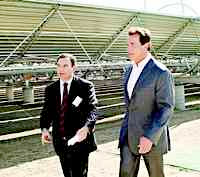 WHAT began to take shape in a Sydney back yard about four years ago culminated in a commissioning ceremony for a solar thermal plant in California this week by Governor Arnold Schwarzenegger. The plant was built by Australian solar company Ausra, using cutting edge technology developed by Sydney University Professor David Mills. It will power 3500 homes in the central California town of Kimberlina. Professor Mills started Ausra in 2002 as Solar Heat and Power when he proposed a solar thermal plant to power the generators for the giant coal-fired Liddell Power Station in the Hunter Valley.
With the technology proven, Liddell became the first - and for now the only - hybrid solar/coal power station in the world, according to Ausra's Melbourne-based CEO and president Bob Matthews. Professor Mills then took his company to California where it attracted the two top venture capitalists in the world and morphed into Ausra Inc, leading to this week's ceremony with Governor Schwarzenegger. "This week was significant for two reasons," Mr Matthews said. "The first is that this is the first solar thermal plant built in California in the past 20 years. The second is that while solar thermal technology has been around since the early 1980s, ours is the next generation. It is more cost effective, more feasible.
"Solar thermal has been a bit of a sleeper. For whatever reason it didn't get a guernsey back in the oil shock of the 1980s, but industry now realises that it has the capacity to be highly scaleable, it can produce thousands of megawatts of power, rather than just hundreds. "It has the capacity to power cities. Our technology is the one. It's the 'here and now technology', as the governor said." solar thermal differs from photovoltaic solar panels, which convert light from the sun into electricity and are often seen mounted on home rooftops.
With Ausra's solar thermal technology, fields of mirrors focus the sun's heat on tubes of water to produce steam that drives turbines, generating clean, reliable electricity and steam for industrial use. The Kimberlina project continues Governor Schwarzenegger's pursuit of renewable power for California. "This next generation solar energy plant is evidence that reliable, renewable and pollution-free technology is here to stay, and it will lead to more homes and businesses powered by sunshine," he said. "It will also generate new jobs as California continues to pioneer clean-tech industry."
Thursday 30/10/2008 Page: 78
 WHAT began to take shape in a Sydney back yard about four years ago culminated in a commissioning ceremony for a solar thermal plant in California this week by Governor Arnold Schwarzenegger. The plant was built by Australian solar company Ausra, using cutting edge technology developed by Sydney University Professor David Mills. It will power 3500 homes in the central California town of Kimberlina. Professor Mills started Ausra in 2002 as Solar Heat and Power when he proposed a solar thermal plant to power the generators for the giant coal-fired Liddell Power Station in the Hunter Valley.
With the technology proven, Liddell became the first - and for now the only - hybrid solar/coal power station in the world, according to Ausra's Melbourne-based CEO and president Bob Matthews. Professor Mills then took his company to California where it attracted the two top venture capitalists in the world and morphed into Ausra Inc, leading to this week's ceremony with Governor Schwarzenegger. "This week was significant for two reasons," Mr Matthews said. "The first is that this is the first solar thermal plant built in California in the past 20 years. The second is that while solar thermal technology has been around since the early 1980s, ours is the next generation. It is more cost effective, more feasible.
"Solar thermal has been a bit of a sleeper. For whatever reason it didn't get a guernsey back in the oil shock of the 1980s, but industry now realises that it has the capacity to be highly scaleable, it can produce thousands of megawatts of power, rather than just hundreds. "It has the capacity to power cities. Our technology is the one. It's the 'here and now technology', as the governor said." solar thermal differs from photovoltaic solar panels, which convert light from the sun into electricity and are often seen mounted on home rooftops.
With Ausra's solar thermal technology, fields of mirrors focus the sun's heat on tubes of water to produce steam that drives turbines, generating clean, reliable electricity and steam for industrial use. The Kimberlina project continues Governor Schwarzenegger's pursuit of renewable power for California. "This next generation solar energy plant is evidence that reliable, renewable and pollution-free technology is here to stay, and it will lead to more homes and businesses powered by sunshine," he said. "It will also generate new jobs as California continues to pioneer clean-tech industry."
$1 a day to save planet
Australian
Friday 31/10/2008 Page: 1
THE Rudd Government has moved to ease fears about the impact of its emissions trading scheme, releasing Treasury modelling showing the scheme is affordable, with households paying up to $7 a week more for electricity and gas and no industries forced offshore.
Long-awaited Treasury modelling released yesterday assumes a modest cut in Australian emissions of between 5 and 15 per cent by 2020, and critically that next year's UN summit in Copenhagen succeeds in reaching a climate change agreement under which developed countries immediately begin to reduce their emissions and developing countries join in the global effort over time.
But industry groups and the federal Opposition expressed immediate concerns that the modelling did not reveal the costs of Australia pressing ahead with a domestic carbon price in the event the world does not reach such an agreement. The modelling finds the carbon price would start at between $23 and $32 a tonne in 2010, depending on the emission reduction target, rising to between $115 and $158 in 2050, and that the trading scheme would cut average annual growth by 0.1 per cent.
Wayne Swan described the imposition on growth as "a whisker". The Government has been facing increasing calls from the Coalition and some affected industries to delay the planned 2010 introduction of the emissions trading scheme until 2012, amid concerns about the impact of the global financial crisis. But the benign forecasts contained in the Treasury modelling were seized on by the Government yesterday to bolster its arguments for proceeding as planned in 2010.
The modelling forecasts that electricity prices will rise by between 17 and 24 per cent and gas prices by between 11 and 15 per cent, but points out that these increases would have a modest impact on household budgets, with electricity bills rising by between $4 and $5 a week and gas bills by $2 a week. Real disposable income grows by 1 per cent a year, under the model, rather than the 1.2 per cent that could be expected if there were no ETS.
Petrol prices would not rise for the first three years because the Government has promised to offset the cost with an excise cut. And it has pledged compensation to help low-income households with their power bills. The Government used the modelling to argue that it was economically responsible to press ahead with emissions trading in 2010, despite the immediate effects of the global economic slowdown.
"What this modelling absolutely shows is there is a way ahead which is both pro-growth and pro-jobs," the Treasurer said. "The Australian economy will continue strong growth while reducing emissions. The earlier Australia acts, the cheaper the cost of action, and many of Australia's industries will become more, not less, competitive. .
It is the case at the moment there are substantial challenges out there in the short term. What we are on about here is the long-term health, wealth, prosperity and sustainability of the Australian nation." But Malcolm Turnbull criticised the modelling because it did not take into account a scenario where Australia engages in an emissions trading scheme and cuts its emissions significantly but the rest of the world does not follow suit." And the Minerals Council of Australia had similar concerns.
"Treasury has modelled the world as we'd like it to be, not how it is. It would be great if developed countries signed on in 2010, if China acted in 2015 and India in 2020. If our global leadership achieves that result they'll be handing out Nobel Peace Prizes. But that is not likely to be the reality," said MCA chief executive Mr Mitch Hooke.
The modelling outlines dramatic global economic changes. But it says this will be because of the long-term impacts of the cost on carbon and not because of short-term decisions by individual industries to move offshore. Fears of such "carbon leakage" are unfounded, it says. The modelling finds that industries such as coal and iron and steel will maintain or even increase their global market share. Industries such as forestry thrive in the new carbon constrained world but aluminium and petrol refining lose global market share. aluminium output in 2050 will be at least 45 per cent below what would be expected in a carbon costless world and 7 per cent below current production levels.
Conservation groups said the modelling showed relatively small differences between the costs of the scenarios to cut emissions by 5 or 15 per cent in 2020 and the Garnaut report's most ambitious scenario of cutting emissions by 25 per cent, and urged the Government to opt for the tougher emissions reduction targets for the sake of the environment.
Only one of the four scenarios modelled by Treasury the one that looks at a 25 per cent cut in emissions by 2020 would give our natural icons like the Great Barrier Reef any chance of survival," said ACF executive director Don Henry. The Treasury modelling confirms that a 25 per cent cut by 2020 is affordable and achievable." The modelling assumes that developed countries reach an agreement to make "comparable efforts" to cut their emissions from 2010, that "high-income" developing countries, including China, agree to cuts from 2015, middle-income developing nations such as India by 2020 and low-income countries by 2025.
Friday 31/10/2008 Page: 1
THE Rudd Government has moved to ease fears about the impact of its emissions trading scheme, releasing Treasury modelling showing the scheme is affordable, with households paying up to $7 a week more for electricity and gas and no industries forced offshore.
Long-awaited Treasury modelling released yesterday assumes a modest cut in Australian emissions of between 5 and 15 per cent by 2020, and critically that next year's UN summit in Copenhagen succeeds in reaching a climate change agreement under which developed countries immediately begin to reduce their emissions and developing countries join in the global effort over time.
But industry groups and the federal Opposition expressed immediate concerns that the modelling did not reveal the costs of Australia pressing ahead with a domestic carbon price in the event the world does not reach such an agreement. The modelling finds the carbon price would start at between $23 and $32 a tonne in 2010, depending on the emission reduction target, rising to between $115 and $158 in 2050, and that the trading scheme would cut average annual growth by 0.1 per cent.
Wayne Swan described the imposition on growth as "a whisker". The Government has been facing increasing calls from the Coalition and some affected industries to delay the planned 2010 introduction of the emissions trading scheme until 2012, amid concerns about the impact of the global financial crisis. But the benign forecasts contained in the Treasury modelling were seized on by the Government yesterday to bolster its arguments for proceeding as planned in 2010.
The modelling forecasts that electricity prices will rise by between 17 and 24 per cent and gas prices by between 11 and 15 per cent, but points out that these increases would have a modest impact on household budgets, with electricity bills rising by between $4 and $5 a week and gas bills by $2 a week. Real disposable income grows by 1 per cent a year, under the model, rather than the 1.2 per cent that could be expected if there were no ETS.
Petrol prices would not rise for the first three years because the Government has promised to offset the cost with an excise cut. And it has pledged compensation to help low-income households with their power bills. The Government used the modelling to argue that it was economically responsible to press ahead with emissions trading in 2010, despite the immediate effects of the global economic slowdown.
"What this modelling absolutely shows is there is a way ahead which is both pro-growth and pro-jobs," the Treasurer said. "The Australian economy will continue strong growth while reducing emissions. The earlier Australia acts, the cheaper the cost of action, and many of Australia's industries will become more, not less, competitive. .
It is the case at the moment there are substantial challenges out there in the short term. What we are on about here is the long-term health, wealth, prosperity and sustainability of the Australian nation." But Malcolm Turnbull criticised the modelling because it did not take into account a scenario where Australia engages in an emissions trading scheme and cuts its emissions significantly but the rest of the world does not follow suit." And the Minerals Council of Australia had similar concerns.
"Treasury has modelled the world as we'd like it to be, not how it is. It would be great if developed countries signed on in 2010, if China acted in 2015 and India in 2020. If our global leadership achieves that result they'll be handing out Nobel Peace Prizes. But that is not likely to be the reality," said MCA chief executive Mr Mitch Hooke.
The modelling outlines dramatic global economic changes. But it says this will be because of the long-term impacts of the cost on carbon and not because of short-term decisions by individual industries to move offshore. Fears of such "carbon leakage" are unfounded, it says. The modelling finds that industries such as coal and iron and steel will maintain or even increase their global market share. Industries such as forestry thrive in the new carbon constrained world but aluminium and petrol refining lose global market share. aluminium output in 2050 will be at least 45 per cent below what would be expected in a carbon costless world and 7 per cent below current production levels.
Conservation groups said the modelling showed relatively small differences between the costs of the scenarios to cut emissions by 5 or 15 per cent in 2020 and the Garnaut report's most ambitious scenario of cutting emissions by 25 per cent, and urged the Government to opt for the tougher emissions reduction targets for the sake of the environment.
Only one of the four scenarios modelled by Treasury the one that looks at a 25 per cent cut in emissions by 2020 would give our natural icons like the Great Barrier Reef any chance of survival," said ACF executive director Don Henry. The Treasury modelling confirms that a 25 per cent cut by 2020 is affordable and achievable." The modelling assumes that developed countries reach an agreement to make "comparable efforts" to cut their emissions from 2010, that "high-income" developing countries, including China, agree to cuts from 2015, middle-income developing nations such as India by 2020 and low-income countries by 2025.
$150b `savings' in early green action
West Australian
Thursday 30/10/2008 Page: 4
Australia would save the equivalent of $150 billion by acting early to reduce its greenhouse gas emissions, long-awaited Treasury modelling of the Rudd Government's planned emissions trading scheme will reveal today. And it asserts that despite the looming carbon price, emissions intensive, trade-exposed industries such as coal mining are likely to become more competitive and increase their share of global trade.
Treasurer Wayne Swan will claim the 12-month Treasury modelling - the most complex done in Australia of any economic measure - showed an ETS was a "pro-growth, pro- competitiveness strategy" that would be affordable to families and pensioners. "The modelling proves that the longer we delay, the more expensive responding to climate change will become," Mr Swan will say in a speech, details of which were released yesterday. "Delay could encourage buildup of emissions-intensive capital stock that will later become a significant liability.
"The modelling suggests that, by 2050, GDP costs for economies that act early are 15 per cent lower than countries that wait for the world to act together. The message is clear: Acting early is an economic imperative." But the assumptions underlying the Treasury modelling have come under attack, even before its formal release.
Research by Concept Economics for the Minerals Council of Australia argues assumptions used by Treasury in areas such as the cost for power stations to reduce emissions, base metal prices and carbon capture and storage expenses were seriously underestimated. The ETS is scheduled to begin in 2010 but the Federal Opposition is calling for it to be delayed until 2011 at the earliest so that the international response can be taken into account. The Government is expected to support a slow start to the ETS, with the price of carbon kept at a fixed price of $20 a tonne for the first two years at least.
Thursday 30/10/2008 Page: 4
Australia would save the equivalent of $150 billion by acting early to reduce its greenhouse gas emissions, long-awaited Treasury modelling of the Rudd Government's planned emissions trading scheme will reveal today. And it asserts that despite the looming carbon price, emissions intensive, trade-exposed industries such as coal mining are likely to become more competitive and increase their share of global trade.
Treasurer Wayne Swan will claim the 12-month Treasury modelling - the most complex done in Australia of any economic measure - showed an ETS was a "pro-growth, pro- competitiveness strategy" that would be affordable to families and pensioners. "The modelling proves that the longer we delay, the more expensive responding to climate change will become," Mr Swan will say in a speech, details of which were released yesterday. "Delay could encourage buildup of emissions-intensive capital stock that will later become a significant liability.
"The modelling suggests that, by 2050, GDP costs for economies that act early are 15 per cent lower than countries that wait for the world to act together. The message is clear: Acting early is an economic imperative." But the assumptions underlying the Treasury modelling have come under attack, even before its formal release.
Research by Concept Economics for the Minerals Council of Australia argues assumptions used by Treasury in areas such as the cost for power stations to reduce emissions, base metal prices and carbon capture and storage expenses were seriously underestimated. The ETS is scheduled to begin in 2010 but the Federal Opposition is calling for it to be delayed until 2011 at the earliest so that the international response can be taken into account. The Government is expected to support a slow start to the ETS, with the price of carbon kept at a fixed price of $20 a tonne for the first two years at least.
Eco action an earner
Courier Mail
Thursday 30/10/2008 Page: 23
NATIONS that move early to combat climate change will receive a 15 per cent discount on their carbon reduction costs, new modelling reveals. A long-awaited study from the federal Treasury to be released today shows that acting swiftly on global warming could be a big money spinner. In a major speech today in Brisbane, Treasurer Wayne Swan will seize on the new study to argue Australia must be a climate change leader. "The message is clear: acting early is an economic imperative," Mr Swan will say in his speech.
"The modelling suggests that, by 2050, GDP costs for economies that act early are 15 per cent lower than countries that wait for the world to act together." The modelling is great ammunition for the Federal Government as it pushes for a 2010 start for an emissions trading scheme while the Opposition wants it delayed.
The 2010 start date has come under increasing fire with the economic crisis. The Treasury modelling argues that countries that hold off miss out on lucrative global investment in low emissions technology. Mr Swan will also offer a lifeline to the Queensland coal industry, saying an emissions scheme is not necessarily bad news. "Some of Australia's emissions-intensive trade exposed sectors, such as coal, are likely to become more competitive, and increase their share of global trade," he says.
The Treasurer will also ramp up his language against global capitalism, saying the market has failed by not putting a price on carbon. "The consequence is dangerous climate change, which threatens to slow economic growth and imperil our way of life," he says. It comes as Climate Minister Penny Wong will today announce Queensland's Griffith University will spearhead new research on how climate change will affect water resources, human health, emergency services, infrastructure and biodiversity.
Senator Wong said the $10 million four-year project would foster critical research into the effects of climate change. "Taking action now to reduce the future impact of climate change on our communities, environment and industries is a critical pillar of our strategy," she said.
Thursday 30/10/2008 Page: 23
NATIONS that move early to combat climate change will receive a 15 per cent discount on their carbon reduction costs, new modelling reveals. A long-awaited study from the federal Treasury to be released today shows that acting swiftly on global warming could be a big money spinner. In a major speech today in Brisbane, Treasurer Wayne Swan will seize on the new study to argue Australia must be a climate change leader. "The message is clear: acting early is an economic imperative," Mr Swan will say in his speech.
"The modelling suggests that, by 2050, GDP costs for economies that act early are 15 per cent lower than countries that wait for the world to act together." The modelling is great ammunition for the Federal Government as it pushes for a 2010 start for an emissions trading scheme while the Opposition wants it delayed.
The 2010 start date has come under increasing fire with the economic crisis. The Treasury modelling argues that countries that hold off miss out on lucrative global investment in low emissions technology. Mr Swan will also offer a lifeline to the Queensland coal industry, saying an emissions scheme is not necessarily bad news. "Some of Australia's emissions-intensive trade exposed sectors, such as coal, are likely to become more competitive, and increase their share of global trade," he says.
The Treasurer will also ramp up his language against global capitalism, saying the market has failed by not putting a price on carbon. "The consequence is dangerous climate change, which threatens to slow economic growth and imperil our way of life," he says. It comes as Climate Minister Penny Wong will today announce Queensland's Griffith University will spearhead new research on how climate change will affect water resources, human health, emergency services, infrastructure and biodiversity.
Senator Wong said the $10 million four-year project would foster critical research into the effects of climate change. "Taking action now to reduce the future impact of climate change on our communities, environment and industries is a critical pillar of our strategy," she said.
Bilateral ties will help push on climate
Australian
Thursday 30/10/2008 Page: 6
AUSTRALIA can play a key role in climate talks between China and the US and in using its strong bilateral ties with developing nations to help push for a global greenhouse reduction regime. International climate change heavyweight Yvo de Boer warned that "unless the relationship between the US and China on climate is worked out, then the broader picture, a global deal, will be that much harder".
"The dialogue taking place between China, the US and Australia can play a key bridging role," the executive secretary of the UN Framework Convention on Climate Change said. Climate experts and representatives from each nation's government and private sectors met in Washington last month at a conference organised by the Global Foundation citizens group to discuss international energy security and climate change.
Mr de Boer told the foundation's Australia Unlimited 2008 Roundtable in Melbourne via video link from New York yesterday that last month's meeting had resulted in progress in cooperation between the big powers before the international climate summit in Copenhagen next year. A delegate at the Washington meeting, World Business Council on Sustainable Development president Bjorn Stigson, told the conference yesterday climate change was a national security issue for the US and China.
"If we don't solve the challenges of climate change, there is the risk of instability in societies," Mr Stigson said. "The markets won't be enough to meet the challenge of global warming we need market mechanisms and good regulation." Mr de Boer said the international community was "overjoyed" when Kevin Rudd ratified the Kyoto Protocol after winning office in November last year. "Australia's new commitment to climate change and its geographic position can see it play a bridging role between developed and developing countries," Mr de Boer said.
Thursday 30/10/2008 Page: 6
AUSTRALIA can play a key role in climate talks between China and the US and in using its strong bilateral ties with developing nations to help push for a global greenhouse reduction regime. International climate change heavyweight Yvo de Boer warned that "unless the relationship between the US and China on climate is worked out, then the broader picture, a global deal, will be that much harder".
"The dialogue taking place between China, the US and Australia can play a key bridging role," the executive secretary of the UN Framework Convention on Climate Change said. Climate experts and representatives from each nation's government and private sectors met in Washington last month at a conference organised by the Global Foundation citizens group to discuss international energy security and climate change.
Mr de Boer told the foundation's Australia Unlimited 2008 Roundtable in Melbourne via video link from New York yesterday that last month's meeting had resulted in progress in cooperation between the big powers before the international climate summit in Copenhagen next year. A delegate at the Washington meeting, World Business Council on Sustainable Development president Bjorn Stigson, told the conference yesterday climate change was a national security issue for the US and China.
"If we don't solve the challenges of climate change, there is the risk of instability in societies," Mr Stigson said. "The markets won't be enough to meet the challenge of global warming we need market mechanisms and good regulation." Mr de Boer said the international community was "overjoyed" when Kevin Rudd ratified the Kyoto Protocol after winning office in November last year. "Australia's new commitment to climate change and its geographic position can see it play a bridging role between developed and developing countries," Mr de Boer said.
Early carbon trading backed by report
Adelaide Advertiser
Thursday 30/10/2008 Page: 10
THE Rudd Government today will fire another broadside at unregulated capitalism, blaming market failures for the scourge of global warming. Just days after Prime Minister Kevin Rudd railed against "extreme capitalism," and excessive greed for causing the U.S.-led financial crisis, the Treasurer, Wayne Swan, this morning will use a speech to argue for decisive government action to turn around the climate change problem. "The market has failed to price the impact of carbon on our economy," he will tell a Brisbane conference, according to speech notes obtained by The Advertiser.
"The consequence is dangerous climate change which threatens to slow economic growth and imperil our way of life." The speech comes before the official release of a Treasury report later today modelling the economic impacts of an emissions trading scheme. Mr Swan will say the economic case for early action is strongly supported by that modelling. "New evidence which has just come in, suggests we are heading in the right direction," the notes say.
The Rudd Government has stuck doggedly to its promised July, 2010, introduction date despite intense pressure from the Opposition to delay its implementation because of the global economic downturn. Mr Swan believes growth can be protected. "With efficient emissions pricing, Australia can reduce the emissions intensity of GDP rather than actual GDP.
The modelling suggests that by 2050, GDP costs for economies that act early are 15 per cent lower than countries that wait for the world to act together. "The message is clear: acting early is an economic imperative. The assertions proved by the modelling all point to one conclusion: the carbon pollution reduction scheme is a pro-growth, pro competitiveness strategy for the Australian economy."
Thursday 30/10/2008 Page: 10
THE Rudd Government today will fire another broadside at unregulated capitalism, blaming market failures for the scourge of global warming. Just days after Prime Minister Kevin Rudd railed against "extreme capitalism," and excessive greed for causing the U.S.-led financial crisis, the Treasurer, Wayne Swan, this morning will use a speech to argue for decisive government action to turn around the climate change problem. "The market has failed to price the impact of carbon on our economy," he will tell a Brisbane conference, according to speech notes obtained by The Advertiser.
"The consequence is dangerous climate change which threatens to slow economic growth and imperil our way of life." The speech comes before the official release of a Treasury report later today modelling the economic impacts of an emissions trading scheme. Mr Swan will say the economic case for early action is strongly supported by that modelling. "New evidence which has just come in, suggests we are heading in the right direction," the notes say.
The Rudd Government has stuck doggedly to its promised July, 2010, introduction date despite intense pressure from the Opposition to delay its implementation because of the global economic downturn. Mr Swan believes growth can be protected. "With efficient emissions pricing, Australia can reduce the emissions intensity of GDP rather than actual GDP.
The modelling suggests that by 2050, GDP costs for economies that act early are 15 per cent lower than countries that wait for the world to act together. "The message is clear: acting early is an economic imperative. The assertions proved by the modelling all point to one conclusion: the carbon pollution reduction scheme is a pro-growth, pro competitiveness strategy for the Australian economy."
Tuesday, 11 November 2008
Jobs boom in the wind
Herald Sun
Wednesday 29/10/2008 Page: 23
 EFFECTS of the economic downturn could be offset by more than 200,000 new jobs in solar, wind and geothermal energy in coming decades. Treasury modelling of the potential growth in alternative emissions technology due out soon suggests there will be growth of 2900 per cent (around 30 times what it is today) by 2050. This estimate is based on government taking action to increase renewable energy as an alternative to coal.
Even if the Government takes no action, the Treasury says the sector will grow 17 times its current size by 2050. Based on current estimates of around 10,000 jobs in the green energy sector, a 3000 per cent growth rate should equate to hundreds of thousands of new jobs, according to government analysis.
The Rudd Government has pledged to deliver 20 per cent of Australia's energy consumption in renewables by 2020 - a goal that will require massive investment in alternative energy sources. The Government is also banking on the emergence of carbon capture-and-storage technology to permit continuing use of abundant coal. The modelling came as the Opposition increased the pressure on the Rudd Government to delay its carbon emissions scheme in the light of the global economic crisis.
Shadow industry minister Eric Abetz said: At a time when businesses are struggling to stay afloat, when many have empty order books ... Labor's blind push to implement the emissions trading scheme by 2010 is economic madness." Senator Abetz said the push for a carbon emissions scheme was also without any reference to the economic crisis. "In its headlong rash to implement an emissions trading scheme in the face of the worst economic conditions for decades, Labor will further tax Australian industry," he said.
Wednesday 29/10/2008 Page: 23
 EFFECTS of the economic downturn could be offset by more than 200,000 new jobs in solar, wind and geothermal energy in coming decades. Treasury modelling of the potential growth in alternative emissions technology due out soon suggests there will be growth of 2900 per cent (around 30 times what it is today) by 2050. This estimate is based on government taking action to increase renewable energy as an alternative to coal.
Even if the Government takes no action, the Treasury says the sector will grow 17 times its current size by 2050. Based on current estimates of around 10,000 jobs in the green energy sector, a 3000 per cent growth rate should equate to hundreds of thousands of new jobs, according to government analysis.
The Rudd Government has pledged to deliver 20 per cent of Australia's energy consumption in renewables by 2020 - a goal that will require massive investment in alternative energy sources. The Government is also banking on the emergence of carbon capture-and-storage technology to permit continuing use of abundant coal. The modelling came as the Opposition increased the pressure on the Rudd Government to delay its carbon emissions scheme in the light of the global economic crisis.
Shadow industry minister Eric Abetz said: At a time when businesses are struggling to stay afloat, when many have empty order books ... Labor's blind push to implement the emissions trading scheme by 2010 is economic madness." Senator Abetz said the push for a carbon emissions scheme was also without any reference to the economic crisis. "In its headlong rash to implement an emissions trading scheme in the face of the worst economic conditions for decades, Labor will further tax Australian industry," he said.
AGL bonanza from Queensland Gas takeover
Sydney Morning Herald
Wednesday 29/10/2008 Page: 20
AGL ENERGY is set to pocket a windfall from BG Group's takeover of Queensland Gas, giving it the chance to firm up its gas supplies or pounce on other energy assets. AGL said it would sell its 22 per cent stake in Queensland Gas for $5.75 a share after buying at $1.60 a share in March last year, unless a higher offer emerges. Proceeds from the sale would be $1.18 billion, taking AGL's net debt to $700 million. The sale also gives AGL the option to buy a significant acreage in the Walloons area that Queensland Gas snapped up in its takeover of Sunshine Gas.
Under the clause, AGL would acquire Sunshine's two biggest assets - the Lacerta fields and a stake of 15 per cent in the Polaris exploration project - for $856 million. Deloitte valued the fields at $500 million to $650 million in an independent valuation of Sunshine Gas last month. AGL also has the option to buy QGC's Condamine gasfired power plant, expected to be completed in 2014.
The sale comes as the market waits for the results of AGL's sale of its 3.4 per cent stake in the PNG LNG project, expected to fetch about $900 million. With the extra cash in hand, possible targets could also include NSW electricity assets and parts of the troubled energy business Babcock and Brown Power. "We will conduct a thorough assessment of not only the assets potentially available under the BG Group deal but also other opportunities available in the gas and electricity markets," AGL's managing director, Michael Fraser, said in a statement.
Increasing direct ownership of gas reserves is a longstanding goal for the company: it buys gas from third parties to supply its retail business. An analyst at UBS, David Leitch, said he doubted AGL would want to buy all of Babcock and Brown Power because this would not serve AGL's goal of building an integrated generation-retail business.
"They'll look at all of those things, and do the one that makes the most sense," Mr Leitch said. "But certainly one of the things that does make a lot of sense is to get some more upstream gas." Andrew Preston, an investment manager at the AGL shareholder Aberdeen Asset Management, said more acreage would keep a lid on rising gas costs. "They've had equity ownership in QGC for some time now, but the potential to convert that into actual reserves is attractive for them," he said. "It secures that upstream source of reserves for them at reasonable prices." AGL shares gained 98c, or 7.3 per cent, to close at $14.38.
Wednesday 29/10/2008 Page: 20
AGL ENERGY is set to pocket a windfall from BG Group's takeover of Queensland Gas, giving it the chance to firm up its gas supplies or pounce on other energy assets. AGL said it would sell its 22 per cent stake in Queensland Gas for $5.75 a share after buying at $1.60 a share in March last year, unless a higher offer emerges. Proceeds from the sale would be $1.18 billion, taking AGL's net debt to $700 million. The sale also gives AGL the option to buy a significant acreage in the Walloons area that Queensland Gas snapped up in its takeover of Sunshine Gas.
Under the clause, AGL would acquire Sunshine's two biggest assets - the Lacerta fields and a stake of 15 per cent in the Polaris exploration project - for $856 million. Deloitte valued the fields at $500 million to $650 million in an independent valuation of Sunshine Gas last month. AGL also has the option to buy QGC's Condamine gasfired power plant, expected to be completed in 2014.
The sale comes as the market waits for the results of AGL's sale of its 3.4 per cent stake in the PNG LNG project, expected to fetch about $900 million. With the extra cash in hand, possible targets could also include NSW electricity assets and parts of the troubled energy business Babcock and Brown Power. "We will conduct a thorough assessment of not only the assets potentially available under the BG Group deal but also other opportunities available in the gas and electricity markets," AGL's managing director, Michael Fraser, said in a statement.
Increasing direct ownership of gas reserves is a longstanding goal for the company: it buys gas from third parties to supply its retail business. An analyst at UBS, David Leitch, said he doubted AGL would want to buy all of Babcock and Brown Power because this would not serve AGL's goal of building an integrated generation-retail business.
"They'll look at all of those things, and do the one that makes the most sense," Mr Leitch said. "But certainly one of the things that does make a lot of sense is to get some more upstream gas." Andrew Preston, an investment manager at the AGL shareholder Aberdeen Asset Management, said more acreage would keep a lid on rising gas costs. "They've had equity ownership in QGC for some time now, but the potential to convert that into actual reserves is attractive for them," he said. "It secures that upstream source of reserves for them at reasonable prices." AGL shares gained 98c, or 7.3 per cent, to close at $14.38.
Carbon polluters cry wolf Treasury
Sydney Morning Herald
Wednesday 29/10/2008 Page: 1
THE federal Treasury has disputed claims that many of the nation's biggest polluting industries would be forced to move offshore because of price rises caused by the Government's proposed emissions trading scheme. It is understood that Treasury modelling to be released this week concludes that the assistance measures proposed in the July green paper to help the big polluters adapt to an emissions trading scheme would be sufficient to keep them competitive.
Even the most extreme option facing the Government - a cut to emissions by 25 per cent by 2020, resulting in a carbon price of $60 a tonne - would not be severe enough "to induce industry relocation". The findings are made explicit in the Treasury report and will be controversial, given big industry has been critical of the structure of the proposed scheme as it was outlined in the green paper.
Two weeks ago, Exxon-MobilExxon-Mobil warned petrol refining would cease in Australia as the carbon price rose from $20 to $50 a tonne. The company's head of refining in Australia and New Zealand, Glenn Henson, told a meeting of Coalition MPs and senators that Australian fuel would be supplied from refineries in Asia where there would be no emissions trading scheme.
In August, the Business Council of Australia released a study of 14 industries. Based on a carbon price of $40 and the compensation scheme as outlined in the green paper, the study concluded three industries would have to shut immediately, four would suffer a loss of earnings of between 32 per cent and 63 per cent, and the other seven would have to slash costs to remain viable. "Many potential investments will not take place," it said.
But the Treasury modelling challenges these types of claims, saying so-called emissions intensive, trade-exposed industries are not expected to relocate offshore under the ETS. The modelling shows that under the compensation - in which industries are given between 60 per cent and 90 per cent free emissions trading permits, depending on how much they pollute - the pollution from their rivals in countries where there is no ETS will not increase. This is because the carbon price in Australia would not send any local firms offshore.
The modelling also concludes the assistance would reduce the impact of the additional costs a full-blown ETS would have on the firms' bottom line. It does acknowledge there would be some slowing in growth due to climate change but this would be significantly more gradual than without the assistance and could reflect a more general decline in global demand. Industries such as LNG, which will receive no assistance because they are "clean", would not be adversely affected despite their own claims to the contrary. If they did not qualify for assistance, by implication they would not need it.
The Treasury modelling will reinforce resolve within the Rudd Government to have an emissions trading scheme running in 2010. Despite the global financial crisis adding to the concerns of business, Mr Rudd and his ministers have argued that it is no reason to put off the ETS. However, it is now more than likely that the scheme will be gentle when it starts, to avoid hurting business and consumers. Big business supports a scheme but does not want it in full force until the world's major polluters join in. The Opposition Leader, Malcolm Turnbull, urged the Government again yesterday to wait at least until 2011.
Wednesday 29/10/2008 Page: 1
THE federal Treasury has disputed claims that many of the nation's biggest polluting industries would be forced to move offshore because of price rises caused by the Government's proposed emissions trading scheme. It is understood that Treasury modelling to be released this week concludes that the assistance measures proposed in the July green paper to help the big polluters adapt to an emissions trading scheme would be sufficient to keep them competitive.
Even the most extreme option facing the Government - a cut to emissions by 25 per cent by 2020, resulting in a carbon price of $60 a tonne - would not be severe enough "to induce industry relocation". The findings are made explicit in the Treasury report and will be controversial, given big industry has been critical of the structure of the proposed scheme as it was outlined in the green paper.
Two weeks ago, Exxon-MobilExxon-Mobil warned petrol refining would cease in Australia as the carbon price rose from $20 to $50 a tonne. The company's head of refining in Australia and New Zealand, Glenn Henson, told a meeting of Coalition MPs and senators that Australian fuel would be supplied from refineries in Asia where there would be no emissions trading scheme.
In August, the Business Council of Australia released a study of 14 industries. Based on a carbon price of $40 and the compensation scheme as outlined in the green paper, the study concluded three industries would have to shut immediately, four would suffer a loss of earnings of between 32 per cent and 63 per cent, and the other seven would have to slash costs to remain viable. "Many potential investments will not take place," it said.
But the Treasury modelling challenges these types of claims, saying so-called emissions intensive, trade-exposed industries are not expected to relocate offshore under the ETS. The modelling shows that under the compensation - in which industries are given between 60 per cent and 90 per cent free emissions trading permits, depending on how much they pollute - the pollution from their rivals in countries where there is no ETS will not increase. This is because the carbon price in Australia would not send any local firms offshore.
The modelling also concludes the assistance would reduce the impact of the additional costs a full-blown ETS would have on the firms' bottom line. It does acknowledge there would be some slowing in growth due to climate change but this would be significantly more gradual than without the assistance and could reflect a more general decline in global demand. Industries such as LNG, which will receive no assistance because they are "clean", would not be adversely affected despite their own claims to the contrary. If they did not qualify for assistance, by implication they would not need it.
The Treasury modelling will reinforce resolve within the Rudd Government to have an emissions trading scheme running in 2010. Despite the global financial crisis adding to the concerns of business, Mr Rudd and his ministers have argued that it is no reason to put off the ETS. However, it is now more than likely that the scheme will be gentle when it starts, to avoid hurting business and consumers. Big business supports a scheme but does not want it in full force until the world's major polluters join in. The Opposition Leader, Malcolm Turnbull, urged the Government again yesterday to wait at least until 2011.
Green-power profit
Daily Telegraph
Wednesday 29/10/2008 Page: 20
A CARBON emissions market will force a massive overhaul of power stations and create thousands of jobs as Australia develops renewable power sources. A confidential Treasury analysis reveals the renewable energy industry in 2050 could be 30 times bigger than it is today. And it would be more than 17 times bigger in 2020 than it would were no action taken to address climate change.
Treasury expects investment in wind energy to be the most significant area of expansion in development of non-fossil fuel energy. The findings are part of Treasury modelling of an emissions trading scheme. The report highlights the possible consequences of new restrictions on carbon pollution. They include higher petrol and electricity expenses for households and the loss of jobs in some energy intensive industries.
Wednesday 29/10/2008 Page: 20
A CARBON emissions market will force a massive overhaul of power stations and create thousands of jobs as Australia develops renewable power sources. A confidential Treasury analysis reveals the renewable energy industry in 2050 could be 30 times bigger than it is today. And it would be more than 17 times bigger in 2020 than it would were no action taken to address climate change.
Treasury expects investment in wind energy to be the most significant area of expansion in development of non-fossil fuel energy. The findings are part of Treasury modelling of an emissions trading scheme. The report highlights the possible consequences of new restrictions on carbon pollution. They include higher petrol and electricity expenses for households and the loss of jobs in some energy intensive industries.
`Nothing to fear in emissions trading'
Canberra Times
Wednesday 29/10/2008 Page: 4
Australians have been told they have nothing to fear from emissions trading from one place that knows first-hand: Europe. The European Union has had emissions trading since 2005. A senior EU official on a fact finding visit to Australia, Simon Marr, said the scheme worked well. "There's no reason to be afraid of it, certainly not," Dr Marr said. He gave the thumbs tip to Australia's draft plan for emissions trading, due to start in 2010. "I think you're going along the right path," the senior policy officer with the European Commission's environment division said. Australia's draft plan was "very robust", he said.
Dr Marr dismissed critics who want emissions trading delayed because of the financial crisis, telling them they should look for another planet on which to live. "There is no alternative to tackling climate change ... we don't have time to lose." Dr Marr said the challenge for Australia was to choose a strong target for reducing emissions by 2020, and to avoid those mistakes made by the EU.
Australia should not give out too many free carbon permits, should insist on accurate data on greenhouse emissions, and must ensure operators complied with the scheme. The European scheme was widely criticised in the early years because too many carbon permits were given out for free, causing the price to crash, resulting in a limited impact on greenhouse emissions. The scheme has since been recast.
Dr Marr said in some respects the draft Australian scheme was better than Europe's. He noted Australia planned to give out fewer carbon permits gratis, a move he praised. Dr Marr was also impressed that Australia would use some of the revenue from emissions trading to compensate lower-income households, which Europe does not do. But Australia should spend more of the revenue on tackling climate change and energy efficiency.
Dr Marr said in practice, what emissions trading meant to EU residents was higher electricity bills. He said there had been no backlash because people understood environmental issues and wanted Europe to take the lead on climate change. Since arriving in Australia he had read some "quite embarrassing" comments in the media from people who did not want to take action on climate change.
Wednesday 29/10/2008 Page: 4
Australians have been told they have nothing to fear from emissions trading from one place that knows first-hand: Europe. The European Union has had emissions trading since 2005. A senior EU official on a fact finding visit to Australia, Simon Marr, said the scheme worked well. "There's no reason to be afraid of it, certainly not," Dr Marr said. He gave the thumbs tip to Australia's draft plan for emissions trading, due to start in 2010. "I think you're going along the right path," the senior policy officer with the European Commission's environment division said. Australia's draft plan was "very robust", he said.
Dr Marr dismissed critics who want emissions trading delayed because of the financial crisis, telling them they should look for another planet on which to live. "There is no alternative to tackling climate change ... we don't have time to lose." Dr Marr said the challenge for Australia was to choose a strong target for reducing emissions by 2020, and to avoid those mistakes made by the EU.
Australia should not give out too many free carbon permits, should insist on accurate data on greenhouse emissions, and must ensure operators complied with the scheme. The European scheme was widely criticised in the early years because too many carbon permits were given out for free, causing the price to crash, resulting in a limited impact on greenhouse emissions. The scheme has since been recast.
Dr Marr said in some respects the draft Australian scheme was better than Europe's. He noted Australia planned to give out fewer carbon permits gratis, a move he praised. Dr Marr was also impressed that Australia would use some of the revenue from emissions trading to compensate lower-income households, which Europe does not do. But Australia should spend more of the revenue on tackling climate change and energy efficiency.
Dr Marr said in practice, what emissions trading meant to EU residents was higher electricity bills. He said there had been no backlash because people understood environmental issues and wanted Europe to take the lead on climate change. Since arriving in Australia he had read some "quite embarrassing" comments in the media from people who did not want to take action on climate change.
Go green for jobs bonanza
Adelaide Advertiser
Wednesday 29/10/2008 Page: 3
EMPLOYMENT in the green energy sector is set to sky-rocket, confidential Treasury modelling to be released by the Federal Government shows. The modelling, which sets out the Commonwealth Treasury's best assessments of the impact on the economy of climate change, and a planned emissions trading scheme, suggests a virtual bonanza of jobs will occur in the renewable/clean energy sector. That growth could be as high as 2900 per cent suggesting that as many as 300,000 green jobs could be created over the next 40 years.
The Advertiser has learned the spectacular growth of the alternative energy sector is predicted assuming continuation of the 20 per cent mandatory renewable energy target, and the economic incentives inherent in the emissions trading scheme. It finds the alternative energy sector is, expected to grow by 1735 per cent by 2050. That jumps out to a massive 2900 per cent growth in output once the emissions trading scheme and other green policies are factored in. The long-awaited Treasury data should strengthen the Government's commitment to stick to its timetable for introduction of the emissions trading scheme by 2010 even though the Opposition says that is too soon.
News of the modelling comes less than a week before the U.S. election where both candidates, Barack Obama, and John McCain, are promising greener policies. Democratic Party chairman Howard Dean yesterday told Sky News the economic downturn was no reason to delay cutting emissions. "The world is in trouble, our industrialised jobs are in trouble, and having a renewable energy source which would reduce the carbon footprint would be a great way of stimulating the economy," he said.
The Government plans to release the modelling soon for public consultation before settling on its carbon emissions targets in December. It is the last crucial piece in the Rudd Government's climate change puzzle ahead of that determination. Treasury believes the carbon price, will act as a strong price signal to consumers and to investors swinging the balance towards currently more expensive alternative energy sources.
Wednesday 29/10/2008 Page: 3
EMPLOYMENT in the green energy sector is set to sky-rocket, confidential Treasury modelling to be released by the Federal Government shows. The modelling, which sets out the Commonwealth Treasury's best assessments of the impact on the economy of climate change, and a planned emissions trading scheme, suggests a virtual bonanza of jobs will occur in the renewable/clean energy sector. That growth could be as high as 2900 per cent suggesting that as many as 300,000 green jobs could be created over the next 40 years.
The Advertiser has learned the spectacular growth of the alternative energy sector is predicted assuming continuation of the 20 per cent mandatory renewable energy target, and the economic incentives inherent in the emissions trading scheme. It finds the alternative energy sector is, expected to grow by 1735 per cent by 2050. That jumps out to a massive 2900 per cent growth in output once the emissions trading scheme and other green policies are factored in. The long-awaited Treasury data should strengthen the Government's commitment to stick to its timetable for introduction of the emissions trading scheme by 2010 even though the Opposition says that is too soon.
News of the modelling comes less than a week before the U.S. election where both candidates, Barack Obama, and John McCain, are promising greener policies. Democratic Party chairman Howard Dean yesterday told Sky News the economic downturn was no reason to delay cutting emissions. "The world is in trouble, our industrialised jobs are in trouble, and having a renewable energy source which would reduce the carbon footprint would be a great way of stimulating the economy," he said.
The Government plans to release the modelling soon for public consultation before settling on its carbon emissions targets in December. It is the last crucial piece in the Rudd Government's climate change puzzle ahead of that determination. Treasury believes the carbon price, will act as a strong price signal to consumers and to investors swinging the balance towards currently more expensive alternative energy sources.
Monday, 10 November 2008
Geothermal gains ground at dead centre of the energy debate
Courier Mail
Monday 27/10/2008 Page: 30
 THE knock on John Osborne's door is the sound of worldwide hopes for a clean, reliable alternative to polluting power plants starting to turn into reality. Brisbane company GeoDynamics is working toward harnessing deep underground heat sources to build a network of enhanced geothermal system (EGS) power plants (see box) on the largest scale ever seen. Its project location couldn't be more remote: in the Cooper Basin, across Queensland's most southwestern border, where three deserts meet.
But its plans are high on the radar of governments, scientists and investors in the US, Europe and Asia, all looking for the holy grail: clean sources of electricity, given scientific advice that the developed nations must cut green-house gas emissions by 80-90 per cent by 2050 to give a reasonable chance of avoiding catastrophic rises in temperature and sea levels.
Barclays Capital says investors should think seriously about putting policies to combat climate change and growing energy scarcity "at the centre" of their investment decisions. UBS analysts in London say they don't expect a global economic downturn will derail governments' climate change policy developments, though how they are implemented may change.
UBS says moves in China, Japan, Europe, the US, Canada and Australia toward adopting or expanding emissions trading means that "we expect what happens or does not happen in the area of globally co-ordinated climate change policy (at a key meeting in Copenhagen late next year) will be much less important than what is already happening on the ground".
A Lowy Institute poll last month showed the Australian public's top concerns when thinking of the next 10 years are increased water scarcity, climate change and then terrorism. The Murray Darling river system, the source of much of Australia's food supply, is now in crisis due to a drought that has the "fingerprints" of climate change "all over it", says Wendy Craik, who heads the government- appointed management agency of the river network.
The challenge of curbing carbon emissions is rapidly growing worse. Data from Global Carbon Project last month showed that global output of carbon dioxide the most prevalent of planet warming greenhouse gases has grown four times as fast since 2000 as during the prior decade. John Osborne is now part of a hoped-for energy "revolution" to find environmentally friendly alternatives to burning coal and gas. He is one of 12 permanent residents of Innamincka, the desert-hugged South Australian town about 8km from GeoDynamics' small 1-MW EGS pilot plant due to be launched early next year.
Mr Osborne and other townsfolk will say goodbye to collective monthly diesel generator bills of about $15,000 and hello to free, continuous, baseload power from the GeoDynamics plant. "In fact, I've just had the power subcontractor crews at the door to start arrangements for linking up, so we know it's definitely moving ahead. We are joining the experiment," Mr Osborne says. The EGS process is technically proven already. There are EGS plants in Germany and France but they are tiny the largest is about 3.5MW compared with the scale GeoDynamics is on course for.
GeoDynamics chief scientist and executive director Doone Wyborn, pictured, says the company is on course for an early 2009 launch of the 1MW demonstration plant to provide free power to Innamincka as proof EGS works. It will soon after make a final investment decision on the go-ahead for a 50MW plant and thereafter aims to start a massive expansion involving a total of 90 wells tapping heat from Australia's hot granite heart. It is looking at potentially up to 10,000MW of generating capacity enough to run New South Wales on a high consumption day.
Would other EGS plants need to be up and running in order to provide mainstream investors with the confidence to plough billions into EGS plants? "No, we can do it," Dr Wyborn says. "I'm hopeful others are able to get plants up and running. But we've got the best place in the world to do it. "When we can show EGS can be done economically, other projects will follow in slightly less favourable conditions. Some of those will be in Australia and some in other countries in the US, Europe and Asia. "Scaling up is the critical thing.
We're trying to show we can build a 50MW plant every 2km in every direction for 1000sq km. When does that show it's commercially viable? I think we can say that after our first 50MW power plant is up and running in 2012, we will be able to show it is economically viable on a large scale." The addition of the costs of carbon capture and storage for both coal and gas-fired plants and the costs of nuclear waste makes EGS plants the cheapest long-term baseload-capable energy source around, according to GeoDynamics' calculations.
The company is in "constant" talks with government on building connecting infrastructure to Adelaide and to Brisbane, given the Cooper Basin is about 500km from the existing national electricity grid. But Dr Wyborn says there are still longterm savings of "billions" when costs are calculated per-head of those densely populated cities.
The eyes of the world are on Australia's EGS industry. In the US, lawsuits brought on environmental grounds have blocked scores of proposed new coalfired power plants. The US federal energy department is now close to releasing $43 million in funding specifically to boost the development of EGS plants. An R&D alliance has also just been formed of US, Icelandic and Australian government energy department officials, companies and scientists to ramp up EGS development.
University of Queensland geothermal Energy Centre director Professor Hal Gurgenci said once that funding is released, likely after the November 4 presidential election, US interest in EGS technology is likely to "come with a vengeance". Australian geothermal Energy Association chief executive Susan Jeanes says it underlines how Australia is a world leader in new geothermal technology. "How to fracture granite layers to produce underground reservoirs for power sources is where we do lead the world," Ms Jeanes says.
But she says that while GeoDynamics has succeeded in securing powerful private investors such as Origin Energy and Tata Steel, other Australian developers will face problems in sourcing funds due to the financial crisis. While Australian EGS developers have lined up to show that when the climate change problem knocks, there is someone there to answer, Ms Jeanes says the industry's development could be stalled if government policy doesn't help now.
"If the Government doesn't introduce the emissions trading scheme, hurry up and get its renewable energy legislation through, hurry up and get its renewable energy fund guidelines out and the money available it's going to set back the course of our industry by decades," Ms Jeanes says.
Monday 27/10/2008 Page: 30
 THE knock on John Osborne's door is the sound of worldwide hopes for a clean, reliable alternative to polluting power plants starting to turn into reality. Brisbane company GeoDynamics is working toward harnessing deep underground heat sources to build a network of enhanced geothermal system (EGS) power plants (see box) on the largest scale ever seen. Its project location couldn't be more remote: in the Cooper Basin, across Queensland's most southwestern border, where three deserts meet.
But its plans are high on the radar of governments, scientists and investors in the US, Europe and Asia, all looking for the holy grail: clean sources of electricity, given scientific advice that the developed nations must cut green-house gas emissions by 80-90 per cent by 2050 to give a reasonable chance of avoiding catastrophic rises in temperature and sea levels.
Barclays Capital says investors should think seriously about putting policies to combat climate change and growing energy scarcity "at the centre" of their investment decisions. UBS analysts in London say they don't expect a global economic downturn will derail governments' climate change policy developments, though how they are implemented may change.
UBS says moves in China, Japan, Europe, the US, Canada and Australia toward adopting or expanding emissions trading means that "we expect what happens or does not happen in the area of globally co-ordinated climate change policy (at a key meeting in Copenhagen late next year) will be much less important than what is already happening on the ground".
A Lowy Institute poll last month showed the Australian public's top concerns when thinking of the next 10 years are increased water scarcity, climate change and then terrorism. The Murray Darling river system, the source of much of Australia's food supply, is now in crisis due to a drought that has the "fingerprints" of climate change "all over it", says Wendy Craik, who heads the government- appointed management agency of the river network.
The challenge of curbing carbon emissions is rapidly growing worse. Data from Global Carbon Project last month showed that global output of carbon dioxide the most prevalent of planet warming greenhouse gases has grown four times as fast since 2000 as during the prior decade. John Osborne is now part of a hoped-for energy "revolution" to find environmentally friendly alternatives to burning coal and gas. He is one of 12 permanent residents of Innamincka, the desert-hugged South Australian town about 8km from GeoDynamics' small 1-MW EGS pilot plant due to be launched early next year.
Mr Osborne and other townsfolk will say goodbye to collective monthly diesel generator bills of about $15,000 and hello to free, continuous, baseload power from the GeoDynamics plant. "In fact, I've just had the power subcontractor crews at the door to start arrangements for linking up, so we know it's definitely moving ahead. We are joining the experiment," Mr Osborne says. The EGS process is technically proven already. There are EGS plants in Germany and France but they are tiny the largest is about 3.5MW compared with the scale GeoDynamics is on course for.
GeoDynamics chief scientist and executive director Doone Wyborn, pictured, says the company is on course for an early 2009 launch of the 1MW demonstration plant to provide free power to Innamincka as proof EGS works. It will soon after make a final investment decision on the go-ahead for a 50MW plant and thereafter aims to start a massive expansion involving a total of 90 wells tapping heat from Australia's hot granite heart. It is looking at potentially up to 10,000MW of generating capacity enough to run New South Wales on a high consumption day.
Would other EGS plants need to be up and running in order to provide mainstream investors with the confidence to plough billions into EGS plants? "No, we can do it," Dr Wyborn says. "I'm hopeful others are able to get plants up and running. But we've got the best place in the world to do it. "When we can show EGS can be done economically, other projects will follow in slightly less favourable conditions. Some of those will be in Australia and some in other countries in the US, Europe and Asia. "Scaling up is the critical thing.
We're trying to show we can build a 50MW plant every 2km in every direction for 1000sq km. When does that show it's commercially viable? I think we can say that after our first 50MW power plant is up and running in 2012, we will be able to show it is economically viable on a large scale." The addition of the costs of carbon capture and storage for both coal and gas-fired plants and the costs of nuclear waste makes EGS plants the cheapest long-term baseload-capable energy source around, according to GeoDynamics' calculations.
The company is in "constant" talks with government on building connecting infrastructure to Adelaide and to Brisbane, given the Cooper Basin is about 500km from the existing national electricity grid. But Dr Wyborn says there are still longterm savings of "billions" when costs are calculated per-head of those densely populated cities.
The eyes of the world are on Australia's EGS industry. In the US, lawsuits brought on environmental grounds have blocked scores of proposed new coalfired power plants. The US federal energy department is now close to releasing $43 million in funding specifically to boost the development of EGS plants. An R&D alliance has also just been formed of US, Icelandic and Australian government energy department officials, companies and scientists to ramp up EGS development.
University of Queensland geothermal Energy Centre director Professor Hal Gurgenci said once that funding is released, likely after the November 4 presidential election, US interest in EGS technology is likely to "come with a vengeance". Australian geothermal Energy Association chief executive Susan Jeanes says it underlines how Australia is a world leader in new geothermal technology. "How to fracture granite layers to produce underground reservoirs for power sources is where we do lead the world," Ms Jeanes says.
But she says that while GeoDynamics has succeeded in securing powerful private investors such as Origin Energy and Tata Steel, other Australian developers will face problems in sourcing funds due to the financial crisis. While Australian EGS developers have lined up to show that when the climate change problem knocks, there is someone there to answer, Ms Jeanes says the industry's development could be stalled if government policy doesn't help now.
"If the Government doesn't introduce the emissions trading scheme, hurry up and get its renewable energy legislation through, hurry up and get its renewable energy fund guidelines out and the money available it's going to set back the course of our industry by decades," Ms Jeanes says.
Hydro blames big dry for $58m loss
Hobart Mercury
Tuesday 28/10/2008 Page: 7
Hydro Tasmania has blamed poor rainfall for a massive $58 million operating loss for the past financial year - only months after the State Government injected $270 million into its ailing energy business. The Hydro said keeping the lights on in Tasmania had cost it an extra $120 million. The Tasmanian government business had bought extra power, including 2264 gigawatt hours imported over the Basslink undersea cable from coalfired power stations interstate.
Tasmania exported 236GWh of the 7158 GWh hydro storages were able to generate. Hydro chairman David Crean said it was a tough year. "The last three years has been the driest three years on record," he said. "This has impacted on Hydro's cash flow." After operating expenses, the company was left with a net cash flow of $24.9 million. Because of new accounting standards, Hydro assets increased in value, which means the company made $158.9 million in profits after tax.
The State Government's $270 million injection meant the company was able to reduce its debt from $1.141 billion to $878 million. "It would have been some $200 million less if we had average rainfall over the last two years," he said. "This demonstrates in a very stark manner the importance of average rainfall to the finances of Hydro Tasmania." Dr Crean said the company was potentially in a strong position because it was the country's largest renewable energy business.
Chief executive Vince Hawksworth said Tasmania was forced to import 20 per cent of Tasmania's power demand last year. He said the low storage situation had restricted Hydro's ability to export to Victoria. To maintain Tasmania's supply, he said the business continued to import power at a significantly higher cost than it could sell to major industrial customers under existing longterm contracts. Mr Hawksworth said the impact of this was major lost revenue to Hydro and pressure on the future price of power.
Opposition energy spokesman Peter Gutwein said the State Government must help Tasmanians become more energy efficient. He said a reduction in demand would reduce Hydro's dependence on importing dirty, expensive energy from coal-fired power stations. "If we become energy efficient now, Tasmania will be better placed to potentially export clean hydro power to the mainland at a premium when storage levels finally improve," he said.
Tuesday 28/10/2008 Page: 7
Hydro Tasmania has blamed poor rainfall for a massive $58 million operating loss for the past financial year - only months after the State Government injected $270 million into its ailing energy business. The Hydro said keeping the lights on in Tasmania had cost it an extra $120 million. The Tasmanian government business had bought extra power, including 2264 gigawatt hours imported over the Basslink undersea cable from coalfired power stations interstate.
Tasmania exported 236GWh of the 7158 GWh hydro storages were able to generate. Hydro chairman David Crean said it was a tough year. "The last three years has been the driest three years on record," he said. "This has impacted on Hydro's cash flow." After operating expenses, the company was left with a net cash flow of $24.9 million. Because of new accounting standards, Hydro assets increased in value, which means the company made $158.9 million in profits after tax.
The State Government's $270 million injection meant the company was able to reduce its debt from $1.141 billion to $878 million. "It would have been some $200 million less if we had average rainfall over the last two years," he said. "This demonstrates in a very stark manner the importance of average rainfall to the finances of Hydro Tasmania." Dr Crean said the company was potentially in a strong position because it was the country's largest renewable energy business.
Chief executive Vince Hawksworth said Tasmania was forced to import 20 per cent of Tasmania's power demand last year. He said the low storage situation had restricted Hydro's ability to export to Victoria. To maintain Tasmania's supply, he said the business continued to import power at a significantly higher cost than it could sell to major industrial customers under existing longterm contracts. Mr Hawksworth said the impact of this was major lost revenue to Hydro and pressure on the future price of power.
Opposition energy spokesman Peter Gutwein said the State Government must help Tasmanians become more energy efficient. He said a reduction in demand would reduce Hydro's dependence on importing dirty, expensive energy from coal-fired power stations. "If we become energy efficient now, Tasmania will be better placed to potentially export clean hydro power to the mainland at a premium when storage levels finally improve," he said.
Powered by rubbish tip
Daily Telegraph
Tuesday 28/10/2008 Page: 9
A Sydney rubbish dump is powering 6000 houses by recycling potent greenhouse gases. The Eastern Creek Waste and Recycling Centre at Sydney's west, the biggest waste-to-energy project to come online this decade, was yesterday given a 20 per cent boost when a new engine was installed. Recycling industry leader WSN Environmental Solutions captures methane created during the breakdown of household waste in the landfill and burns it to make electricity.
The by-product is still carbon dioxide, but methane is 21 times more potent as a greenhouse gas so the process is beneficial in the fight against climate change. "This project prevents methane escaping into the atmosphere and generates renewable energy so it provides a twofold benefit," WSN Environmental Solutions CEO Ken Kanofski said yesterday.
Tuesday 28/10/2008 Page: 9
A Sydney rubbish dump is powering 6000 houses by recycling potent greenhouse gases. The Eastern Creek Waste and Recycling Centre at Sydney's west, the biggest waste-to-energy project to come online this decade, was yesterday given a 20 per cent boost when a new engine was installed. Recycling industry leader WSN Environmental Solutions captures methane created during the breakdown of household waste in the landfill and burns it to make electricity.
The by-product is still carbon dioxide, but methane is 21 times more potent as a greenhouse gas so the process is beneficial in the fight against climate change. "This project prevents methane escaping into the atmosphere and generates renewable energy so it provides a twofold benefit," WSN Environmental Solutions CEO Ken Kanofski said yesterday.
State wind energy project on hold
Adelaide Advertiser
Monday 27/10/2008 Page: 4
THE STATE Government's green credentials are being queried after MPs were told a mini wind turbine rollout has "collapsed". The $331,000 project followed Premier Mike Rann's announcement in 2006 to install turbines on his and four other prominent Adelaide office buildings, as part of a commitment to renewable energy. At the time, Mr Rann said the turbines would be monitored for 12 months, but the Government has told The Advertiser that it does not know how much electricity is being generated from the project.
It says the data will be available once a new version of the machines are in place. Last week's Public Works Committee hearing was shown drawings of the Victor Harbor High School upgrade, complete with a mini wind turbine. However, Department of Education infrastructure director John Chadwick told the committee the turbines would not be installed on new capital works programs across the state because they were not available. "I understand ... a government contract has not come through," he said.
Opposition Education spokesman David Pisoni said the "plans across the whole of Government had collapsed" because a contract had failed to come through. Measurement Engineering Australia, the company that supplied the monitoring equipment on the five government buildings, describes the turbines as "window dressing" because of the turbulent airflow in urban environments. "There is no great wind on the Adelaide plain anyway," engineering director Andrew Skinner said.
The Opposition says the Scottish-invented SWIFT mini turbines, which are supposed to be able to supply up to half of a household's electricity requirements, have not lived up to expectations. "A foolhardy Premier rushed into buying the mini turbines without testing the claims of the product's inventors," Opposition Leader Martin Hamilton-Smith said. A spokesman for Mr Rann said the Government's wind energy policy wasn't simply about mini wind turbines on top of city buildings. "When the Rann Government came to power, there were no wind farms in SA," he said. "The state is now home to 53 per cent of the nation's wind energy."
Monday 27/10/2008 Page: 4
THE STATE Government's green credentials are being queried after MPs were told a mini wind turbine rollout has "collapsed". The $331,000 project followed Premier Mike Rann's announcement in 2006 to install turbines on his and four other prominent Adelaide office buildings, as part of a commitment to renewable energy. At the time, Mr Rann said the turbines would be monitored for 12 months, but the Government has told The Advertiser that it does not know how much electricity is being generated from the project.
It says the data will be available once a new version of the machines are in place. Last week's Public Works Committee hearing was shown drawings of the Victor Harbor High School upgrade, complete with a mini wind turbine. However, Department of Education infrastructure director John Chadwick told the committee the turbines would not be installed on new capital works programs across the state because they were not available. "I understand ... a government contract has not come through," he said.
Opposition Education spokesman David Pisoni said the "plans across the whole of Government had collapsed" because a contract had failed to come through. Measurement Engineering Australia, the company that supplied the monitoring equipment on the five government buildings, describes the turbines as "window dressing" because of the turbulent airflow in urban environments. "There is no great wind on the Adelaide plain anyway," engineering director Andrew Skinner said.
The Opposition says the Scottish-invented SWIFT mini turbines, which are supposed to be able to supply up to half of a household's electricity requirements, have not lived up to expectations. "A foolhardy Premier rushed into buying the mini turbines without testing the claims of the product's inventors," Opposition Leader Martin Hamilton-Smith said. A spokesman for Mr Rann said the Government's wind energy policy wasn't simply about mini wind turbines on top of city buildings. "When the Rann Government came to power, there were no wind farms in SA," he said. "The state is now home to 53 per cent of the nation's wind energy."
Friday, 7 November 2008
Australian shines in `solar explosion'
Canberra Times
Saturday 25/10/2008 Page: 4
 New-generation solar technology created in Australia will drive "a solar explosion" across California, the state's Governor, Arnold Schwarzenegger, says. "Today, we celebrate clean energy and new jobs," Mr Schwarzenegger told a crowd at this week's launch of the biggest solar thermal energy plant built in the United States.
The 5-megawatt plant, which will power more than 3500 homes, was built by Ausra, a company established last year by former Sydney University solar research pioneer Professor David Mills. "I love days like this because we are celebrating something great. I love to see good up-beat stories," Mr Schwarzenegger said, before officially launching the solar energy station by flicking a switch to turn a row of mirrors towards the sun.
The launch has been a vindication of optimists and innovation for Professor Mills, who left Australia in February last year after failing to attract support from the Howard government for his world-first solar thermal technology. Californian venture capitalist Vinod Khosla-who trade his fortune in the IT industry - saw the technology's potential to provide lowcost green energy and provided backing to commercialise it. The Kimberlina solar thermal energy plant, built in Bakersfield - California's third-largest inland city uses 300-metre rows of mirrors to track the sun, reflecting solar heat on to boiler tubes to produce steam which powers a turbine.
Mr Schwarzenegger wants solar energy to provide at least 20 per cent of the state's power by 2010 and has created a $US2.9 billion incentive plan for homes and business to go solar. "Solar, solar, solar - that's my goal," he said, adding Ausra's new power plant was further evidence that reliable, renewable and pollution-free technology is here to stay.
The Kimberlina power plant was built in only seven months, with the steel-backed mirrors mass-produced by a factory in Las Vegas. Ausra has also signed a purchase deal with power utility Pacific Gas and Electric Company for a 177 megawatt solar thermal power plant that will generate enough electricity to power more than 120.000 homes. "Our technology is real, it works, and it's ready to power businesses," Ausra's chief executive and chairman Bob Fishman said.
"There is a reason why people across the energy industry are talking about what we're doing here today ... We're proving that solar thermal power at utility scale is cost-effective. It works." Professor Mills spent 30 years trying to establish a solar energy industry in Australia. During a visit to Australia in August, he said Australia should begin replacing older coldfired power stations with solar thermal technology. He urged the Rudd Government to (:0! II nit to big, inspirational renewable energy projects that would make Australia a global centre of clean energy expertise.
"solar thermal can provide electricity on a large scale. It can carry the power needs of our entire society, and once the investment is there, we have the resources and expertise to build solar energy plants within months." Prime Minister Kevin Rudd recently announced plans for a $100 million clean coal research institute aimed at making Australia a world hub for carbon capture and storage technology.
In a research paper published this year, Professor Mills argued solar thermal could supply more than 90 per cent of power for the US electricity grid, and also meet a 70 per cent growth in national demand as plug-in electric hybrid vehicles came on to the market. "The US could nearly eliminate our dependence on coal, oil and gas for electricity and transportation, drastically slashing global warming pollution without increasing costs for energy," he said. "solar thermal's been proved for many years, but nobody has successfully proven a coal sequestration plant."
Saturday 25/10/2008 Page: 4
 New-generation solar technology created in Australia will drive "a solar explosion" across California, the state's Governor, Arnold Schwarzenegger, says. "Today, we celebrate clean energy and new jobs," Mr Schwarzenegger told a crowd at this week's launch of the biggest solar thermal energy plant built in the United States.
The 5-megawatt plant, which will power more than 3500 homes, was built by Ausra, a company established last year by former Sydney University solar research pioneer Professor David Mills. "I love days like this because we are celebrating something great. I love to see good up-beat stories," Mr Schwarzenegger said, before officially launching the solar energy station by flicking a switch to turn a row of mirrors towards the sun.
The launch has been a vindication of optimists and innovation for Professor Mills, who left Australia in February last year after failing to attract support from the Howard government for his world-first solar thermal technology. Californian venture capitalist Vinod Khosla-who trade his fortune in the IT industry - saw the technology's potential to provide lowcost green energy and provided backing to commercialise it. The Kimberlina solar thermal energy plant, built in Bakersfield - California's third-largest inland city uses 300-metre rows of mirrors to track the sun, reflecting solar heat on to boiler tubes to produce steam which powers a turbine.
Mr Schwarzenegger wants solar energy to provide at least 20 per cent of the state's power by 2010 and has created a $US2.9 billion incentive plan for homes and business to go solar. "Solar, solar, solar - that's my goal," he said, adding Ausra's new power plant was further evidence that reliable, renewable and pollution-free technology is here to stay.
The Kimberlina power plant was built in only seven months, with the steel-backed mirrors mass-produced by a factory in Las Vegas. Ausra has also signed a purchase deal with power utility Pacific Gas and Electric Company for a 177 megawatt solar thermal power plant that will generate enough electricity to power more than 120.000 homes. "Our technology is real, it works, and it's ready to power businesses," Ausra's chief executive and chairman Bob Fishman said.
"There is a reason why people across the energy industry are talking about what we're doing here today ... We're proving that solar thermal power at utility scale is cost-effective. It works." Professor Mills spent 30 years trying to establish a solar energy industry in Australia. During a visit to Australia in August, he said Australia should begin replacing older coldfired power stations with solar thermal technology. He urged the Rudd Government to (:0! II nit to big, inspirational renewable energy projects that would make Australia a global centre of clean energy expertise.
"solar thermal can provide electricity on a large scale. It can carry the power needs of our entire society, and once the investment is there, we have the resources and expertise to build solar energy plants within months." Prime Minister Kevin Rudd recently announced plans for a $100 million clean coal research institute aimed at making Australia a world hub for carbon capture and storage technology.
In a research paper published this year, Professor Mills argued solar thermal could supply more than 90 per cent of power for the US electricity grid, and also meet a 70 per cent growth in national demand as plug-in electric hybrid vehicles came on to the market. "The US could nearly eliminate our dependence on coal, oil and gas for electricity and transportation, drastically slashing global warming pollution without increasing costs for energy," he said. "solar thermal's been proved for many years, but nobody has successfully proven a coal sequestration plant."
BG still angling for a deal in Queensland
Age
Saturday 25/10/2008 Page: 4
WEEKS after abandoning a $13.8 billion hostile bid for Origin Energy, Britain's BG Group has returned to Australia to claim a consolation prize: its joint-venture partner, Queensland Gas. QGC and its largest shareholder, AGL Energy, entered simultaneous trading halts yesterday morning. BusinessDay believes BG Group has approached the pair about a friendly, $3 billion plus bid for QGC. A deal is expected to be announced to the market as early as Monday, but the terms were still being negotiated yesterday.
QGC shares last traded at $3.20, down from a peak of $6.39 in May. The highest broker price target on the stock is $6.40. The deal would involve AGL agreeing to sell its 25% stake in QGC to BG Group. QGC and BG Group are partners in a proposed $8 billion liquefied natural gas project at Gladstone. That deal would immediately boost BG Group's stake in QGC from 10% to 35% and serve as a strong platform from which to launch its friendly takeover. In return, AGL would be granted the right to coal seam gas resources, possibly through a direct equity ownership in permits.
AGL has been considering options for its valuable stake in QGC for months. In August, AGL's managing director, Michael Fraser, said the holding could be leveraged in return for access to more direct control over gas resources. "In the longer term, one of our aspirations is to have our foot on our own equity gas production at the asset level, rather than through a company," Mr Fraser said.
AGL at present sells more gas through its retail business than it has in reserve, forcing it to buy additional gas from other suppliers. Carbon trading is expected to raise the value of gas on domestic markets, as gas-fired power plants emit up to 70% less carbon than do brown coalfired plants. But increased demand for gas around the world is increasing the value of controlling gas assets directly.
The rush of projects to convert Queensland's coal seam gas reserves into exportable LNG has ratcheted up the benchmark value of gas reserves. Santos has signed an LNG alliance with Malaysia's Petronas, while Origin Energy thwarted BG Group's hostile bid by agreeing to a partnership with US oil giant ConocoPhillips. Both of those deals attracted record prices of $1.65 a gigajoule for the possible reserves to be used in the first two trains of the LNG projects.
QGC, which has extensive coal seam gas acreage in Queensland, has recently moved to extend its holdings through takeovers of Sunshine Gas and Roma Petroleum. It cited the need to bulk up and become an "Australian champion" in the sector. In the past, QGC managing director Richard Cottee had striven to maintain his company's independence. Shares in rival coal seam gas producer Arrow Energy, which has an alliance with Royal Dutch Shell, rose 24(, or 12%, to $2.23 on the news yesterday. Santos shares closed 67g, or 6%, higher at $11.56.
Saturday 25/10/2008 Page: 4
WEEKS after abandoning a $13.8 billion hostile bid for Origin Energy, Britain's BG Group has returned to Australia to claim a consolation prize: its joint-venture partner, Queensland Gas. QGC and its largest shareholder, AGL Energy, entered simultaneous trading halts yesterday morning. BusinessDay believes BG Group has approached the pair about a friendly, $3 billion plus bid for QGC. A deal is expected to be announced to the market as early as Monday, but the terms were still being negotiated yesterday.
QGC shares last traded at $3.20, down from a peak of $6.39 in May. The highest broker price target on the stock is $6.40. The deal would involve AGL agreeing to sell its 25% stake in QGC to BG Group. QGC and BG Group are partners in a proposed $8 billion liquefied natural gas project at Gladstone. That deal would immediately boost BG Group's stake in QGC from 10% to 35% and serve as a strong platform from which to launch its friendly takeover. In return, AGL would be granted the right to coal seam gas resources, possibly through a direct equity ownership in permits.
AGL has been considering options for its valuable stake in QGC for months. In August, AGL's managing director, Michael Fraser, said the holding could be leveraged in return for access to more direct control over gas resources. "In the longer term, one of our aspirations is to have our foot on our own equity gas production at the asset level, rather than through a company," Mr Fraser said.
AGL at present sells more gas through its retail business than it has in reserve, forcing it to buy additional gas from other suppliers. Carbon trading is expected to raise the value of gas on domestic markets, as gas-fired power plants emit up to 70% less carbon than do brown coalfired plants. But increased demand for gas around the world is increasing the value of controlling gas assets directly.
The rush of projects to convert Queensland's coal seam gas reserves into exportable LNG has ratcheted up the benchmark value of gas reserves. Santos has signed an LNG alliance with Malaysia's Petronas, while Origin Energy thwarted BG Group's hostile bid by agreeing to a partnership with US oil giant ConocoPhillips. Both of those deals attracted record prices of $1.65 a gigajoule for the possible reserves to be used in the first two trains of the LNG projects.
QGC, which has extensive coal seam gas acreage in Queensland, has recently moved to extend its holdings through takeovers of Sunshine Gas and Roma Petroleum. It cited the need to bulk up and become an "Australian champion" in the sector. In the past, QGC managing director Richard Cottee had striven to maintain his company's independence. Shares in rival coal seam gas producer Arrow Energy, which has an alliance with Royal Dutch Shell, rose 24(, or 12%, to $2.23 on the news yesterday. Santos shares closed 67g, or 6%, higher at $11.56.
Cold beer thanks to the hot rocks
Adelaide Advertiser
Saturday 25/10/2008 Page: 81
THE small Outback town of Innamincka is re-energising itself this weekend with some hot rocks-chilled beer. Residents will be celebrating a lifetime's supply of free power thanks to geothermal energy explorer GeoDynamics. In a deal - first reported by The Advertiser in May this year - the company has offered the 12 residents of Innamincka free geothermal power from early next year while it puts its technology to the test.
GeoDynamics executive director Dr Doone Wyborn will be officiating at the opening of Innamincka Hotel's redeveloped Outamincka Bar and Grill, which will serve beer chilled using hot rocks energy. "We don't have really a market for our power and we need to run our small pilot power station as much as we can so that we can make sure these sort of systems work properly," he said. Hot rock geothermal energy is produced by continuously cycling water through naturally hot rocks 3-5km underground. The water is heated to around 300C, generating steam to drive an electricity turbine.
Saturday 25/10/2008 Page: 81
THE small Outback town of Innamincka is re-energising itself this weekend with some hot rocks-chilled beer. Residents will be celebrating a lifetime's supply of free power thanks to geothermal energy explorer GeoDynamics. In a deal - first reported by The Advertiser in May this year - the company has offered the 12 residents of Innamincka free geothermal power from early next year while it puts its technology to the test.
GeoDynamics executive director Dr Doone Wyborn will be officiating at the opening of Innamincka Hotel's redeveloped Outamincka Bar and Grill, which will serve beer chilled using hot rocks energy. "We don't have really a market for our power and we need to run our small pilot power station as much as we can so that we can make sure these sort of systems work properly," he said. Hot rock geothermal energy is produced by continuously cycling water through naturally hot rocks 3-5km underground. The water is heated to around 300C, generating steam to drive an electricity turbine.
Thursday, 6 November 2008
A bright future making pay while the sun shines
Sydney Morning Herald
Wednesday 22/10/2008 Page: 14
 NATHAN BROWN and his wife, Arnie, run a solar panel installation business in Richmond, which they founded eight years ago. They were slightly ahead of their time but Brown says the business has grown steadily. He did an apprenticeship as an electrician before crossing to solar. "It's a big advantage to have an electrical background," Brown says.
Another advantage is to have no fear of heights, because Brown often has to clamber over rooftops, affixing silicon panels and inverters. Unlike solar hot water systems, the solar electricity panels work on UV radiation and are more efficient in cooler weather. "It's like you can get sunburnt on an overcast cold day - same thing with solar panels," Brown says. He prefers to install Australian made solar panels, although cheaper Chinese ones are available.
Before government rebates, an average grid-connected system might cost about $12,000. Customers with grid connected systems feed any excess solar-generated electricity back into the grid, and draw off the grid at night. In countries that have forged ahead with solar energy, there is usually a feed-in tariff, where excess solar energy is bought from solar households at a higher rate than electricity is sold off the grid. "In the ACT it has gone through Parliament. It stimulates investment in solar energy. That's what the industry is hoping for."
Wednesday 22/10/2008 Page: 14
 NATHAN BROWN and his wife, Arnie, run a solar panel installation business in Richmond, which they founded eight years ago. They were slightly ahead of their time but Brown says the business has grown steadily. He did an apprenticeship as an electrician before crossing to solar. "It's a big advantage to have an electrical background," Brown says.
Another advantage is to have no fear of heights, because Brown often has to clamber over rooftops, affixing silicon panels and inverters. Unlike solar hot water systems, the solar electricity panels work on UV radiation and are more efficient in cooler weather. "It's like you can get sunburnt on an overcast cold day - same thing with solar panels," Brown says. He prefers to install Australian made solar panels, although cheaper Chinese ones are available.
Before government rebates, an average grid-connected system might cost about $12,000. Customers with grid connected systems feed any excess solar-generated electricity back into the grid, and draw off the grid at night. In countries that have forged ahead with solar energy, there is usually a feed-in tariff, where excess solar energy is bought from solar households at a higher rate than electricity is sold off the grid. "In the ACT it has gone through Parliament. It stimulates investment in solar energy. That's what the industry is hoping for."
Embrace wind farms, Garrett tells NIMBYs
Australian
Friday 24/10/2008 Page: 8
Peter Garrett has called on Australians to "learn to love" wind farms, warning that too many alternative energy proposals have been rejected because of opposition from not in my back yard" activists. The Environment Minister has foreshadowed major changes in conservation spending, accusing the Howard government of using its multi-billion-dollar National Heritage Trust program for pork barreling, and vowing to deliver better and more co-ordinated environmental outcomes.
In an interview with The Australian in Canberra yesterday, Mr Garrett said he was worried by the number of wind farm proposals that had been refused because of community objections. "Australians have got to realise the time has come to embrace wind and wind farms in appropriate locations, bearing in mind they are going to be visible on the landscape that a not in my back yard' kind of mentality won't see us rolling out the deployment of wind that we need," Mr Garrett said.
Labor came to power last year promising to increase the use of renewable power sources to 20 per cent by 2020. It hopes to achieve the target through greater use of solar energy and emerging technologies such as wind and geothermal power. Australia has 45 wind farms generating 894 megawatts of power a year. But many proposals for wind farms have faced stiff local opposition in the rural communities in which they have been proposed. Mr Garrett said he had seen large arrays of wind farms in Europe and did not find them unattractive. "If we're going to be serious about lowering our emissions and producing energy in a cleaner way, then wind has a real role to play," he said.
"I think this is part of the modern landscape in the climate change age." Mr Garrett said proposals for wind farms had to be carefully considered and properly located, including paying heed to the flight paths of birds, scenic tourism value and the integrity of national parks. "But the fact is that for some people in the community, the thought of anything being on a hill or in an area which is considered unsightly can often slow down a process or see frustrating delays happen, or the power companies don't pursue it," he said. "We've got to learn to love wind and the look of wind farms.
It will be one of the primary technologies that fulfills the buy that generators and retailers will be looking for." Asked if the Rudd Government was prepared to offer locals a subsidy or incentive to make construction of wind farms more attractive, Mr Garrett said there was no need, because the introduction of mandatory renewable energy targets would boost the amount companies would pay landholders for their land.
The comments come before a meeting next month between Mr Garrett and state and territory environment ministers to discuss a proposal for national guidelines for wind farms, including best practice in site selection and community engagement for such projects. Mr Garrett said the Howard government had used its heritage trust program for pork-barreling in key electorates. He said Labor's new $2.25 billion, five-year Caring for our Country scheme would be much better targeted, and that councils, community conservation groups and universities would be encouraged to create partnerships to help protect and conserve large areas of land.
Friday 24/10/2008 Page: 8
Peter Garrett has called on Australians to "learn to love" wind farms, warning that too many alternative energy proposals have been rejected because of opposition from not in my back yard" activists. The Environment Minister has foreshadowed major changes in conservation spending, accusing the Howard government of using its multi-billion-dollar National Heritage Trust program for pork barreling, and vowing to deliver better and more co-ordinated environmental outcomes.
In an interview with The Australian in Canberra yesterday, Mr Garrett said he was worried by the number of wind farm proposals that had been refused because of community objections. "Australians have got to realise the time has come to embrace wind and wind farms in appropriate locations, bearing in mind they are going to be visible on the landscape that a not in my back yard' kind of mentality won't see us rolling out the deployment of wind that we need," Mr Garrett said.
Labor came to power last year promising to increase the use of renewable power sources to 20 per cent by 2020. It hopes to achieve the target through greater use of solar energy and emerging technologies such as wind and geothermal power. Australia has 45 wind farms generating 894 megawatts of power a year. But many proposals for wind farms have faced stiff local opposition in the rural communities in which they have been proposed. Mr Garrett said he had seen large arrays of wind farms in Europe and did not find them unattractive. "If we're going to be serious about lowering our emissions and producing energy in a cleaner way, then wind has a real role to play," he said.
"I think this is part of the modern landscape in the climate change age." Mr Garrett said proposals for wind farms had to be carefully considered and properly located, including paying heed to the flight paths of birds, scenic tourism value and the integrity of national parks. "But the fact is that for some people in the community, the thought of anything being on a hill or in an area which is considered unsightly can often slow down a process or see frustrating delays happen, or the power companies don't pursue it," he said. "We've got to learn to love wind and the look of wind farms.
It will be one of the primary technologies that fulfills the buy that generators and retailers will be looking for." Asked if the Rudd Government was prepared to offer locals a subsidy or incentive to make construction of wind farms more attractive, Mr Garrett said there was no need, because the introduction of mandatory renewable energy targets would boost the amount companies would pay landholders for their land.
The comments come before a meeting next month between Mr Garrett and state and territory environment ministers to discuss a proposal for national guidelines for wind farms, including best practice in site selection and community engagement for such projects. Mr Garrett said the Howard government had used its heritage trust program for pork-barreling in key electorates. He said Labor's new $2.25 billion, five-year Caring for our Country scheme would be much better targeted, and that councils, community conservation groups and universities would be encouraged to create partnerships to help protect and conserve large areas of land.
Companies warned on carbon capture
Age
Thursday 23/10/2008 Page: 2
THE International Energy Agency has told governments and resource companies to put their money where their mouth is on carbon capture and storage, warning that unless activity accelerates rapidly, it might not be a commercial option until after 2030. In a 266-page report released in Paris, the agency says carbon capture and storage (CCS) was the only technology available to mitigate greenhouse gas emissions from large-scale fossil fuel usage", with the potential to deliver 20% of the greenhouse gas reductions needed to halve global emissions by 2050.
Yet despite bold statements such as G8 leaders recently proposing to build 20 CCS largescale demonstration projects by 2010, it concludes "current spending and activity levels are nowhere near enough to achieve these deployment goals". Costs of projects have risen significantly in recent years, and instead of stepping up their efforts, public and private investors have pulled back, while no country has produced the comprehensive legal and regulatory framework needed to make carbon capture and storage commercially viable.
The window of opportunity is closing for the global community to cost-effectively address climate change", said the agency's executive director Nobuo Tanaka. "CCS technologies must play a key role, but first they must be proven in the next decade.
"If we do not successfully demonstrate CCS soon, it will raise costs for other climate mitigation options." The IEA is the energy counterpart of the OECD, set up jointly by Western governments as a source of expert advice on energy issues. In a recent report, Energy Technology Perspectives 2008, it urged the world to invest $US30 trillion ($A43.4 trillion) in a combination of CCS, renewable energy, nuclear energy and energy efficiency to meet the target of halving emissions by
2050.
Its new report argues that 20 to 30 full-scale CCS demonstration projects were needed to bring down costs and find a commercially viable technology. On current technology, it warns, the cost of using CCS for a coalfired plant is about $US60 to $US75 per tonne of emissions saved, putting it way behind wind or nuclear energy as an option. Australia, as the world's biggest coal exporter, has a vital stake in developing the technology But while several small pilot projects are under way, and some larger ones are being planned, no demonstration-size coal projects are planned in Australia until after 2015.
Thursday 23/10/2008 Page: 2
THE International Energy Agency has told governments and resource companies to put their money where their mouth is on carbon capture and storage, warning that unless activity accelerates rapidly, it might not be a commercial option until after 2030. In a 266-page report released in Paris, the agency says carbon capture and storage (CCS) was the only technology available to mitigate greenhouse gas emissions from large-scale fossil fuel usage", with the potential to deliver 20% of the greenhouse gas reductions needed to halve global emissions by 2050.
Yet despite bold statements such as G8 leaders recently proposing to build 20 CCS largescale demonstration projects by 2010, it concludes "current spending and activity levels are nowhere near enough to achieve these deployment goals". Costs of projects have risen significantly in recent years, and instead of stepping up their efforts, public and private investors have pulled back, while no country has produced the comprehensive legal and regulatory framework needed to make carbon capture and storage commercially viable.
The window of opportunity is closing for the global community to cost-effectively address climate change", said the agency's executive director Nobuo Tanaka. "CCS technologies must play a key role, but first they must be proven in the next decade.
"If we do not successfully demonstrate CCS soon, it will raise costs for other climate mitigation options." The IEA is the energy counterpart of the OECD, set up jointly by Western governments as a source of expert advice on energy issues. In a recent report, Energy Technology Perspectives 2008, it urged the world to invest $US30 trillion ($A43.4 trillion) in a combination of CCS, renewable energy, nuclear energy and energy efficiency to meet the target of halving emissions by
2050.
Its new report argues that 20 to 30 full-scale CCS demonstration projects were needed to bring down costs and find a commercially viable technology. On current technology, it warns, the cost of using CCS for a coalfired plant is about $US60 to $US75 per tonne of emissions saved, putting it way behind wind or nuclear energy as an option. Australia, as the world's biggest coal exporter, has a vital stake in developing the technology But while several small pilot projects are under way, and some larger ones are being planned, no demonstration-size coal projects are planned in Australia until after 2015.
Wanted: wind farm bladerunners
Sydney Morning Herald
Wednesday 22/10/2008 Page: 14
SHAUN BLACKIE manages three wind farms in Victoria. A former electricity linesman, he oversees the maintenance of Pacific Hydro's huge windmills on their wind farms at Yambuk, Codrington and Challicum Hills. Together, the three sites have 69 huge wind-powered generators - 70-metre towers with 30-metre blades - and supply enough electricity to power 53,000 homes annually. "I find it a fantastic company to work for," Blackie says. "I do love the feel-good factor of knowing you're making renewable energy and the impact that has on the environment. I won't say I was a diehard greenie, but obviously it was on my mind.
Now it's on everyone's mind; a lot of people are curious about how it works and what I do out there." Pacific Hydro leases farmland from farmers, paying them rent for the right to install the towers. They can graze their sheep and cattle around our machines without a hassle," Blackie says. if they get enough machines on their property they can drought-proof their farm because it's a constant income." As part of safety requirements, Blackie and the maintenance workers have to practise abseiling the side of the towers in case of an accident while they are up there. Under normal operating procedure, ladders are used.
"We hope we never have to use it, but we refresh our training every year to keep our skills intact." Blackie says there are many jobs in wind farms. "A lot of people think it's really high-tech but there's a lot of trade jobs there as well ... We've got guys who are ex-mechanics, and we had some [aircraft mechanics] when Ansett went bust come down as service technicians. We have electricians and linesmen and anyone with an electrical background."
Wednesday 22/10/2008 Page: 14
SHAUN BLACKIE manages three wind farms in Victoria. A former electricity linesman, he oversees the maintenance of Pacific Hydro's huge windmills on their wind farms at Yambuk, Codrington and Challicum Hills. Together, the three sites have 69 huge wind-powered generators - 70-metre towers with 30-metre blades - and supply enough electricity to power 53,000 homes annually. "I find it a fantastic company to work for," Blackie says. "I do love the feel-good factor of knowing you're making renewable energy and the impact that has on the environment. I won't say I was a diehard greenie, but obviously it was on my mind.
Now it's on everyone's mind; a lot of people are curious about how it works and what I do out there." Pacific Hydro leases farmland from farmers, paying them rent for the right to install the towers. They can graze their sheep and cattle around our machines without a hassle," Blackie says. if they get enough machines on their property they can drought-proof their farm because it's a constant income." As part of safety requirements, Blackie and the maintenance workers have to practise abseiling the side of the towers in case of an accident while they are up there. Under normal operating procedure, ladders are used.
"We hope we never have to use it, but we refresh our training every year to keep our skills intact." Blackie says there are many jobs in wind farms. "A lot of people think it's really high-tech but there's a lot of trade jobs there as well ... We've got guys who are ex-mechanics, and we had some [aircraft mechanics] when Ansett went bust come down as service technicians. We have electricians and linesmen and anyone with an electrical background."
Doubts cast over solar rebate
Sydney Morning Herald
Wednesday 22/10/2008 Page: 5
A REBATE for solar panels is proving so popular there are concerns it could be axed or cut back. Households earning less than $100,000 qualify for an $8000 rebate from the Federal Government if they install roof-top solar panels to generate electricity. But an extraordinary surge in applications has led to the Climate Change Minister, Penny Wong, refusing to guarantee that the rebate has a future. She also refused to say if the rebate would be offered in three months' time.
The Government is receiving 30 times as many applications for the rebate as it budgeted for, a estimates hearing was told yesterday. Cheaper panels, special deals and concern about climate change have resulted in more than 1000 applications lodged each week. The Government only budgeted for 6000 installations for the financial year. In a controversial budget move, the Government opted to means-test the rebate to reduce demand. The Liberal senator Simon Birmingham told yesterday's hearing he was concerned the Government would take further steps to restrict the rebate as the applications flooded in.
Ross Carter, of the Government's renewable energy efficiency division, said the Government would meet demand - for now. "Future support for the solar industry will be considered in the context of the national energy efficiency strategy, and the Government's response to the [emissions trading] green paper," he said. Senator Wong repeatedly batted away questions about how long the rebate would continue for. Senator Birmingham said the hedging was concerning. "It's irresponsible," he said. "It is creating a lot of uncertainty in the [solar] industry." He said there was a rush for solar panels because people were worried about the rebate's future.
Senator Birmingham said he feared the Government would axe the rebate, reduce its value, or drop the income threshold for the means test. Government officials told the hearing they received just over 1000 applications for the rebate each week, and about 200 to 300 installation reports. They said the bottleneck could be caused by the solar industry and the Government struggling to keep up with demand.
Wednesday 22/10/2008 Page: 5
A REBATE for solar panels is proving so popular there are concerns it could be axed or cut back. Households earning less than $100,000 qualify for an $8000 rebate from the Federal Government if they install roof-top solar panels to generate electricity. But an extraordinary surge in applications has led to the Climate Change Minister, Penny Wong, refusing to guarantee that the rebate has a future. She also refused to say if the rebate would be offered in three months' time.
The Government is receiving 30 times as many applications for the rebate as it budgeted for, a estimates hearing was told yesterday. Cheaper panels, special deals and concern about climate change have resulted in more than 1000 applications lodged each week. The Government only budgeted for 6000 installations for the financial year. In a controversial budget move, the Government opted to means-test the rebate to reduce demand. The Liberal senator Simon Birmingham told yesterday's hearing he was concerned the Government would take further steps to restrict the rebate as the applications flooded in.
Ross Carter, of the Government's renewable energy efficiency division, said the Government would meet demand - for now. "Future support for the solar industry will be considered in the context of the national energy efficiency strategy, and the Government's response to the [emissions trading] green paper," he said. Senator Wong repeatedly batted away questions about how long the rebate would continue for. Senator Birmingham said the hedging was concerning. "It's irresponsible," he said. "It is creating a lot of uncertainty in the [solar] industry." He said there was a rush for solar panels because people were worried about the rebate's future.
Senator Birmingham said he feared the Government would axe the rebate, reduce its value, or drop the income threshold for the means test. Government officials told the hearing they received just over 1000 applications for the rebate each week, and about 200 to 300 installation reports. They said the bottleneck could be caused by the solar industry and the Government struggling to keep up with demand.
Wednesday, 5 November 2008
ETS threat to gas projects
Courier Mail
Tuesday 21/10/2008 Page: 55
 OIL major Chevron Corp says Australia's proposed emissions trading scheme (ETS) could jeopardise the development of the multibillion dollar Gorgon and Wheatstone liquefied natural gas projects in Western Australia. Chevron Australia managing director Roy Krzywosinski said that in its existing format, the ETS could significantly increase the operating costs of the two projects and put the viability of the investments in danger. "This result could very well increase the operating costs of the Chevron-operated Gorgon and Wheatstone projects by $100 million to $200 million each per year," Mr Krzywosinski said.
"This is an additional cost that could put the viability of these massive investments in jeopardy." Mr Krzywosinski's comments echoed those of Woodside Petroleum chief executive Don Voelte, who has been critical of the scheme and warned that the company might cut spending on its key LNG projects if the ETS went ahead in its current form. Economist Ross Garnaut, who is advising state and federal governments on climate, recommended emissions trading start in 2010.
Tuesday 21/10/2008 Page: 55
 OIL major Chevron Corp says Australia's proposed emissions trading scheme (ETS) could jeopardise the development of the multibillion dollar Gorgon and Wheatstone liquefied natural gas projects in Western Australia. Chevron Australia managing director Roy Krzywosinski said that in its existing format, the ETS could significantly increase the operating costs of the two projects and put the viability of the investments in danger. "This result could very well increase the operating costs of the Chevron-operated Gorgon and Wheatstone projects by $100 million to $200 million each per year," Mr Krzywosinski said.
"This is an additional cost that could put the viability of these massive investments in jeopardy." Mr Krzywosinski's comments echoed those of Woodside Petroleum chief executive Don Voelte, who has been critical of the scheme and warned that the company might cut spending on its key LNG projects if the ETS went ahead in its current form. Economist Ross Garnaut, who is advising state and federal governments on climate, recommended emissions trading start in 2010.
Premier urges gas-fired power to curb emissions
West Australian
Tuesday 21/10/2008 Page: 7
Colin Barnett called on other States to use more natural gas for Australia's energy needs as a way of reducing greenhouse gas emissions and proposed building a pipeline from the Kimberley to South Australia. The Premier yesterday told a petroleum engineers' conference that Australia's emissions could be cut 5 per cent, and probably more, if the nation set a target to use natural gas for half its energy by 2030 and reduce reliance on coal, which accounts for 85 per cent of electricity production.
"Gas is a far cleaner fuel than coal," he said. "(Modern gas power stations) produce probably a third of the greenhouse emissions of coal." Mr Barnett said a policy of using more natural gas in power generation was a practical and cost-free alternative to the more complex emissions trading scheme being touted by the Rudd Government to start in 2010.
"It's far better to use science and engineering and get more certain outcomes than hope a complex trading scheme is going to reduce emissions," he said. "What the Federal Government is proposing is extraordinarily complicated. It's not understood by the community let alone industry and the biggest loser out of that scheme looks like being WA, because we have energy intensive industries." Mr Barnett said that to achieve more gas use it would be necessary to build a pipeline from the Kimberley to at least the Cooper Basin in central Australia, where existing pipelines would connect it to the East Coast. An energy mandate from State governments would ensure that it was viable for the private sector to build the pipeline without public funding.
Woodside Petroleum chief executive Don Voelte said shipping LNG from WA to "re-gassification" plants on the east coast would likely be more viable. Mr Barnett's proposal would face other hurdles, notably from the Federal Government and Environment Minister Peter Garrett, who on Friday flagged a strategic assessment of the Kimberley region would recommend putting an LNG hub in the Pilbara if the environmental impacts of a hub in the far north were deemed too great.
Tuesday 21/10/2008 Page: 7
Colin Barnett called on other States to use more natural gas for Australia's energy needs as a way of reducing greenhouse gas emissions and proposed building a pipeline from the Kimberley to South Australia. The Premier yesterday told a petroleum engineers' conference that Australia's emissions could be cut 5 per cent, and probably more, if the nation set a target to use natural gas for half its energy by 2030 and reduce reliance on coal, which accounts for 85 per cent of electricity production.
"Gas is a far cleaner fuel than coal," he said. "(Modern gas power stations) produce probably a third of the greenhouse emissions of coal." Mr Barnett said a policy of using more natural gas in power generation was a practical and cost-free alternative to the more complex emissions trading scheme being touted by the Rudd Government to start in 2010.
"It's far better to use science and engineering and get more certain outcomes than hope a complex trading scheme is going to reduce emissions," he said. "What the Federal Government is proposing is extraordinarily complicated. It's not understood by the community let alone industry and the biggest loser out of that scheme looks like being WA, because we have energy intensive industries." Mr Barnett said that to achieve more gas use it would be necessary to build a pipeline from the Kimberley to at least the Cooper Basin in central Australia, where existing pipelines would connect it to the East Coast. An energy mandate from State governments would ensure that it was viable for the private sector to build the pipeline without public funding.
Woodside Petroleum chief executive Don Voelte said shipping LNG from WA to "re-gassification" plants on the east coast would likely be more viable. Mr Barnett's proposal would face other hurdles, notably from the Federal Government and Environment Minister Peter Garrett, who on Friday flagged a strategic assessment of the Kimberley region would recommend putting an LNG hub in the Pilbara if the environmental impacts of a hub in the far north were deemed too great.
Subscribe to:
Posts (Atom)