Summaries - Australian Financial Review
Tuesday 21/10/2008 Page: 10
The Federal Government is behind schedule to reach its 20 percent renewable energy target, while treasury modelling on the economic impact of emissions trading is scheduled for release by the end of the month. Federal Treasurer Wayne Swan had promised the modelling four months earlier. In July, the Council of Australian Governments released a consultation paper on the 20 percent renewable energy target [RET] setting out two alternate options for the roll-out of an emissions scheme. Pacific Hydro's executive manager of corporate affairs, Andrew Richards, said in the past month industry activity had eased off as companies wait to see the legislation that will govern the RET.
Wednesday, 5 November 2008


Rich polluters stand to rake in $3b
Sydney Morning Herald
Monday 20/10/2008 Page: 2
A NEW report estimates the Rudd Government could hand almost $3 billion to some of the richest companies in Australia in free carbon pollution permits when its scheme to cut greenhouse gases begins in 2010. The report released by the Australian Conservation Foundation found much of the assistance, an estimated $825 million, would go to big aluminium producers, including Rio Tinto in Australia and Britain, the American company Alcoa, the Norwegian company Norsk Hydro and the Australian company Alumina Ltd.
Other beneficiaries would be the Chinese trading company CITIC, says the report, which was produced by the financial advisory company, Innovest. If the Government also agrees to protect the export coal industry, almost half the assistance could go to foreign companies including the Swiss giant Xstrata, the Japanese Mitsubishi company and the British Anglo American coal company. BHP Billiton, could also be given up to $340 million worth of permits, the report finds.
The value of the permits is based on production figures from the companies and on the proposals in the Government's green paper on its carbon pollution reduction scheme, which was released by the Minister for Climate Change, Penny Wong, this year. Under the plan, the Government will require most businesses producing greenhouse gases to obtain permits to pollute. The Government plans to limit the number of permits, forcing companies to cut back greenhouse gas emissions. The initial cost of permits is expected to be about $20 per tonne of greenhouse gas.
Companies with permits will be allowed to freely trade them on a carbon market. But the Government has promised to protect key industries, such as aluminium, steel and cement, by giving them 30 per cent of permits free. These are industries facing competition from countries that do not have similar schemes to cut greenhouse gases. The industries have argued they could be forced to close or cut operations and investments if they are not compensated.
In its submission to the green paper last month, Rio Tinto argued Australia's major competitors in the supply of aluminium, coal and iron ore are from countries that "are unlikely to introduce comparable climate change policies in the medium term". It said the scheme risked disadvantaging key export industries and delivering "no net gain to the environment".
But environmentalists argue these "trade-exposed industries" are owned by highly profitable companies who could receive windfall profits from the free permits. They want the Government to carefully assess requests for free permits to determine whether they are justified. The Australian Conservation Foundation is the first group to try to quantify the value of free permits to industries.
"This analysis shows the compensation arrangements proposed in the green paper are far too generous to big polluters and overseas interests," said the foundation's climate change manager, Tony Mohr. "The amount being given away to the big polluters is more than the total federal budget spend on climate change and the environment." The Government is also proposing compensating the domestic coal-fired power generators under the scheme, which could cost another $900 million.
Data from The Climate Group also shows greenhouse gas emissions from power stations and transport in NSW are less than last year's figures.
Monday 20/10/2008 Page: 2
A NEW report estimates the Rudd Government could hand almost $3 billion to some of the richest companies in Australia in free carbon pollution permits when its scheme to cut greenhouse gases begins in 2010. The report released by the Australian Conservation Foundation found much of the assistance, an estimated $825 million, would go to big aluminium producers, including Rio Tinto in Australia and Britain, the American company Alcoa, the Norwegian company Norsk Hydro and the Australian company Alumina Ltd.
Other beneficiaries would be the Chinese trading company CITIC, says the report, which was produced by the financial advisory company, Innovest. If the Government also agrees to protect the export coal industry, almost half the assistance could go to foreign companies including the Swiss giant Xstrata, the Japanese Mitsubishi company and the British Anglo American coal company. BHP Billiton, could also be given up to $340 million worth of permits, the report finds.
The value of the permits is based on production figures from the companies and on the proposals in the Government's green paper on its carbon pollution reduction scheme, which was released by the Minister for Climate Change, Penny Wong, this year. Under the plan, the Government will require most businesses producing greenhouse gases to obtain permits to pollute. The Government plans to limit the number of permits, forcing companies to cut back greenhouse gas emissions. The initial cost of permits is expected to be about $20 per tonne of greenhouse gas.
Companies with permits will be allowed to freely trade them on a carbon market. But the Government has promised to protect key industries, such as aluminium, steel and cement, by giving them 30 per cent of permits free. These are industries facing competition from countries that do not have similar schemes to cut greenhouse gases. The industries have argued they could be forced to close or cut operations and investments if they are not compensated.
In its submission to the green paper last month, Rio Tinto argued Australia's major competitors in the supply of aluminium, coal and iron ore are from countries that "are unlikely to introduce comparable climate change policies in the medium term". It said the scheme risked disadvantaging key export industries and delivering "no net gain to the environment".
But environmentalists argue these "trade-exposed industries" are owned by highly profitable companies who could receive windfall profits from the free permits. They want the Government to carefully assess requests for free permits to determine whether they are justified. The Australian Conservation Foundation is the first group to try to quantify the value of free permits to industries.
"This analysis shows the compensation arrangements proposed in the green paper are far too generous to big polluters and overseas interests," said the foundation's climate change manager, Tony Mohr. "The amount being given away to the big polluters is more than the total federal budget spend on climate change and the environment." The Government is also proposing compensating the domestic coal-fired power generators under the scheme, which could cost another $900 million.
Data from The Climate Group also shows greenhouse gas emissions from power stations and transport in NSW are less than last year's figures.
Free kick for worst polluters to cost $3b
Canberra Times
Monday 20/10/2008 Page: 3
Free carbon permits for big polluters will cost Australian taxpayers $3 billion in the first year of the Rudd Government's carbon trading scheme, a new report says. The coal industry will receive the lion's share, with $1.5 billion in free permits, based on a carbon price of $20 a tonne. Under its proposed carbon pollution reduction scheme, the Rudd Government has outlined two industry assistance packages offering free permits - to coal-fired power stations and high-emission industries - to soften the impact of a carbon price.
An analysis by global financial investment advisers Innovest estimates $825 million will go to aluminium smelting industries, $227 million to alumina refiners, $l46 million to cement manufacturers and $124 million to steel makers. The biggest recipients of Government assistance are expected to be Rio Tinto ($489 million), BHP Billiton ($340 million) Xstrata ($234 million), Mitsubishi ($200 trillion) and mining company Anglo American ($185 million).
The report, commissioned from Innovest by the Australian Conservation Foundation, estimates 47 per cent of federal assistance to emissions-intensive industries will go offshore, chiefly to Japan. Australian Greens climate change spokeswoman Christine Milne has called for the Government to abandon plans to allocate free permits to the country's biggest polluters. "Why is the Government determined to make ordinary Australians bear the burden of greater energy costs while giving polluters a windfall?" Senator Milne asked.
"The Rudd Government should immediately abandon their plans to reward the big polluters in favour of auctioning all permits, which would raise the cash the Government needs to invest in clean energy solutions and to drive equitable outcomes." The Innovest report estimates coal-fired electricity generators will receive $900 trillion in free permits under the Government's electricity sector adjustment scheme. The NSW, Queensland and West Australian governments will be the biggest beneficiaries. The biggest non-government recipients are expected to be power companies in Britain, Hong Kong and Japan.
Australian Conservation Foundation spokesman Tony Mohr said the report showed compensation arrangements proposed in the carbon pollution reduction scheme were " far too generous to big polluters and overseas interests". "Under the current plans for emissions trading, the amount being given away to the big polluters is more than the total federal budget spend on climate change and the environment," Mr Mohr said.
A spokeswoman for federal Climate Change and Water Minister Penny Wong said the Rudd Government welcomed all contributions to discussions regarding the best design for its carbon pollution reduction scheme. "This is a complex economic reform, and we are determined to get it right," she said.
Monday 20/10/2008 Page: 3
Free carbon permits for big polluters will cost Australian taxpayers $3 billion in the first year of the Rudd Government's carbon trading scheme, a new report says. The coal industry will receive the lion's share, with $1.5 billion in free permits, based on a carbon price of $20 a tonne. Under its proposed carbon pollution reduction scheme, the Rudd Government has outlined two industry assistance packages offering free permits - to coal-fired power stations and high-emission industries - to soften the impact of a carbon price.
An analysis by global financial investment advisers Innovest estimates $825 million will go to aluminium smelting industries, $227 million to alumina refiners, $l46 million to cement manufacturers and $124 million to steel makers. The biggest recipients of Government assistance are expected to be Rio Tinto ($489 million), BHP Billiton ($340 million) Xstrata ($234 million), Mitsubishi ($200 trillion) and mining company Anglo American ($185 million).
The report, commissioned from Innovest by the Australian Conservation Foundation, estimates 47 per cent of federal assistance to emissions-intensive industries will go offshore, chiefly to Japan. Australian Greens climate change spokeswoman Christine Milne has called for the Government to abandon plans to allocate free permits to the country's biggest polluters. "Why is the Government determined to make ordinary Australians bear the burden of greater energy costs while giving polluters a windfall?" Senator Milne asked.
"The Rudd Government should immediately abandon their plans to reward the big polluters in favour of auctioning all permits, which would raise the cash the Government needs to invest in clean energy solutions and to drive equitable outcomes." The Innovest report estimates coal-fired electricity generators will receive $900 trillion in free permits under the Government's electricity sector adjustment scheme. The NSW, Queensland and West Australian governments will be the biggest beneficiaries. The biggest non-government recipients are expected to be power companies in Britain, Hong Kong and Japan.
Australian Conservation Foundation spokesman Tony Mohr said the report showed compensation arrangements proposed in the carbon pollution reduction scheme were " far too generous to big polluters and overseas interests". "Under the current plans for emissions trading, the amount being given away to the big polluters is more than the total federal budget spend on climate change and the environment," Mr Mohr said.
A spokeswoman for federal Climate Change and Water Minister Penny Wong said the Rudd Government welcomed all contributions to discussions regarding the best design for its carbon pollution reduction scheme. "This is a complex economic reform, and we are determined to get it right," she said.
Tuesday, 4 November 2008
Youthful energy adds to winning formula
Weekend Australian
Saturday 18/10/2008 Page: 5
 Impeccable green credentials are helping one company attract Australia's best and brightest.
Origin Energy is growing in energy exploration, production, retailing and renewables. As one of the leading providers of energy electricity, LPG, natural gas and appliances - to households and businesses throughout Australia, New Zealand and the Pacific - it needs recruits in almost every area of its activities: technical, operational, administrative and retail. Its general manager for oil and gas production, Paul Zealand, says the company's growth is very strong. This was increased with the recent 50 per cent joint venture with ConocoPhillips in an LNG project. ConocoPhillips is the third largest energy company in the US and the fifth largest refiner in the world.
Mr Zealand, who has been with Origin Energy for three years after 25 years with Shell, says the company would keep growing for the next five years at least. It has nearly 4000 employees in Australia, New Zealand and the Pacific. It has more than three million customer accounts in Australia and the Pacific and more than 105,000 shareholders. He says that many graduates and non graduates are attracted to the company because of its attitude to sustainability. "Our 100 per cent wind and 100 per cent solar government accredited Green Power products are rated Australia's best in reducing greenhouse gas emissions by Green Electricity Watch, the independent review by leading Australian environmental groups," he says.
The company likes to point out that collecting solar energy is one of the most environmentally friendly ways to produce clean electricity and heat the household boiler. The selling point is that, by choosing solar energy, consumers are not only helping the environment but also saving on their energy costs. It stresses that solar energy systems are now more affordable than ever. It is this environmentally responsible culture that makes Origin Energy attractive to many young recruits, according to Mr Zealand. In South Australia, the company is working on revolutionary Sliver technology to create innovative and cost-effective systems.
It says its Adelaide Solar Cities project, which it is leading, will deliver significant benefits to the South Australian community. "Origin Energy's rapid and sustained growth is the element that gives a youthful feel to the company," Mr Zealand says. "People joining us find that their values are our values. They find themselves aligned with what we are doing. It's our character, that's who we are." The company is moving ahead with a range of new projects across the supply chain from coal seam gas and offshore exploration and production projects to the expansion of its generating and retailing capabilities. It takes pride in being one of Australia's 25 leading listed companies. Its expansion is across Australia and internationally.
It is an equal opportunity employer and Mr Zealand stresses that it aims to provide a safe environment for people to work. It wants it people to be motivated to achieve. Origin Energy also helps guide people to study further in order to enhance their employment prospects. It provides mentoring and encourages the professional and personal development of each individual it employs. "We are committed to the continuous improvement in the sustainability of the environment, and in social and economic activities, and offer great career opportunities and attractive benefits," Mr Zealand adds.
Graduates across a variety of disciplines work within the company because of the varied nature of its business in Australia and New Zealand. Origin Energy also promotes vacation and work experience opportunities. Mr Zealand says that one of the attributes of a young expanding company was that new recruits achieved positions of responsibility very quickly after they joined the organisation. "We have a strong graduate development program and our people soon reach positions of responsibility giving a great sense of worth," he says.
Origin Energy came about in February, 2000, when shareholders of Boral approved a de-merger of its energy business from its building and construction materials business. In the next couple of years, it increased its customer base and electricity retailing with the acquisition of the Powercor and Citipower electricity retail business in Victoria. It has Otway Basin investments and substantial interests in Queensland, especially around Roma. It was responsible for the construction and commissioning of the SEA Gas pipeline linking Victoria and South Australia's gas markets. It crossed the Tasman in 2004 when it acquired a 50 per cent interest in the Kupe gas field and acquired Edison Mission's 51.4 per cent interest in Contact Energy.
Saturday 18/10/2008 Page: 5
 Impeccable green credentials are helping one company attract Australia's best and brightest.
Origin Energy is growing in energy exploration, production, retailing and renewables. As one of the leading providers of energy electricity, LPG, natural gas and appliances - to households and businesses throughout Australia, New Zealand and the Pacific - it needs recruits in almost every area of its activities: technical, operational, administrative and retail. Its general manager for oil and gas production, Paul Zealand, says the company's growth is very strong. This was increased with the recent 50 per cent joint venture with ConocoPhillips in an LNG project. ConocoPhillips is the third largest energy company in the US and the fifth largest refiner in the world.
Mr Zealand, who has been with Origin Energy for three years after 25 years with Shell, says the company would keep growing for the next five years at least. It has nearly 4000 employees in Australia, New Zealand and the Pacific. It has more than three million customer accounts in Australia and the Pacific and more than 105,000 shareholders. He says that many graduates and non graduates are attracted to the company because of its attitude to sustainability. "Our 100 per cent wind and 100 per cent solar government accredited Green Power products are rated Australia's best in reducing greenhouse gas emissions by Green Electricity Watch, the independent review by leading Australian environmental groups," he says.
The company likes to point out that collecting solar energy is one of the most environmentally friendly ways to produce clean electricity and heat the household boiler. The selling point is that, by choosing solar energy, consumers are not only helping the environment but also saving on their energy costs. It stresses that solar energy systems are now more affordable than ever. It is this environmentally responsible culture that makes Origin Energy attractive to many young recruits, according to Mr Zealand. In South Australia, the company is working on revolutionary Sliver technology to create innovative and cost-effective systems.
It says its Adelaide Solar Cities project, which it is leading, will deliver significant benefits to the South Australian community. "Origin Energy's rapid and sustained growth is the element that gives a youthful feel to the company," Mr Zealand says. "People joining us find that their values are our values. They find themselves aligned with what we are doing. It's our character, that's who we are." The company is moving ahead with a range of new projects across the supply chain from coal seam gas and offshore exploration and production projects to the expansion of its generating and retailing capabilities. It takes pride in being one of Australia's 25 leading listed companies. Its expansion is across Australia and internationally.
It is an equal opportunity employer and Mr Zealand stresses that it aims to provide a safe environment for people to work. It wants it people to be motivated to achieve. Origin Energy also helps guide people to study further in order to enhance their employment prospects. It provides mentoring and encourages the professional and personal development of each individual it employs. "We are committed to the continuous improvement in the sustainability of the environment, and in social and economic activities, and offer great career opportunities and attractive benefits," Mr Zealand adds.
Graduates across a variety of disciplines work within the company because of the varied nature of its business in Australia and New Zealand. Origin Energy also promotes vacation and work experience opportunities. Mr Zealand says that one of the attributes of a young expanding company was that new recruits achieved positions of responsibility very quickly after they joined the organisation. "We have a strong graduate development program and our people soon reach positions of responsibility giving a great sense of worth," he says.
Origin Energy came about in February, 2000, when shareholders of Boral approved a de-merger of its energy business from its building and construction materials business. In the next couple of years, it increased its customer base and electricity retailing with the acquisition of the Powercor and Citipower electricity retail business in Victoria. It has Otway Basin investments and substantial interests in Queensland, especially around Roma. It was responsible for the construction and commissioning of the SEA Gas pipeline linking Victoria and South Australia's gas markets. It crossed the Tasman in 2004 when it acquired a 50 per cent interest in the Kupe gas field and acquired Edison Mission's 51.4 per cent interest in Contact Energy.
Solar rebates go sky high - Government hands out $150m
Sun Herald
Sunday 19/10/2008 Page: 3
THE national solar panel rebate for Australian homes is so popular that the Federal Government has handed out $150 million - the equivalent of three years' funding - in 16 months. Only four months into this financial year, the bucket of money put aside to subsidise solar panels is empty. However, Federal Environment Minister Peter Garrett said the Government would continue to fund the initiative out of next year's budget. High demand has meant that approval for rebates takes two months as bureaucrats in the Environment Department find themselves swamped by applications.
Householders can claim rebates of up to $8000 to install solar panels. But the solar industry is claiming millions of dollars in investment are at risk because the future of solar rebates and alternative methods of subsidising solar panels are unclear. The industry is pushing the Government to scrap the rebate in favour of a feed-in tariff based on the generous German model. A feed-in tariff is a payment people receive for the electricity generated by their solar panels.
The solar industry no longer prefers a rebate because it is a measure that is subject to government whim and will become increasingly unnecessary as the upfront price of panels starts to fall, which is expected in the next two years. The Clean Energy Council, speaking on behalf of the solar industry, said a feed-in tariff would provide a locked-in return for purchasers of solar panels and better underpin the industry. The Government is looking at a national feed-in tariff but already the states are moving on different models.
No progress was made on the issue at a recent meeting of State and Federal governments. "We are a company that is growing around the country," Richard Turner, chief executive of Zen Home Energy Systems, said. "We have $60 million of investment subject to some sort of rebate or tariff. We can't understand why the Government has not come up with some sort of announcement about the next step. "Are they prepared to let the solar industry in Australia collapse?" Shadow minister for climate change Greg Hunt said the Government had stalled on its promise of a national feed-in tariff and should guarantee that the rebate scheme will not be abolished. "The Government's solar policy is in disarray and the industry had been left in financial limbo," he said.
But Mr Garrett said the popularity of the solar rebate had proven wrong Mr Hunt's claim that a means-tested rebate would kill the solar industry. In this year's budget, the Government changed the rules to prevent households with incomes above $100,000 from receiving the rebate. Mr Garrett said the Government's next move to support solar would be part of a "comprehensive approach" to tackling climate change. He said he was working through stakeholder responses and considering solar in the context of the national energy efficiency strategy and the Government's response to the Green Paper on emissions trading.
Mr Garrett said there were plenty of opportunities for the solar industry, including 2500 applications to put solar panels in schools. Under the new means test, solar panels have continued to sell well but anecdotal reports from suppliers indicate that people can afford only to buy smaller systems. Mr Garrett said the popularity of solar panels was being driven by an increasing awareness of climate change in the community and a greater interest in renewable energy.
Sunday 19/10/2008 Page: 3
THE national solar panel rebate for Australian homes is so popular that the Federal Government has handed out $150 million - the equivalent of three years' funding - in 16 months. Only four months into this financial year, the bucket of money put aside to subsidise solar panels is empty. However, Federal Environment Minister Peter Garrett said the Government would continue to fund the initiative out of next year's budget. High demand has meant that approval for rebates takes two months as bureaucrats in the Environment Department find themselves swamped by applications.
Householders can claim rebates of up to $8000 to install solar panels. But the solar industry is claiming millions of dollars in investment are at risk because the future of solar rebates and alternative methods of subsidising solar panels are unclear. The industry is pushing the Government to scrap the rebate in favour of a feed-in tariff based on the generous German model. A feed-in tariff is a payment people receive for the electricity generated by their solar panels.
The solar industry no longer prefers a rebate because it is a measure that is subject to government whim and will become increasingly unnecessary as the upfront price of panels starts to fall, which is expected in the next two years. The Clean Energy Council, speaking on behalf of the solar industry, said a feed-in tariff would provide a locked-in return for purchasers of solar panels and better underpin the industry. The Government is looking at a national feed-in tariff but already the states are moving on different models.
No progress was made on the issue at a recent meeting of State and Federal governments. "We are a company that is growing around the country," Richard Turner, chief executive of Zen Home Energy Systems, said. "We have $60 million of investment subject to some sort of rebate or tariff. We can't understand why the Government has not come up with some sort of announcement about the next step. "Are they prepared to let the solar industry in Australia collapse?" Shadow minister for climate change Greg Hunt said the Government had stalled on its promise of a national feed-in tariff and should guarantee that the rebate scheme will not be abolished. "The Government's solar policy is in disarray and the industry had been left in financial limbo," he said.
But Mr Garrett said the popularity of the solar rebate had proven wrong Mr Hunt's claim that a means-tested rebate would kill the solar industry. In this year's budget, the Government changed the rules to prevent households with incomes above $100,000 from receiving the rebate. Mr Garrett said the Government's next move to support solar would be part of a "comprehensive approach" to tackling climate change. He said he was working through stakeholder responses and considering solar in the context of the national energy efficiency strategy and the Government's response to the Green Paper on emissions trading.
Mr Garrett said there were plenty of opportunities for the solar industry, including 2500 applications to put solar panels in schools. Under the new means test, solar panels have continued to sell well but anecdotal reports from suppliers indicate that people can afford only to buy smaller systems. Mr Garrett said the popularity of solar panels was being driven by an increasing awareness of climate change in the community and a greater interest in renewable energy.
Green energy map is `a cracker'
Sunday Canberra Times
Sunday 19/10/2008 Page: 19
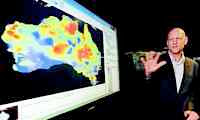 AUSTRALIA'S fight against climate change now has directions to the battlefield, thanks to a green energy treasure map. The new online Renewable Energy Atlas identifies the nation's green power goldmines - and the results seem promising. geothermal, wind, solar, wave and tidal power hotspots abound, mapped out in vivid colours on the federal Environment Department's website.
At the launch on Friday, Environment Minister Peter Garrett described the atlas as an "absolute cracker". "The fact is that renewable energy resources have hugely untapped potential for Australia, Mr Garrett said. Emissions-conscious Australians can use the program to figure out if a solar panel or wind turbine would be an eco-friendly investment. For governments and developers, it's a map to the most viable green energy sources. The atlas is the brainchild of scientists from CSIRO and the Bureau of Meteorology and received funding of $770,000 from the Environment Department.
Mr Garrett said it would benefit governments, businesses and the public, thanks to a user-friendly design. "[The atlas is] a great example of how Australian innovation is providing renewable solutions for the future." Strictly speaking, the atlas isn't an Australian innovation: areas of Britain and the United States have experimented with similar systems. Nevertheless, Mr Garrett was confident the atlas would become "one of the most powerful and important tools for liberating the Australian economy" from carbon-emitting energy.
The minister said the atlas would be vital in helping meet the Government's "crystal-clear" commitment to renewable energy. The Rudd Government has pledged that green power will provide 20 per cent of electricity needs by 2020. That would be met despite the current financial turmoil, Mr Garrett said, reiterating Thursday's pledges from Climate Change Minister Penny Wong.
The Government has vet to set the 20 per cent target into legislation, but the minister was adamant it would be met. 'We'll have more to say about that further down the track but the Government is profoundly committed to ensuring that we (10 have a 20 per cent renewable energy target, and that will be delivered." he said.
Sunday 19/10/2008 Page: 19
 AUSTRALIA'S fight against climate change now has directions to the battlefield, thanks to a green energy treasure map. The new online Renewable Energy Atlas identifies the nation's green power goldmines - and the results seem promising. geothermal, wind, solar, wave and tidal power hotspots abound, mapped out in vivid colours on the federal Environment Department's website.
At the launch on Friday, Environment Minister Peter Garrett described the atlas as an "absolute cracker". "The fact is that renewable energy resources have hugely untapped potential for Australia, Mr Garrett said. Emissions-conscious Australians can use the program to figure out if a solar panel or wind turbine would be an eco-friendly investment. For governments and developers, it's a map to the most viable green energy sources. The atlas is the brainchild of scientists from CSIRO and the Bureau of Meteorology and received funding of $770,000 from the Environment Department.
Mr Garrett said it would benefit governments, businesses and the public, thanks to a user-friendly design. "[The atlas is] a great example of how Australian innovation is providing renewable solutions for the future." Strictly speaking, the atlas isn't an Australian innovation: areas of Britain and the United States have experimented with similar systems. Nevertheless, Mr Garrett was confident the atlas would become "one of the most powerful and important tools for liberating the Australian economy" from carbon-emitting energy.
The minister said the atlas would be vital in helping meet the Government's "crystal-clear" commitment to renewable energy. The Rudd Government has pledged that green power will provide 20 per cent of electricity needs by 2020. That would be met despite the current financial turmoil, Mr Garrett said, reiterating Thursday's pledges from Climate Change Minister Penny Wong.
The Government has vet to set the 20 per cent target into legislation, but the minister was adamant it would be met. 'We'll have more to say about that further down the track but the Government is profoundly committed to ensuring that we (10 have a 20 per cent renewable energy target, and that will be delivered." he said.
Britain leads with vow to cut carbon emissions by 80pc
Canberra Times
Saturday 18/10/2008 Page: 15
Britain will introduce a legally binding pledge to cut carbon emissions by 80 per cent by 2050, the minister for the newly created Department for Energy and Climate Change said yesterday. The promise, which involves amending soon-to-be approved legislation that requires Britain to cut carbon emissions by 60 per cent of 1990 levels by 2050, came after a recommendation to do so from a government-appointed committee.
Energy and Climate Change Secretary Ed Miliband said in a statement to the House of Commons, "We will amend the Climate Change Bill to cut greenhouse gas emissions by 80 per cent by 2050, and that target will be binding in law." British Prime Minister Gordon Brown is determined to lead the way in tackling climate change. He hinted the Government would accept the new emissions target in a Labour Party conference speech last month. The cuts will cover all industries, including shipping and aviation.
The committee that made the initial recommendations said it would cost 1-2 per cent of gross domestic product in 2050 and was feasible. Mr Miliband said other laws would be amended to encourage smallscale energy generation through the use of home-based wind turbines or solar panels. He called on European countries to follow suit. Campaigners welcomed the pledge, but said Britain should lower carbon emissions locally, and not rely on the use of carbon offsetting, whereby individuals or companies can pay for green projects elsewhere to "offset" their own emissions.
Britain's World Wildlife Fund chief executive David Nussbaum said, "The key issue now is to ensure that we move swiftly to a low-carbon economy which creates new jobs here in the UK... rather than relying excessively on imported carbon credits." Britain became the first country in the world to introduce legally binding cuts in emissions of carbon dioxide when the Climate Change Bill completed its passage through Parliament in March. It is awaiting Royal Assent, effectively a rubber stamp that shows the monarch has approved it.
Saturday 18/10/2008 Page: 15
Britain will introduce a legally binding pledge to cut carbon emissions by 80 per cent by 2050, the minister for the newly created Department for Energy and Climate Change said yesterday. The promise, which involves amending soon-to-be approved legislation that requires Britain to cut carbon emissions by 60 per cent of 1990 levels by 2050, came after a recommendation to do so from a government-appointed committee.
Energy and Climate Change Secretary Ed Miliband said in a statement to the House of Commons, "We will amend the Climate Change Bill to cut greenhouse gas emissions by 80 per cent by 2050, and that target will be binding in law." British Prime Minister Gordon Brown is determined to lead the way in tackling climate change. He hinted the Government would accept the new emissions target in a Labour Party conference speech last month. The cuts will cover all industries, including shipping and aviation.
The committee that made the initial recommendations said it would cost 1-2 per cent of gross domestic product in 2050 and was feasible. Mr Miliband said other laws would be amended to encourage smallscale energy generation through the use of home-based wind turbines or solar panels. He called on European countries to follow suit. Campaigners welcomed the pledge, but said Britain should lower carbon emissions locally, and not rely on the use of carbon offsetting, whereby individuals or companies can pay for green projects elsewhere to "offset" their own emissions.
Britain's World Wildlife Fund chief executive David Nussbaum said, "The key issue now is to ensure that we move swiftly to a low-carbon economy which creates new jobs here in the UK... rather than relying excessively on imported carbon credits." Britain became the first country in the world to introduce legally binding cuts in emissions of carbon dioxide when the Climate Change Bill completed its passage through Parliament in March. It is awaiting Royal Assent, effectively a rubber stamp that shows the monarch has approved it.
Italy's climate threat
Herald Sun
Friday 17/10/2008 Page: 42
BRUSSELS - Italian Prime Minister Silvio Berlusconi has threatened to torpedo the European Union's climate change plans, branding them too big a burden for business amid the global financial crisis. His announcement, at an EU summit in Brussels, came despite pleas from fellow leaders not to abandon the targets in the face of growing financial pressure, although Poland also appeared ready to vote parts of it down. "I have announced my intention to exercise my veto," the Italian leader told a press conference yesterday on the sidelines of the summit. "Our businesses are in absolutely no position at the moment to absorb the costs of the regulations that have been proposed," he said.
Last year, EU leaders vowed to cut greenhouse gas emissions by 20 per cent by 2020, compared with 1990 levels, and also pledged to have renewable energies make up 20 per cent of all energy sources. But many EU nations have begun to baulk at the costs involved and the consequences to industry of the climate change goals. The call for special attention to be paid to economic concerns in finalising the climate package is just what Brussels and other EU member states had feared as the financial crisis takes hold.
"This is not the time to abandon a climate change agenda which is important for the future," British Prime Minister Gordon Brown warned ahead of the summit. European Commission chief Jose Manuel Barroso also urged the leaders to press ahead and not abandon Europe's leadership role. In London, Australian Climate Change Minister Penny Wong said now was as good a time as any to introduce tougher greenhouse gas targets. Ms Wong said the risks of delaying outweighed the risks of acting on climate change.
Friday 17/10/2008 Page: 42
BRUSSELS - Italian Prime Minister Silvio Berlusconi has threatened to torpedo the European Union's climate change plans, branding them too big a burden for business amid the global financial crisis. His announcement, at an EU summit in Brussels, came despite pleas from fellow leaders not to abandon the targets in the face of growing financial pressure, although Poland also appeared ready to vote parts of it down. "I have announced my intention to exercise my veto," the Italian leader told a press conference yesterday on the sidelines of the summit. "Our businesses are in absolutely no position at the moment to absorb the costs of the regulations that have been proposed," he said.
Last year, EU leaders vowed to cut greenhouse gas emissions by 20 per cent by 2020, compared with 1990 levels, and also pledged to have renewable energies make up 20 per cent of all energy sources. But many EU nations have begun to baulk at the costs involved and the consequences to industry of the climate change goals. The call for special attention to be paid to economic concerns in finalising the climate package is just what Brussels and other EU member states had feared as the financial crisis takes hold.
"This is not the time to abandon a climate change agenda which is important for the future," British Prime Minister Gordon Brown warned ahead of the summit. European Commission chief Jose Manuel Barroso also urged the leaders to press ahead and not abandon Europe's leadership role. In London, Australian Climate Change Minister Penny Wong said now was as good a time as any to introduce tougher greenhouse gas targets. Ms Wong said the risks of delaying outweighed the risks of acting on climate change.
Monday, 3 November 2008
Consumers face higher bills as AGL feels pinch
Sydney Morning Herald
Thursday 16/10/2008 Page: 31
 THE country's largest gas and electricity retailer yesterday warned consumers that energy prices would have to rise in the face of increasing costs caused by climate change and higher financing charges. AGL, which is also a major energy producer, is to press regulators to allow it to charge more for the currently price-capped sources of power it supplies as it prepares to deal with the Federal Government's planned carbon pollution reduction scheme due to start in 2010.
The emissions trading plan which is the central plank of the Rudd Government's environmental agenda, will have a "material impact" on AGLs cost structure and those of other energy suppliers, the company's chairman Mark Johnson warned shareholders yesterday. Speaking at AGL's annual meeting, Mr Johnson said the regulatory risks facing the group were more significant than ever before even when taking into consideration the existing price controls that limit what the company can charge its customers.
The bill that AGL faces for implementing the new carbon reduction measures will only add to the costs to business caused by the global credit crunch that will push up the interest charge on the debt it is looking to refinance over the coming year. "It is crucial that governments [federal and state] and regulators recognise this," said Mr Johnson.
"It is imperative that the regulators allow increases in the regulated prices of gas and electricity in line with the increased costs energy retailers will continue to face." Underlining the argument that the energy industry needs to take long-term investment decisions - such as AGL's plan to source 20 per cent of its electricity need from renewable energy such as wind by 2020 - Mr Johnson said governments had signalled that these were best done by the private sector.
"But the private sector can only invest if it has the confidence that governments and regulators will make decisions on a consistent and transparent basis... None of us like the prospect of paying more for our energy but short term decisions to keep prices artificially low will prove to be more disruptive and more expensive over the long term." Mr Johnson's comments came as AGL confirmed it was on target to meet its existing profit guidance for its 2009 financial year of net earnings of between $360 million and $390 million.
That compares to the net profit of $355 million it declared for the year to June 30, which itself was 8 per cent up on the previous 12 months. Michael Fraser, AGL's chief executive who replaced his controversial predecessor, Paul Anthony, exactly a year ago, said the company had enjoyed a "solid" first quarter, a period that covers most of the winter months. Mr Anthony's 17-month reign saw him earn $17 million before he left the company. AGL's shares rose 16c yesterday to $13.60.
Thursday 16/10/2008 Page: 31
 THE country's largest gas and electricity retailer yesterday warned consumers that energy prices would have to rise in the face of increasing costs caused by climate change and higher financing charges. AGL, which is also a major energy producer, is to press regulators to allow it to charge more for the currently price-capped sources of power it supplies as it prepares to deal with the Federal Government's planned carbon pollution reduction scheme due to start in 2010.
The emissions trading plan which is the central plank of the Rudd Government's environmental agenda, will have a "material impact" on AGLs cost structure and those of other energy suppliers, the company's chairman Mark Johnson warned shareholders yesterday. Speaking at AGL's annual meeting, Mr Johnson said the regulatory risks facing the group were more significant than ever before even when taking into consideration the existing price controls that limit what the company can charge its customers.
The bill that AGL faces for implementing the new carbon reduction measures will only add to the costs to business caused by the global credit crunch that will push up the interest charge on the debt it is looking to refinance over the coming year. "It is crucial that governments [federal and state] and regulators recognise this," said Mr Johnson.
"It is imperative that the regulators allow increases in the regulated prices of gas and electricity in line with the increased costs energy retailers will continue to face." Underlining the argument that the energy industry needs to take long-term investment decisions - such as AGL's plan to source 20 per cent of its electricity need from renewable energy such as wind by 2020 - Mr Johnson said governments had signalled that these were best done by the private sector.
"But the private sector can only invest if it has the confidence that governments and regulators will make decisions on a consistent and transparent basis... None of us like the prospect of paying more for our energy but short term decisions to keep prices artificially low will prove to be more disruptive and more expensive over the long term." Mr Johnson's comments came as AGL confirmed it was on target to meet its existing profit guidance for its 2009 financial year of net earnings of between $360 million and $390 million.
That compares to the net profit of $355 million it declared for the year to June 30, which itself was 8 per cent up on the previous 12 months. Michael Fraser, AGL's chief executive who replaced his controversial predecessor, Paul Anthony, exactly a year ago, said the company had enjoyed a "solid" first quarter, a period that covers most of the winter months. Mr Anthony's 17-month reign saw him earn $17 million before he left the company. AGL's shares rose 16c yesterday to $13.60.
Canada’s vote dims hopes on climate change
www.carbon-financeonline.com/
15 October, 2008
Canada's Conservative Party, which has consistently received low marks on environmental issues, expanded its position as the ruling party after securing more than a third of the popular vote in Tuesday's federal election. The Liberal Party suffered a disappointing second place finish after weeks of being attacked by Conservative Party leaders on its proposed federal carbon tax.
But the Conservatives did not receive enough support to form the majority government it was seeking, meaning it must still work with other parties to pass legislation. A return of the Liberals to power either independently or as part of a governing coalition with other opposition parties would have provided a major boost to climate change initiatives such as the party's proposed carbon tax.
Liberal Party leader Stéphane Dion introduced the party's Green Shift plan in June, which included a carbon tax that would immediately price greenhouse gas emissions at C$10 (US$8.47) per tonne, reaching C$40 per tonne within four years. The Conservative Party has resisted efforts to impose a carbon levy or hard emissions cap, proposing an intensity-based approach to emissions criticised by opposition parties as insufficient.
Prime Minister Stephen Harper said a new carbon tax would hurt jobs and damage Canada's economy. His government also abandoned Canadian efforts to comply with the Kyoto Protocol. A Sierra Club of Canada analysis ranked the Green Party as having the best plan to address environmental issues, but the party did not gain a single seat in the election.
The NDP and Liberals tied for second place while the Bloc came in third. The Conservative Party received the worst scores on environmental issues in the environmental group's analysis. The Conservative Party won a total of 143 seats in Parliament, picking up 19 seats from the 2006 elections by garnering 37.6% of the popular vote. In contrast, the Liberal Party secured only 76 seats, losing 27 seats from its 2006 tally after receiving just 26.2% of the vote.
15 October, 2008
Canada's Conservative Party, which has consistently received low marks on environmental issues, expanded its position as the ruling party after securing more than a third of the popular vote in Tuesday's federal election. The Liberal Party suffered a disappointing second place finish after weeks of being attacked by Conservative Party leaders on its proposed federal carbon tax.
But the Conservatives did not receive enough support to form the majority government it was seeking, meaning it must still work with other parties to pass legislation. A return of the Liberals to power either independently or as part of a governing coalition with other opposition parties would have provided a major boost to climate change initiatives such as the party's proposed carbon tax.
Liberal Party leader Stéphane Dion introduced the party's Green Shift plan in June, which included a carbon tax that would immediately price greenhouse gas emissions at C$10 (US$8.47) per tonne, reaching C$40 per tonne within four years. The Conservative Party has resisted efforts to impose a carbon levy or hard emissions cap, proposing an intensity-based approach to emissions criticised by opposition parties as insufficient.
Prime Minister Stephen Harper said a new carbon tax would hurt jobs and damage Canada's economy. His government also abandoned Canadian efforts to comply with the Kyoto Protocol. A Sierra Club of Canada analysis ranked the Green Party as having the best plan to address environmental issues, but the party did not gain a single seat in the election.
The NDP and Liberals tied for second place while the Bloc came in third. The Conservative Party received the worst scores on environmental issues in the environmental group's analysis. The Conservative Party won a total of 143 seats in Parliament, picking up 19 seats from the 2006 elections by garnering 37.6% of the popular vote. In contrast, the Liberal Party secured only 76 seats, losing 27 seats from its 2006 tally after receiving just 26.2% of the vote.
Battery powers ahead
Canberra Times
Friday 17/10/2008 Page: 21
A CSIRO-invented battery is doing its bit to reduce greenhouse gas emissions by making hybrid electric vehicles more efficient and affordable. The UltraBattery has four times the life cycle of conventional energy storage systems, produces 50 per cent more power and is 70 per cent cheaper than the batteries now used in hybrid electric vehicles. The battery will now be distributed internationally under a deal with Japan's Furukawa Battery Company and US manufacturer East Penn. The Japanese company has already begun production of the technologically advanced battery.
The UltraBattery combines an enhanced-power negative electrode and a lead acid battery in a single unit and has applications for lowemissions transport and renewable energy storage. The exclusive sub-licence agreement will see the UltraBattery distributed by East Penn throughout North America while Furukawa will release the technology in Japan and Thailand. CSIRO director Dr John Wright says he is delighted to see an Australian-developed technology gain attention on a world stage.
"This technology could significantly reduce greenhouse gas emissions from the transport sector by lowering the cost of hybrid electric vehicles and increasing their uptake, meaning that we could be looking at success on both commercial and environmental fronts," Wright says. The UltraBattery was not yet licensed in Australia for automotive applications. CSIRO was accepting expressions of interest for manufacture and distribution of the technology in this region. The UltraBattery technology also had applications for renewable energy storage from wind and solar.
Friday 17/10/2008 Page: 21
A CSIRO-invented battery is doing its bit to reduce greenhouse gas emissions by making hybrid electric vehicles more efficient and affordable. The UltraBattery has four times the life cycle of conventional energy storage systems, produces 50 per cent more power and is 70 per cent cheaper than the batteries now used in hybrid electric vehicles. The battery will now be distributed internationally under a deal with Japan's Furukawa Battery Company and US manufacturer East Penn. The Japanese company has already begun production of the technologically advanced battery.
The UltraBattery combines an enhanced-power negative electrode and a lead acid battery in a single unit and has applications for lowemissions transport and renewable energy storage. The exclusive sub-licence agreement will see the UltraBattery distributed by East Penn throughout North America while Furukawa will release the technology in Japan and Thailand. CSIRO director Dr John Wright says he is delighted to see an Australian-developed technology gain attention on a world stage.
"This technology could significantly reduce greenhouse gas emissions from the transport sector by lowering the cost of hybrid electric vehicles and increasing their uptake, meaning that we could be looking at success on both commercial and environmental fronts," Wright says. The UltraBattery was not yet licensed in Australia for automotive applications. CSIRO was accepting expressions of interest for manufacture and distribution of the technology in this region. The UltraBattery technology also had applications for renewable energy storage from wind and solar.
New clean energy projects, jobs and investments are on the map
Clean Energy Council
17 October 2008
 NATIONAL: The Clean Energy Council today congratulated the federal government on launching the national renewable energy atlas ahead of increasing the renewable energy target to 20% by 2020. The online tool provides comprehensive information on Australia's plentiful renewable energy resources including wind, solar, geothermal, tidal and biomass; as well as a map of transmission infrastructure and other geographic elements.
The Clean Energy Council CEO, Matthew Warren said: "This map is a fantastic resource that will assist both the industry for locating projects and communities seeking to make the most of zero-emission, natural energy sources in their area." Mr Warren said the atlas shows what this industry has been saying for years – Australia has some of the world's best and most diverse clean energy reserves, giving it real potential to become a global clean energy Silicon Valley.
"The clean energy industry is ready to commit billions of dollars of new investment into regional communities, we are just waiting for the federal government to flick the switch," Mr Warren said. "Given the emerging scarcity of global capital, the government will need to move swiftly to drive key infrastructure projects, or risk losing investment offshore. "The rules have changed in the past weeks," he said, "it's crucial we don't allow global credit scarcity to impede Australia assuming its rightful status as a clean energy superpower."
The Clean Energy Council will include the atlas as part of its program at the National Conference and Exhibition on the Gold Coast, 24-26 November 2008.
17 October 2008
 NATIONAL: The Clean Energy Council today congratulated the federal government on launching the national renewable energy atlas ahead of increasing the renewable energy target to 20% by 2020. The online tool provides comprehensive information on Australia's plentiful renewable energy resources including wind, solar, geothermal, tidal and biomass; as well as a map of transmission infrastructure and other geographic elements.
The Clean Energy Council CEO, Matthew Warren said: "This map is a fantastic resource that will assist both the industry for locating projects and communities seeking to make the most of zero-emission, natural energy sources in their area." Mr Warren said the atlas shows what this industry has been saying for years – Australia has some of the world's best and most diverse clean energy reserves, giving it real potential to become a global clean energy Silicon Valley.
"The clean energy industry is ready to commit billions of dollars of new investment into regional communities, we are just waiting for the federal government to flick the switch," Mr Warren said. "Given the emerging scarcity of global capital, the government will need to move swiftly to drive key infrastructure projects, or risk losing investment offshore. "The rules have changed in the past weeks," he said, "it's crucial we don't allow global credit scarcity to impede Australia assuming its rightful status as a clean energy superpower."
The Clean Energy Council will include the atlas as part of its program at the National Conference and Exhibition on the Gold Coast, 24-26 November 2008.
Masdar takes 20% stake in London Array
www.environmental-finance.com/
London, 16 October:
Masdar has taken a 20% stake in the London Array, the UK's flagship offshore wind farm that is due to begin operating in 2012. The Abu Dhabi government-backed clean energy investment company's involvement follows the withdrawal earlier this year of Royal Dutch/Shell from the project, leaving the London Array in the hands of two shareholders, power utilities E.ON and Denmark's DONG Energy.
Shell's decision cast doubts over whether the £2.4 billion ($4.1 billion), 1,000MW project would actually be built. The London Array is set to be the largest offshore wind farm in the world and represents a significant step towards the UK meeting its target of producing 20% of its electricity from offshore wind by 2020. Masdar paid an undisclosed sum to buy a 20% stake in the project from E.ON, leaving the German utility holding 30% and Dong the remaining 50%.
UK Prime Minister Gordon Brown said: "I very much welcome Masdar's decision to invest in renewable energy in the UK. This is an excellent example of the partnership we need between oil-producing and oil-consuming countries to develop new energy sources and technologies, diversifying their economies and reducing our dependence on carbon." Masdar and E.ON "will also extend their relationship further and intend to work together across a range of potential projects that will complement their existing renewable energy strategies", according to the German firm.
The initial focus will be on wind energy and the London Array project, but this will broaden out into other renewable energies and carbon emission reduction projects such as those under the UN's Clean Development Mechanism and Joint Implementation scheme.
A spokesman for E.ON said the firms were looking to develop projects "with similar scale and scope as the London Array". The Abu Dhabi government has invested $15 billion in Masdar, which in May committed $2 billion to start production on thin-film solar photovoltaic cells, and last month made a €120 million ($177 million) investment in Finnish wind turbine manufacturer WinWinD.
London, 16 October:
Masdar has taken a 20% stake in the London Array, the UK's flagship offshore wind farm that is due to begin operating in 2012. The Abu Dhabi government-backed clean energy investment company's involvement follows the withdrawal earlier this year of Royal Dutch/Shell from the project, leaving the London Array in the hands of two shareholders, power utilities E.ON and Denmark's DONG Energy.
Shell's decision cast doubts over whether the £2.4 billion ($4.1 billion), 1,000MW project would actually be built. The London Array is set to be the largest offshore wind farm in the world and represents a significant step towards the UK meeting its target of producing 20% of its electricity from offshore wind by 2020. Masdar paid an undisclosed sum to buy a 20% stake in the project from E.ON, leaving the German utility holding 30% and Dong the remaining 50%.
UK Prime Minister Gordon Brown said: "I very much welcome Masdar's decision to invest in renewable energy in the UK. This is an excellent example of the partnership we need between oil-producing and oil-consuming countries to develop new energy sources and technologies, diversifying their economies and reducing our dependence on carbon." Masdar and E.ON "will also extend their relationship further and intend to work together across a range of potential projects that will complement their existing renewable energy strategies", according to the German firm.
The initial focus will be on wind energy and the London Array project, but this will broaden out into other renewable energies and carbon emission reduction projects such as those under the UN's Clean Development Mechanism and Joint Implementation scheme.
A spokesman for E.ON said the firms were looking to develop projects "with similar scale and scope as the London Array". The Abu Dhabi government has invested $15 billion in Masdar, which in May committed $2 billion to start production on thin-film solar photovoltaic cells, and last month made a €120 million ($177 million) investment in Finnish wind turbine manufacturer WinWinD.
ASX to launch renewables, carbon products
www.environmental-finance.com/
London, 16 October:
The Australian Securities Exchange (ASX) is planning to list futures and options contracts for renewable energy certificates and carbon pollution permits and also has ambitions to service New Zealand's emissions trading scheme. The exchange will be ready to offer futures and options contracts on carbon pollution permits as soon as "we see the ink dry" on the legislation establishing the Australian scheme, emerging markets general manager Anthony Collins told Environmental Finance.
In the interim, the exchange aims to "give everybody a sense of what the product specifications will look like so they can start getting their houses in order and thinking about how they can use it", he said. The futures contracts would settle on the first business day in November each year, mirroring the limited number of trades in the over-the-counter market that have occurred to date. Options contracts would expire on the first business day in October.
The ASX plans to launch its futures and options contracts for renewable energy certificates (RECs) sometime between February and May, Collins said. At a carbon price of US$14 per tonne, the carbon market will be worth about US$5.6 billion a year, while the RECs market is likely to be worth roughly US$1.4 billion a year in 2020, Collins said. The Australian government is due to issue a white paper on emissions trading legislation by the end of the year, with a scheme expected to start in 2010. The ASX is also to launch futures and options contracts for New Zealand electricity, and Collins said it is keen to service New Zealand's emissions trading scheme.
Collins says this would be a "natural extension" of the ASX's activities in New Zealand, given that it has operated the country's only futures and options market since 1993. "Most of the banks and financial firms that have an interest in servicing the scheme in New Zealand actually reside in Australia," he added. However, any ASX moves in New Zealand would await the outcome of the 8 November general election, he said.
The opposition National Party, which is favourite to win the election, has pledged to introduce a series of changes to the trading scheme. Passage of New Zealand's emissions trading legislation meant there was now regulatory certainty, but there is still "a lot of political uncertainty", he said. The New Zealand scheme began operating this year, but will cap energy sector emissions from 2010. ASX briefing details are available online.
London, 16 October:
The Australian Securities Exchange (ASX) is planning to list futures and options contracts for renewable energy certificates and carbon pollution permits and also has ambitions to service New Zealand's emissions trading scheme. The exchange will be ready to offer futures and options contracts on carbon pollution permits as soon as "we see the ink dry" on the legislation establishing the Australian scheme, emerging markets general manager Anthony Collins told Environmental Finance.
In the interim, the exchange aims to "give everybody a sense of what the product specifications will look like so they can start getting their houses in order and thinking about how they can use it", he said. The futures contracts would settle on the first business day in November each year, mirroring the limited number of trades in the over-the-counter market that have occurred to date. Options contracts would expire on the first business day in October.
The ASX plans to launch its futures and options contracts for renewable energy certificates (RECs) sometime between February and May, Collins said. At a carbon price of US$14 per tonne, the carbon market will be worth about US$5.6 billion a year, while the RECs market is likely to be worth roughly US$1.4 billion a year in 2020, Collins said. The Australian government is due to issue a white paper on emissions trading legislation by the end of the year, with a scheme expected to start in 2010. The ASX is also to launch futures and options contracts for New Zealand electricity, and Collins said it is keen to service New Zealand's emissions trading scheme.
Collins says this would be a "natural extension" of the ASX's activities in New Zealand, given that it has operated the country's only futures and options market since 1993. "Most of the banks and financial firms that have an interest in servicing the scheme in New Zealand actually reside in Australia," he added. However, any ASX moves in New Zealand would await the outcome of the 8 November general election, he said.
The opposition National Party, which is favourite to win the election, has pledged to introduce a series of changes to the trading scheme. Passage of New Zealand's emissions trading legislation meant there was now regulatory certainty, but there is still "a lot of political uncertainty", he said. The New Zealand scheme began operating this year, but will cap energy sector emissions from 2010. ASX briefing details are available online.
Thursday, 30 October 2008
Big hurdles, but huge benefits
Australian
Thursday 16/10/2008 Page: 6
 FEW people will be watching the outcome of the emissions trading debate in Australia with more interest than Mark Rowsthorn. As chief executive of Asciano, the ports and rail giant that has been spun out of Toll Holdings, he is acutely aware that a push for more environmentally friendly freight operations will favour rail and sea services at the expense of road transport. With rail accounting for a mere 5 per cent of the domestic freight load, the scope for growth and profits is obvious. Rowsthorn has welcomed Ross Garnaut's Climate Change Review report and supports the introduction of an emissions trading scheme. He is calling on government to resist calls from big business to back away from a full-fledged ETS.
If they're serious about what they're trying to do, politicising it and watering it down will just reduce the impact of it and, from my perspective, it will also reduce the impact of anything done about our industry, which is just ludicrous." Asciano cites statistics revealing that rail uses two-thirds less fuel than road per tonne of goods carried and is three times more environmentally efficient. And, according to the Australian Department of Transport's 2008 statistics, road transport accounted for 84.9 per cent of Australia's domestic transport greenhouse gas emissions in 2007 and 1616 deaths, compared with respective figures for rail of 4.6 per cent and 37 deaths. Yet Rowsthorn concedes that breaking the dominance of the all-powerful road transport sector will be tough, and that federal and state assistance will be required.
At some point governments need to sit up and take notice of the benefits from a congestion, from a safety, from an environmental climate change perspective and say, well, there's actually enormous benefit in switching from road to rail. Yes, there are lobby groups and the trucking industry is quite powerful and the rail industry has been fragmented, (but) I think I'm seeing signs now of the rail industry coming together and pushing some very common agendas." Asciano has had its own well-publicised issues, with high debt levels and a slumping share price getting headlines.
Another distraction has been a scorned takeover attempt in August from investment firms TPG Capital and Global Infrastructure Partners. Nevertheless, with Australia's freight task expected to double over the next 15 to 20 years and bottlenecks at ports such as Newcastle and Gladstone already threatening resources exports, it is clear that the opportunities for rail are significant. There are issues to confront, though. Infrastructure shortfalls have been well chronicled, while the fragmented ownership of rail lines across the country on top of different rail gauges between the states represents a major barrier to the greater uptake of rail transportation.
Rowsthorn says action is long overdue. "There's no common ownership of the track between Brisbane and Perth," he says. "There are all sorts of regulatory impediments in getting the job done and you've got a lack of spending on the infrastructure that really limits rail's ability to take the market share off road.
"So how are you supposed to, as an above rail operator, get any confidence about the future of the business? How are you supposed to plan your (freight) paths running trains between those capitals with all the different track ownerships? You've got misalignment of investment." Bureau of Infrastructure, Transport and Regional Economics figures point to part of the problem. For the 2006-07 financial year, $11.85 billion was spent on roads and bridges compared with $2.48 billion on rail.
Rowsthorn suggests such lack of investment, if continued, will compound supply line difficulties in the future and increase dependence on roads. "You know, if the freight task doubles we have an expectation that the number of trucks on the road is going to double. I think that's just an incredibly asinine thing to do." Improving rail networks may take at least a decade and cost tens of billions of dollars. However, Rowsthorn says if upgrades are completed in "chunks" through upgrades of Sydney-Melbourne lines, then Sydney- Brisbane and ultimately a Melbourne- Brisbane rail project the investment will be manageable.
Asciano takes heart from the federal Government's appointment of respected industry figure Michael Deegan as the inaugural infrastructure co-ordinator, saying it is a sign that Canberra is taking freight transport issues seriously. "He's got a deep knowledge of rail and road," Rowsthorn says. He understands the bottlenecks and I think he's the sort of person that can see the sense in spending more on rail." Rowsthorn acknowledges "self-interest" in pushing for more rail freight, but is adamant it will have benefits for government, the environment, business and the public. "I think that just ticks a lot of boxes for the community, the country and not to mention ourselves. It's an important thing for the country to get right."
Thursday 16/10/2008 Page: 6
 FEW people will be watching the outcome of the emissions trading debate in Australia with more interest than Mark Rowsthorn. As chief executive of Asciano, the ports and rail giant that has been spun out of Toll Holdings, he is acutely aware that a push for more environmentally friendly freight operations will favour rail and sea services at the expense of road transport. With rail accounting for a mere 5 per cent of the domestic freight load, the scope for growth and profits is obvious. Rowsthorn has welcomed Ross Garnaut's Climate Change Review report and supports the introduction of an emissions trading scheme. He is calling on government to resist calls from big business to back away from a full-fledged ETS.
If they're serious about what they're trying to do, politicising it and watering it down will just reduce the impact of it and, from my perspective, it will also reduce the impact of anything done about our industry, which is just ludicrous." Asciano cites statistics revealing that rail uses two-thirds less fuel than road per tonne of goods carried and is three times more environmentally efficient. And, according to the Australian Department of Transport's 2008 statistics, road transport accounted for 84.9 per cent of Australia's domestic transport greenhouse gas emissions in 2007 and 1616 deaths, compared with respective figures for rail of 4.6 per cent and 37 deaths. Yet Rowsthorn concedes that breaking the dominance of the all-powerful road transport sector will be tough, and that federal and state assistance will be required.
At some point governments need to sit up and take notice of the benefits from a congestion, from a safety, from an environmental climate change perspective and say, well, there's actually enormous benefit in switching from road to rail. Yes, there are lobby groups and the trucking industry is quite powerful and the rail industry has been fragmented, (but) I think I'm seeing signs now of the rail industry coming together and pushing some very common agendas." Asciano has had its own well-publicised issues, with high debt levels and a slumping share price getting headlines.
Another distraction has been a scorned takeover attempt in August from investment firms TPG Capital and Global Infrastructure Partners. Nevertheless, with Australia's freight task expected to double over the next 15 to 20 years and bottlenecks at ports such as Newcastle and Gladstone already threatening resources exports, it is clear that the opportunities for rail are significant. There are issues to confront, though. Infrastructure shortfalls have been well chronicled, while the fragmented ownership of rail lines across the country on top of different rail gauges between the states represents a major barrier to the greater uptake of rail transportation.
Rowsthorn says action is long overdue. "There's no common ownership of the track between Brisbane and Perth," he says. "There are all sorts of regulatory impediments in getting the job done and you've got a lack of spending on the infrastructure that really limits rail's ability to take the market share off road.
"So how are you supposed to, as an above rail operator, get any confidence about the future of the business? How are you supposed to plan your (freight) paths running trains between those capitals with all the different track ownerships? You've got misalignment of investment." Bureau of Infrastructure, Transport and Regional Economics figures point to part of the problem. For the 2006-07 financial year, $11.85 billion was spent on roads and bridges compared with $2.48 billion on rail.
Rowsthorn suggests such lack of investment, if continued, will compound supply line difficulties in the future and increase dependence on roads. "You know, if the freight task doubles we have an expectation that the number of trucks on the road is going to double. I think that's just an incredibly asinine thing to do." Improving rail networks may take at least a decade and cost tens of billions of dollars. However, Rowsthorn says if upgrades are completed in "chunks" through upgrades of Sydney-Melbourne lines, then Sydney- Brisbane and ultimately a Melbourne- Brisbane rail project the investment will be manageable.
Asciano takes heart from the federal Government's appointment of respected industry figure Michael Deegan as the inaugural infrastructure co-ordinator, saying it is a sign that Canberra is taking freight transport issues seriously. "He's got a deep knowledge of rail and road," Rowsthorn says. He understands the bottlenecks and I think he's the sort of person that can see the sense in spending more on rail." Rowsthorn acknowledges "self-interest" in pushing for more rail freight, but is adamant it will have benefits for government, the environment, business and the public. "I think that just ticks a lot of boxes for the community, the country and not to mention ourselves. It's an important thing for the country to get right."
Power-packed clothing wins funds
Hobart Mercury
Thursday 16/10/2008 Page: 4
A PROJECT to develop small solar panels that can be woven into people's clothing to generate electricity is among the research initiatives to have won federal funding. The intricate use of solar panels is just one of 1100 projects included in the latest round of Australian Research Council funding, announced yesterday, which provides $363 million to the country's top researchers.
Boffins will use the money to study everything from the interactions between humans and robots to maintaining public health during heatwaves. South Australian researchers will study the most appropriate support services for grandparents who do plenty of childcare, while turning wastewater into drinking water will be studied in Western Australia.
Thursday 16/10/2008 Page: 4
A PROJECT to develop small solar panels that can be woven into people's clothing to generate electricity is among the research initiatives to have won federal funding. The intricate use of solar panels is just one of 1100 projects included in the latest round of Australian Research Council funding, announced yesterday, which provides $363 million to the country's top researchers.
Boffins will use the money to study everything from the interactions between humans and robots to maintaining public health during heatwaves. South Australian researchers will study the most appropriate support services for grandparents who do plenty of childcare, while turning wastewater into drinking water will be studied in Western Australia.
Riverland solar farm
Adelaide Advertiser
Thursday 16/10/2008 Page: 28
ONE of the largest grid connected solar energy systems in the state will open in the Riverland. Solar Shop Australia began construction of the "solar farm" yesterday with work on the project due to be completed by the end of the month. The $250,000 Sun Farm near Renmark has 495 individual panels with the capacity to generate more than 55,000kWh of power a year.
Thursday 16/10/2008 Page: 28
ONE of the largest grid connected solar energy systems in the state will open in the Riverland. Solar Shop Australia began construction of the "solar farm" yesterday with work on the project due to be completed by the end of the month. The $250,000 Sun Farm near Renmark has 495 individual panels with the capacity to generate more than 55,000kWh of power a year.
Group slams energy plan
Summaries - Australian Financial Review
Wednesday 15/10/2008 Page: 8
The Energy Users Association of Australia has criticised the Rudd government for its 'unnecessarily ambitious' plan to introduce an emissions trading scheme and compensate coal electricity generators to help maintain investor confidence. The group claims that a similar move in the European Union resulted in big power companies reaping windfall profits at the expense of other industries less able to pass on the additional costs of carbon trading to consumers.
The EUAA also said the government should be focusing on transition to cleaner electricity sources rather than propping up the coal-fired generators. The National Generators Forum said it was important to protect the financial strength of the generators while TRUEnergy warned that any policy which financially impairs generators could jeopardise electricity supplies.
Wednesday 15/10/2008 Page: 8
The Energy Users Association of Australia has criticised the Rudd government for its 'unnecessarily ambitious' plan to introduce an emissions trading scheme and compensate coal electricity generators to help maintain investor confidence. The group claims that a similar move in the European Union resulted in big power companies reaping windfall profits at the expense of other industries less able to pass on the additional costs of carbon trading to consumers.
The EUAA also said the government should be focusing on transition to cleaner electricity sources rather than propping up the coal-fired generators. The National Generators Forum said it was important to protect the financial strength of the generators while TRUEnergy warned that any policy which financially impairs generators could jeopardise electricity supplies.
Wednesday, 29 October 2008
$70m solar project to create 115 jobs
Canberra Times
Monday 13/10/2008 Page: 1
 A $70 million high-tech solar cell factory to be built next year, possibly in Canberra or Queanbeyan, will create 115 skilled jobs, with exports worth more than $400 million to Europe's booming solar markets.
Spark Solar Australia, a Canberra based company co-founded by former Australian National University photovoltaic engineer Michelle McCann, will produce 19 trillion solar cells a year - enough to power 20,000 homes. The company has already attracted start-tip capital from a Swiss investment hind and four key commercial partners in Germany. One of the world's leading solar technology and commercialisation experts, German physicist Dr Peter Fath, has joined Spark Solar Australia as company chairman.
Global demand for solar cells is so strong that Spark Solar Australia is now finalising a contract to sell half its output to one of Europe's biggest solar panel manufacturers. Dr McCann said, "The market for solar cells is enormous and there are not enough cells being made globally to meet demand. Even before the factory is built, we expect to pre-sell almost all of our output for the first five years." The global market for solar cells is growing at a faster rate than markets for laptops, mobile phones and digital cameras.
Last year, the global photovoltaics market grew by 70 per cent, to $A21 billion. Dr McCann said the Spark Solar Australia factory would inject $84 million into the region's economy in its first five years and provide skilled jobs for science and engineering graduates.
"Australia is a world leader in solar technology. But sadly the small manufacturing base that exists here means that a lot of really excellent talent and research has gone overseas in the past. We want to change that." The company will initially export 90 per cent of its product and will be Australia's biggest manufacturer of solar cells.
A state-of-the-art factory, designed and prefabricated in Germany, will be built next year, with the solar cell production beginning in early 2010. The company is looking at potential factory sites in Home and Mitchell, as well as Queanbeyan and Wollongong.
"We would prefer to be close to the ANU for collaboration purposes, but of course we have to consider other business factors including state or territory government incentives. The incentives that other state governments otter are very attractive compared with those available in the ACT.
"Given the current global financial market turndown, if a future ACT Government could provide a loan guarantee to Spark Solar Australia, it would be enormously beneficial to our financing ability and would definitely send a decision to establish in Canberra instead of elsewhere." Dr McCann said manufacturing solar cells offshore - for example, in China - would provide only a marginal financial advantage because labor costs were about 8 per cent of total costs.
Monday 13/10/2008 Page: 1
 A $70 million high-tech solar cell factory to be built next year, possibly in Canberra or Queanbeyan, will create 115 skilled jobs, with exports worth more than $400 million to Europe's booming solar markets.
Spark Solar Australia, a Canberra based company co-founded by former Australian National University photovoltaic engineer Michelle McCann, will produce 19 trillion solar cells a year - enough to power 20,000 homes. The company has already attracted start-tip capital from a Swiss investment hind and four key commercial partners in Germany. One of the world's leading solar technology and commercialisation experts, German physicist Dr Peter Fath, has joined Spark Solar Australia as company chairman.
Global demand for solar cells is so strong that Spark Solar Australia is now finalising a contract to sell half its output to one of Europe's biggest solar panel manufacturers. Dr McCann said, "The market for solar cells is enormous and there are not enough cells being made globally to meet demand. Even before the factory is built, we expect to pre-sell almost all of our output for the first five years." The global market for solar cells is growing at a faster rate than markets for laptops, mobile phones and digital cameras.
Last year, the global photovoltaics market grew by 70 per cent, to $A21 billion. Dr McCann said the Spark Solar Australia factory would inject $84 million into the region's economy in its first five years and provide skilled jobs for science and engineering graduates.
"Australia is a world leader in solar technology. But sadly the small manufacturing base that exists here means that a lot of really excellent talent and research has gone overseas in the past. We want to change that." The company will initially export 90 per cent of its product and will be Australia's biggest manufacturer of solar cells.
A state-of-the-art factory, designed and prefabricated in Germany, will be built next year, with the solar cell production beginning in early 2010. The company is looking at potential factory sites in Home and Mitchell, as well as Queanbeyan and Wollongong.
"We would prefer to be close to the ANU for collaboration purposes, but of course we have to consider other business factors including state or territory government incentives. The incentives that other state governments otter are very attractive compared with those available in the ACT.
"Given the current global financial market turndown, if a future ACT Government could provide a loan guarantee to Spark Solar Australia, it would be enormously beneficial to our financing ability and would definitely send a decision to establish in Canberra instead of elsewhere." Dr McCann said manufacturing solar cells offshore - for example, in China - would provide only a marginal financial advantage because labor costs were about 8 per cent of total costs.
Emission scheme to go on
Hobart Mercury
Wednesday 15/10/2008 Page: 4
THE Rudd Government has rejected pressure to delay or water-down an emissions trading scheme planned for 2010 despite the world economic crisis. The Opposition and some business figures want the scheme put on hold while the world grapples with financial turmoil, but Prime Minister Kevin Rudd is unmoved. He said yesterday climate change had to be tackled and emissions trading was important. "Our ambition remains 2010. Climate change is not going to go away," he said.
"The long-terns economic cost to the entire economy, and to the entire global economy, of not acting on climate change remains formidable," he said. Business wanted consistency and predictability around emissions trading and they would get it. he vowed. The important thing was to get the scheme's design and rules right, and to neap it out early. Federal Climate Change Minister Penny Wong, in Poland for greenhouse talks, said the financial crisis did not lessen the need to tackle climate change.
But she said the economic crisis would be taken into account in designing Australia's emissions scheme. Business heavyweight Don Voelte, chief executive of LNG company Woodside Petroleum, said emissions trading should be put on hold as the world economy withered. "Heck. I think it's off the table right now," the staunch critic of emissions trading said. "You can't put something like that in at this time until we get this whole fiscal chaos that is going on in the world straightened out."
Wednesday 15/10/2008 Page: 4
THE Rudd Government has rejected pressure to delay or water-down an emissions trading scheme planned for 2010 despite the world economic crisis. The Opposition and some business figures want the scheme put on hold while the world grapples with financial turmoil, but Prime Minister Kevin Rudd is unmoved. He said yesterday climate change had to be tackled and emissions trading was important. "Our ambition remains 2010. Climate change is not going to go away," he said.
"The long-terns economic cost to the entire economy, and to the entire global economy, of not acting on climate change remains formidable," he said. Business wanted consistency and predictability around emissions trading and they would get it. he vowed. The important thing was to get the scheme's design and rules right, and to neap it out early. Federal Climate Change Minister Penny Wong, in Poland for greenhouse talks, said the financial crisis did not lessen the need to tackle climate change.
But she said the economic crisis would be taken into account in designing Australia's emissions scheme. Business heavyweight Don Voelte, chief executive of LNG company Woodside Petroleum, said emissions trading should be put on hold as the world economy withered. "Heck. I think it's off the table right now," the staunch critic of emissions trading said. "You can't put something like that in at this time until we get this whole fiscal chaos that is going on in the world straightened out."
Solar may give 25pc of power by 2050
Canberra Times
Tuesday 14/10/2008 Page: 3
Solar thermal energy could provide 25 per cent of Australia's power by 2050 if there is a commitment to build one solar energy station a year, a leading CSIRO scientist says. The manager of CSIRO's renewable energy projects, Wes Stein, told a public meeting in Canberra last night he had already discussed this future possibility with solar mirror manufacturers. "One solar energy station a year: that sort of scale would not scare them. This is technology that likes to be built big," he said.
Delivering the sixth annual Malcolm McIntosh memorial lecture, Mr Stein said Australia should aim to play a leading global role in developing next-generation energy technologies and was well placed to be a large-scale exporter of solar energy and expertise.
But greater support for research and development was needed. "There's plenty of work to be done," he said. "We need smarter solar collectors and clever optics to make more [and] better reflective surfaces. "We also need to come up with some fairly fancy new materials that can handle hot-spot temperatures and we can still improve thermal efficiency."
Mr Stein said solar thermal energy could be collected, stored as synthetic natural gas (syngas) and "transported around the world", creating lucrative export markets for Australia. Farmers suffering the impacts of climate change could switch from crops to earning income from "farming the sun".
"If you convert solar energy into liquid transport fuels, in a sunny environment somewhere in Australia, then three days later it's being exported for use in Tokyo or elsewhere around the world." The McIntosh lecture is given each year by a leading CSIRO scientist and honours the organisation's former chief executive British-born physicist Dr Malcolm McIntosh, who died in 2000.
Mr Stein, who has been a driving force behind solar thermal innovation in Australia, led the CSIRO team that developed the world's first high-concentration solar tower array, which uses 200 computer-controlled mirrors to generate more than 500kW of electricity. Debate over whether solar thermal could provide baseload power for Australia's grid was "a furphy question", he said.
Tuesday 14/10/2008 Page: 3
Solar thermal energy could provide 25 per cent of Australia's power by 2050 if there is a commitment to build one solar energy station a year, a leading CSIRO scientist says. The manager of CSIRO's renewable energy projects, Wes Stein, told a public meeting in Canberra last night he had already discussed this future possibility with solar mirror manufacturers. "One solar energy station a year: that sort of scale would not scare them. This is technology that likes to be built big," he said.
Delivering the sixth annual Malcolm McIntosh memorial lecture, Mr Stein said Australia should aim to play a leading global role in developing next-generation energy technologies and was well placed to be a large-scale exporter of solar energy and expertise.
But greater support for research and development was needed. "There's plenty of work to be done," he said. "We need smarter solar collectors and clever optics to make more [and] better reflective surfaces. "We also need to come up with some fairly fancy new materials that can handle hot-spot temperatures and we can still improve thermal efficiency."
Mr Stein said solar thermal energy could be collected, stored as synthetic natural gas (syngas) and "transported around the world", creating lucrative export markets for Australia. Farmers suffering the impacts of climate change could switch from crops to earning income from "farming the sun".
"If you convert solar energy into liquid transport fuels, in a sunny environment somewhere in Australia, then three days later it's being exported for use in Tokyo or elsewhere around the world." The McIntosh lecture is given each year by a leading CSIRO scientist and honours the organisation's former chief executive British-born physicist Dr Malcolm McIntosh, who died in 2000.
Mr Stein, who has been a driving force behind solar thermal innovation in Australia, led the CSIRO team that developed the world's first high-concentration solar tower array, which uses 200 computer-controlled mirrors to generate more than 500kW of electricity. Debate over whether solar thermal could provide baseload power for Australia's grid was "a furphy question", he said.
Blowing with the wind
Age
Tuesday 14/10/2008 Page: 2
THE biggest wind farm in Victoria is a step closer after Planning Minister Justin Madden ruled that plans to build a 282-turbine project west of Ballarat required no Environmental Effects Statement (EES).
But Mr Madden told the proponents to conduct further work on the wind farm's impact on flocks of Brolga, a large local bird. Mr Madden's decision to waive the EES requirements angered a local protest group, which said it was another example of country Victorians being ignored.
Tuesday 14/10/2008 Page: 2
THE biggest wind farm in Victoria is a step closer after Planning Minister Justin Madden ruled that plans to build a 282-turbine project west of Ballarat required no Environmental Effects Statement (EES).
But Mr Madden told the proponents to conduct further work on the wind farm's impact on flocks of Brolga, a large local bird. Mr Madden's decision to waive the EES requirements angered a local protest group, which said it was another example of country Victorians being ignored.
Solar research burning bright with funding
Weekend Australian
Saturday 11/10/2008 Page: 6
WHEN the National Solar Energy Centre opened two years ago on a small corner of land that once formed part of BHP's steel works, it was an optimistic, if not especially well-funded venture into the exploration of innovative solar technologies. Two and a half years later, funding looks set to increase by a multiple of 10 or more, with the federal Government's budget commitment of $50 million commitment to set up an Australian Solar Institute, incorporating the National Solar Energy Centre and building on its research.
The research facility employs 16 people, mostly engineers and research scientists. It consists of a 26 metre-high tower, and the largest high-concentration solar array in the southern hemisphere. These 200 panels, made of mirrored glass on a steel frame, track the sun, and concentrate its power up to 1000 times its natural strength on to a reactor suspended from the tower. And this is where the magic happens, according to Wes Stein, manager at the National Solar Energy Centre.
"The heat causes a chemical reaction between the natural gas, water and a catalyst in the reactor. This reaction effectively traps the solar energy in the chemical bonds of the natural gas." The resulting gas, solar gas, has 26 per cent more energy than natural gas but with the advantages of the stability and transportability of natural gas. "Solar gas can be stored, tankered and shipped to markets around Australia but also exported to any of the countries that currently import energy," says Stein.
He cites collaborative work with Tokyo's Institute of Technology, the German Aerospace Centre (DLR) and a growing relationship with the Chinese Academy of Sciences as examples of interest from overseas in the technology and in the product's potential.
To Stein, solar gas is a pragmatic solution in the search for transition fuels as Australia moves towards a greater mix of renewable energy sources. "Solar and gas are Australia's most abundant natural resources. In my 30 years in the industry I have seen the fossil and renewable industries bounce off each other often with more conflict than the willingness to work together." Solar gas, he suggests, makes use of existing gas infrastructure. "In terms of transition from the fossil fuel economy, it isn't about a sudden breakthrough overnight.
It is about scalability and the ability to integrate new sources of energy with existing electricity generation knowhow and reliable distribution. It isn't about taking risks and jeopardising supply." A demonstration array is currently under construction in Queensland. It will be completed in 2011.
The National Solar Energy Centre's research into solar gas is just a part of its research activities. solar thermal technology (allocated $50 million in the Rudd Government's budget) is also part of NSEC's plan. This uses a low concentration solar array to convert solar energy into heat to drive a turbine along the lines of traditional electricity generation but removing the need for fossil fuel. The centre is also researching the next generation photovoltaics (solar cells) with an emphasis on low cost and easy integration into the existing built environment.
Saturday 11/10/2008 Page: 6
WHEN the National Solar Energy Centre opened two years ago on a small corner of land that once formed part of BHP's steel works, it was an optimistic, if not especially well-funded venture into the exploration of innovative solar technologies. Two and a half years later, funding looks set to increase by a multiple of 10 or more, with the federal Government's budget commitment of $50 million commitment to set up an Australian Solar Institute, incorporating the National Solar Energy Centre and building on its research.
The research facility employs 16 people, mostly engineers and research scientists. It consists of a 26 metre-high tower, and the largest high-concentration solar array in the southern hemisphere. These 200 panels, made of mirrored glass on a steel frame, track the sun, and concentrate its power up to 1000 times its natural strength on to a reactor suspended from the tower. And this is where the magic happens, according to Wes Stein, manager at the National Solar Energy Centre.
"The heat causes a chemical reaction between the natural gas, water and a catalyst in the reactor. This reaction effectively traps the solar energy in the chemical bonds of the natural gas." The resulting gas, solar gas, has 26 per cent more energy than natural gas but with the advantages of the stability and transportability of natural gas. "Solar gas can be stored, tankered and shipped to markets around Australia but also exported to any of the countries that currently import energy," says Stein.
He cites collaborative work with Tokyo's Institute of Technology, the German Aerospace Centre (DLR) and a growing relationship with the Chinese Academy of Sciences as examples of interest from overseas in the technology and in the product's potential.
To Stein, solar gas is a pragmatic solution in the search for transition fuels as Australia moves towards a greater mix of renewable energy sources. "Solar and gas are Australia's most abundant natural resources. In my 30 years in the industry I have seen the fossil and renewable industries bounce off each other often with more conflict than the willingness to work together." Solar gas, he suggests, makes use of existing gas infrastructure. "In terms of transition from the fossil fuel economy, it isn't about a sudden breakthrough overnight.
It is about scalability and the ability to integrate new sources of energy with existing electricity generation knowhow and reliable distribution. It isn't about taking risks and jeopardising supply." A demonstration array is currently under construction in Queensland. It will be completed in 2011.
The National Solar Energy Centre's research into solar gas is just a part of its research activities. solar thermal technology (allocated $50 million in the Rudd Government's budget) is also part of NSEC's plan. This uses a low concentration solar array to convert solar energy into heat to drive a turbine along the lines of traditional electricity generation but removing the need for fossil fuel. The centre is also researching the next generation photovoltaics (solar cells) with an emphasis on low cost and easy integration into the existing built environment.
Monday, 27 October 2008
Biggest culprit turns to sun, wind
Weekend Australian
Saturday 11/10/2008 Page: 4
 China is the elephant in the international lounge room when it comes to global warming but, far from being ignored, it is constantly being held up by both sides of the argument on emissions management. Detractors of the Rudd Government's plans to introduce a unilateral carbon charge scheme in Australia point to China's emissions it is now the largest greenhouse gas emitter in the world, emitting 24 per cent of the global total and exceeding US emissions in 2007 by about 14 per cent and the enormous increases to come from its commitment to coal-fired power to meet rapid industrialisation.
Supporters of the Government's plans argue we will have little influence over China and other large emitters in the next round of international negotiations on global warming if we cannot ourselves demonstrate commitment and acceptance of economic pain. China, meanwhile, continues to press forward with coal-fired development while maintaining a hard line on a global carbon trading scheme in post-Kyoto negotiations. After the recent G8 meeting in Japan, China, India, South Africa, Mexico and Brazil declined in follow-up talks to endorse a commitment to cut national emissions by 50 per cent by 2050 suggesting that the major developed nations would need to cut emissions by up to 95 per cent to win their support.
Last year China oversaw the commissioning of more than 80,000MW of new coal-fired capacity nearly triple Australia's coalburning generation and it has approved more than 200 new coal-burning generators, each 600MW or more, for delivery by 2012. (By comparison, NSW, which accounts for 40 per cent of Australian electricity consumption, has 12 units of 660MW.
Notwithstanding this activity and its tough negotiating stance, China is busy ensuring that the developed nations understand it is not "doing nothing" about greenhouse gases. One of its leading energy academics, Jianxiong Mao of Tsinghua University in Beijing, told a major clean energy conference in Manila in June that China is closing 4000 of its old, inefficient power stations of up to 300MW capacity and building 120,000MW of renewable energy.
In an interview in New Scientist magazine, Wu Changhua, Greater China director of the Climate Group, says that the country's highest decision-making body has conducted two study sessions on global warming in a year. The country, she says, is "deeply aware of its environmental problems." Wu notes that the Chinese Government has legislated to boost electricity production from renewable energy to 15 per cent by 2020, from 8 per cent at present, and to require 3 per cent to come from wind, solar energy and biomass.
Australian proponents of "showing China the way" gloss over the fact that the country already has 6000MW of wind farms a target Australia hopes to reach in 2020 and that it is aiming to have 100,000MW of wind energy in 12 years' time. China invested $US12 billion in renewable energy last year and its Government has estimated that it will need to spend an average of $US33 billion a year for the next 12 years to achieve zero-emissions and low-carbon goals.
China is also planning a six-fold increase in its nuclear energy capacity, raising a challenging issue for Australian federal and state governments that cannot bring themselves to develop new uranium mines despite estimates that their product could contribute a billion tonnes of greenhouse gas abatement worldwide a year compared with the current 400 million tonnes from our exports. The Chinese Government drives the wind program by insisting that consumers pay the actual price of production. Wu Changhua suggests China does not need any lessons in pursuing cleaner coal burning.
The Government, she says, is already investigating carbon capture and storage, pushing its power sector to buy the most advanced pulverised coal technology, and closely following development in integrated gasified combined-cycle plants. These turn coal into a gas and are in pole position at present to lead the shift to "clean coal" electricity supply. China is also the world's largest producer of solar photovoltaic cells, having doubled its output on sun power panels in each of the past four years.
The Chinese Government is also engaged in ensuring that Western journalists writing about its carbon emissions understand the situation. It points out to them that much of industrial emissions come from production of cement, aluminium and plate glass, essential ingredients for the economic revolution it is pursuing. Twenty per cent of Chinese emissions roughly equivalent to Australia's total greenhouse gas emissions come from cement production.
International government visitors to Beijing for the recent Olympics will have found their attention being drawn to an 11-story building housing the Sino-Japan Friendship Centre for Environment Protection. Here the city's pollution levels are monitored and research information passed on from the globe's most energy-efficient (because it is one of the most energy resource poor) nations. Japan has much to contribute it uses an eighth as much energy as China does to $1 in GDP.
Japan has sponsored 18 "model projects" in China involving emissions-reducing and energy-saving systems. Nippon Steel, Japan's largest steelmaker, for example, has introduced an eco-friendly coke-manufacturing process called dry quenching that is becoming widely used in Chinese operations it now has 30 factories using the technology. Japan, however, remains fearful of selling its best technology to China because low-cost competitors may steal it.
Saturday 11/10/2008 Page: 4
 China is the elephant in the international lounge room when it comes to global warming but, far from being ignored, it is constantly being held up by both sides of the argument on emissions management. Detractors of the Rudd Government's plans to introduce a unilateral carbon charge scheme in Australia point to China's emissions it is now the largest greenhouse gas emitter in the world, emitting 24 per cent of the global total and exceeding US emissions in 2007 by about 14 per cent and the enormous increases to come from its commitment to coal-fired power to meet rapid industrialisation.
Supporters of the Government's plans argue we will have little influence over China and other large emitters in the next round of international negotiations on global warming if we cannot ourselves demonstrate commitment and acceptance of economic pain. China, meanwhile, continues to press forward with coal-fired development while maintaining a hard line on a global carbon trading scheme in post-Kyoto negotiations. After the recent G8 meeting in Japan, China, India, South Africa, Mexico and Brazil declined in follow-up talks to endorse a commitment to cut national emissions by 50 per cent by 2050 suggesting that the major developed nations would need to cut emissions by up to 95 per cent to win their support.
Last year China oversaw the commissioning of more than 80,000MW of new coal-fired capacity nearly triple Australia's coalburning generation and it has approved more than 200 new coal-burning generators, each 600MW or more, for delivery by 2012. (By comparison, NSW, which accounts for 40 per cent of Australian electricity consumption, has 12 units of 660MW.
Notwithstanding this activity and its tough negotiating stance, China is busy ensuring that the developed nations understand it is not "doing nothing" about greenhouse gases. One of its leading energy academics, Jianxiong Mao of Tsinghua University in Beijing, told a major clean energy conference in Manila in June that China is closing 4000 of its old, inefficient power stations of up to 300MW capacity and building 120,000MW of renewable energy.
In an interview in New Scientist magazine, Wu Changhua, Greater China director of the Climate Group, says that the country's highest decision-making body has conducted two study sessions on global warming in a year. The country, she says, is "deeply aware of its environmental problems." Wu notes that the Chinese Government has legislated to boost electricity production from renewable energy to 15 per cent by 2020, from 8 per cent at present, and to require 3 per cent to come from wind, solar energy and biomass.
Australian proponents of "showing China the way" gloss over the fact that the country already has 6000MW of wind farms a target Australia hopes to reach in 2020 and that it is aiming to have 100,000MW of wind energy in 12 years' time. China invested $US12 billion in renewable energy last year and its Government has estimated that it will need to spend an average of $US33 billion a year for the next 12 years to achieve zero-emissions and low-carbon goals.
China is also planning a six-fold increase in its nuclear energy capacity, raising a challenging issue for Australian federal and state governments that cannot bring themselves to develop new uranium mines despite estimates that their product could contribute a billion tonnes of greenhouse gas abatement worldwide a year compared with the current 400 million tonnes from our exports. The Chinese Government drives the wind program by insisting that consumers pay the actual price of production. Wu Changhua suggests China does not need any lessons in pursuing cleaner coal burning.
The Government, she says, is already investigating carbon capture and storage, pushing its power sector to buy the most advanced pulverised coal technology, and closely following development in integrated gasified combined-cycle plants. These turn coal into a gas and are in pole position at present to lead the shift to "clean coal" electricity supply. China is also the world's largest producer of solar photovoltaic cells, having doubled its output on sun power panels in each of the past four years.
The Chinese Government is also engaged in ensuring that Western journalists writing about its carbon emissions understand the situation. It points out to them that much of industrial emissions come from production of cement, aluminium and plate glass, essential ingredients for the economic revolution it is pursuing. Twenty per cent of Chinese emissions roughly equivalent to Australia's total greenhouse gas emissions come from cement production.
International government visitors to Beijing for the recent Olympics will have found their attention being drawn to an 11-story building housing the Sino-Japan Friendship Centre for Environment Protection. Here the city's pollution levels are monitored and research information passed on from the globe's most energy-efficient (because it is one of the most energy resource poor) nations. Japan has much to contribute it uses an eighth as much energy as China does to $1 in GDP.
Japan has sponsored 18 "model projects" in China involving emissions-reducing and energy-saving systems. Nippon Steel, Japan's largest steelmaker, for example, has introduced an eco-friendly coke-manufacturing process called dry quenching that is becoming widely used in Chinese operations it now has 30 factories using the technology. Japan, however, remains fearful of selling its best technology to China because low-cost competitors may steal it.
EU set to renege on climate pledges
Canberra Times
Saturday 11/10/2008 Page: 15
EU heads of state plan to use the global financial crisis as an excuse to renege on climate change commitments, sources close to energy talks in Brussels say. Papers suggest the European Union council, which meets next week, wants to drop the previous pledge of an automatic increase in emissions cuts if the world decides on a big climate change deal next year.
The council also intends to allow countries to avoid having to cut their own emissions by letting them purchase a large proportion of reductions from overseas. The EU has a target of a 20 per cent emissions cut by 2020. This would rise to 30 per cent if a global deal is signed.
But the papers show the European Union is seeking a new legislative process if the EU target rises above 20 per cent. This effectively shelves the move to 30 per cent and would take many years to complete. The commission justifies its proposals by saying EU countries paying for emissions cats would transfer tip to 42 billion euro ($A86.2 billion) to developing and other countries from 2008-2020.
It also wants a change in the auctioning of pollution allowances for power firms, which could lead to windfall profits estimated at tip to $A30.8 billion. Environmental groups said the moves could allow countries such as Britain to build a new generation of coal power stations without fear of exceeding their legally binding emission targets.
The head of international climate at Friends of the Earth, Tom Picker, said, "By simply buying cheap projects in developing countries, the EU will avoid making the type of transformations needed in our domestic economy to avoid dangerous climate change." Britain and Italy, among other nations, have been accused of trying to dilute pledges for renewable energy.
Saturday 11/10/2008 Page: 15
EU heads of state plan to use the global financial crisis as an excuse to renege on climate change commitments, sources close to energy talks in Brussels say. Papers suggest the European Union council, which meets next week, wants to drop the previous pledge of an automatic increase in emissions cuts if the world decides on a big climate change deal next year.
The council also intends to allow countries to avoid having to cut their own emissions by letting them purchase a large proportion of reductions from overseas. The EU has a target of a 20 per cent emissions cut by 2020. This would rise to 30 per cent if a global deal is signed.
But the papers show the European Union is seeking a new legislative process if the EU target rises above 20 per cent. This effectively shelves the move to 30 per cent and would take many years to complete. The commission justifies its proposals by saying EU countries paying for emissions cats would transfer tip to 42 billion euro ($A86.2 billion) to developing and other countries from 2008-2020.
It also wants a change in the auctioning of pollution allowances for power firms, which could lead to windfall profits estimated at tip to $A30.8 billion. Environmental groups said the moves could allow countries such as Britain to build a new generation of coal power stations without fear of exceeding their legally binding emission targets.
The head of international climate at Friends of the Earth, Tom Picker, said, "By simply buying cheap projects in developing countries, the EU will avoid making the type of transformations needed in our domestic economy to avoid dangerous climate change." Britain and Italy, among other nations, have been accused of trying to dilute pledges for renewable energy.
Hot rocking engineers
Independent Weekly
Friday 10/10/2008 Page: 22
No matter what side of the climate change debate you reside on there is no denying the exponential growth in electricity demand worldwide. Incredibly, consumption of electricity is projected to grow by nearly 100 per cent by 2020. Increasing demand for energy and concern over the ill effects of carbon dioxide on the atmosphere has produced an urgent need to explore clean, renewable sources of energy.
Further expansion of nuclear energy is largely unpopular and large-scale hydroelectric projects are now considered environmentally irresponsible. Solar and wind energy technologies have advanced and currently augment electricity supplies, but further advancement is required before these sources of electricity can be suitable as a base load power supply.
Hot Fractured Rock (HFR) geothermal energy is a known source of renewable energy with the capacity to carry large base loads. HFR geothermal energy is environmentally clean and does not produce greenhouse gases. HFR works by utilising heat generated by special high heat producing granites located 3km or more below the Earth's surface. The heat inside these granites is trapped by overlying rocks which act as an insulating blanket.
The heat is extracted from these granites by circulating water through them in an engineered, artificial reservoir. Standard geothermal power stations convert the extracted heat into electricity. GeoDynamics Ltd has been constructing a 1MW proof of concept plant near Innamincka in South Australia to generate electricity using HFR. This has the potential to make South Australia a leader in the generation and supply of renewable clean energy.
As of June 2008,33 companies had applied for geothermal license areas across Australia. According to the Government of South Australia, 23 companies have applied for 237 geothermal licenses covering more than 110,800 sqkm. These licenses account for more than 80 per cent of all geothermal exploration activity underway or proposed throughout Australia.
The upcoming Engineers Australia Breakfast Briefing presentation, to be held on Wednesday, November 12, will hear from Rod Smith, project manager for GeoDynamics Ltd at Innamincka. David Klingberg, chair of the Premiers' Climate Change Council and the 2008 Professional Engineer of the Year, will also deliver a presentation on the impact of climate change and emissions trading.
Attendance is open to Engineers Australia members and the general public. Register your attendance at the Engineers Australia SA Division Office on 82671783 or sa@engineersaustralia.org.au
Friday 10/10/2008 Page: 22
No matter what side of the climate change debate you reside on there is no denying the exponential growth in electricity demand worldwide. Incredibly, consumption of electricity is projected to grow by nearly 100 per cent by 2020. Increasing demand for energy and concern over the ill effects of carbon dioxide on the atmosphere has produced an urgent need to explore clean, renewable sources of energy.
Further expansion of nuclear energy is largely unpopular and large-scale hydroelectric projects are now considered environmentally irresponsible. Solar and wind energy technologies have advanced and currently augment electricity supplies, but further advancement is required before these sources of electricity can be suitable as a base load power supply.
Hot Fractured Rock (HFR) geothermal energy is a known source of renewable energy with the capacity to carry large base loads. HFR geothermal energy is environmentally clean and does not produce greenhouse gases. HFR works by utilising heat generated by special high heat producing granites located 3km or more below the Earth's surface. The heat inside these granites is trapped by overlying rocks which act as an insulating blanket.
The heat is extracted from these granites by circulating water through them in an engineered, artificial reservoir. Standard geothermal power stations convert the extracted heat into electricity. GeoDynamics Ltd has been constructing a 1MW proof of concept plant near Innamincka in South Australia to generate electricity using HFR. This has the potential to make South Australia a leader in the generation and supply of renewable clean energy.
As of June 2008,33 companies had applied for geothermal license areas across Australia. According to the Government of South Australia, 23 companies have applied for 237 geothermal licenses covering more than 110,800 sqkm. These licenses account for more than 80 per cent of all geothermal exploration activity underway or proposed throughout Australia.
The upcoming Engineers Australia Breakfast Briefing presentation, to be held on Wednesday, November 12, will hear from Rod Smith, project manager for GeoDynamics Ltd at Innamincka. David Klingberg, chair of the Premiers' Climate Change Council and the 2008 Professional Engineer of the Year, will also deliver a presentation on the impact of climate change and emissions trading.
Attendance is open to Engineers Australia members and the general public. Register your attendance at the Engineers Australia SA Division Office on 82671783 or sa@engineersaustralia.org.au
Energy firm airs its Yass wind farm plan
Canberra Times
Thursday 9/10/2008 Page: 2
A Sydney-based renewable energy company is looking into building a wind farm near Yass. Epuron will study the wind potential of different sites to determine turbine numbers, their arrangement and location before presenting a concept plan to the community. Areas under investigation for the new wind farm include parts of Black Range, the Coppabella Hills and Carrolls Ridge.
Project director Simon Davey said Yass was well placed to benefit from investment in renewable energy. "With careful consideration and planning, projects like this can be developed in the Yass region with positive benefits to the environment, the local economy and the community," Mr Davey said.
"It will provide the capacity for the Yass region to establish ongoing, longterm, sustainable jobs through the service, construction and related manufacturing industries." Investigations in the area will include measurements of wind speed, noise propagation, visual impact studies, flora and fauna studies and assessment of heritage values.
Epuron plans to feed the electricity produced from the wind farm into the national electricity grid, to be consumed within the national electricity market. Mr Davey said the company had already received planning approval to build three wind farms, including one at Conroys Gap near Yass.
Yass mayor Nic Carmody said he believed the wind farm would have an environmental benefit, but he did not think it would provide "a direct benefit to the people of the Yass Valley". "We all need to be doing our bit for green energy," Mr Carmody said. "I think they should certainly be exploring it and see if it's worthwhile proceeding with it. "I know in the case of the previous [wind farm at Conroys Gap], there were a lot of people who were affected who live nearby. They do have concerns and valid concerns."
Thursday 9/10/2008 Page: 2
A Sydney-based renewable energy company is looking into building a wind farm near Yass. Epuron will study the wind potential of different sites to determine turbine numbers, their arrangement and location before presenting a concept plan to the community. Areas under investigation for the new wind farm include parts of Black Range, the Coppabella Hills and Carrolls Ridge.
Project director Simon Davey said Yass was well placed to benefit from investment in renewable energy. "With careful consideration and planning, projects like this can be developed in the Yass region with positive benefits to the environment, the local economy and the community," Mr Davey said.
"It will provide the capacity for the Yass region to establish ongoing, longterm, sustainable jobs through the service, construction and related manufacturing industries." Investigations in the area will include measurements of wind speed, noise propagation, visual impact studies, flora and fauna studies and assessment of heritage values.
Epuron plans to feed the electricity produced from the wind farm into the national electricity grid, to be consumed within the national electricity market. Mr Davey said the company had already received planning approval to build three wind farms, including one at Conroys Gap near Yass.
Yass mayor Nic Carmody said he believed the wind farm would have an environmental benefit, but he did not think it would provide "a direct benefit to the people of the Yass Valley". "We all need to be doing our bit for green energy," Mr Carmody said. "I think they should certainly be exploring it and see if it's worthwhile proceeding with it. "I know in the case of the previous [wind farm at Conroys Gap], there were a lot of people who were affected who live nearby. They do have concerns and valid concerns."
EU law makes power firms pay for all emissions
Australian
Thursday 9/10/2008 Page: 8
THE future of coal-fired power generation in Europe has been called into question after the European Union backed laws that would force power companies to pay for all their carbon dioxide emissions from 2013. The decision, which could cost the power industry 30 billion ($56 billion) a year and could trigger a steep rise in electricity bills, represents a huge boost for the renewable energy industry.
Chris Davies, an MEP who supported the legislation, said the decision by the EU's environment committee "effectively prevents the building of new coalfired power plants from 2015 unless equipped with CCS (carbon capture and storage technology)' . The new rules require final approval from the European parliament and EU member states. If granted, they would transform the economics of burning coal to generate electricity.
The move came despite fierce resistance from power industry lobbyists, who said the EU's aggressive emissions-cutting targets should be weakened because of the global financial crisis. Avril Doyle, an Irish MEP on the committee, said: "For all the trouble we have, the single greatest challenge facing us is climate change." The committee backed proposed changes to the EU emissions trading scheme, a program in which the bulk of permits are handed out to companies for free.
Members voted in favour of auctioning all emissions permits after 2013 for power companies. The committee proposed that other polluting industries, such as steel making, should pay for 15 per cent of permits in 2013, rising to 100 per cent by 2020. It had been unclear how the ETS program would evolve after 2012. The committee also offered to plough $14 billion from the scheme into carbon capture and storage research, an untried technology designed to strip out greenhouse gases at source and store them underground.
The bill is a key plank of the EU's plan to cut Europe's carbon dioxide emissions by 20 per cent by 2020. The CBI welcomed the scheme yesterday, saying it would provide greater clarity for businesses. Europe's renewable energy industry endorsed the decision. "This new target underlines the urgency of action to deliver clean, sustainable energy now if we are to keep global temperatures within acceptable limits," said Maria McCaffery, of the British Wind Energy Association.
A vote before the full European parliament is likely in December, although opposition is expected from some heavily coal dependent countries, such as Poland. France, which has the EU presidency at the moment, wants to enshrine the bill in law by the end of the year.
Democratic leaders in the US House of Representatives yesterday proposed to reduce by 80 per cent in the next 42 years the gases from power plants, transportation and factories. The draft legislation would begin slowly, capping emissions of heat-trapping gases released by transportation and power plants first, then moving to other sectors of the economy.
Thursday 9/10/2008 Page: 8
THE future of coal-fired power generation in Europe has been called into question after the European Union backed laws that would force power companies to pay for all their carbon dioxide emissions from 2013. The decision, which could cost the power industry 30 billion ($56 billion) a year and could trigger a steep rise in electricity bills, represents a huge boost for the renewable energy industry.
Chris Davies, an MEP who supported the legislation, said the decision by the EU's environment committee "effectively prevents the building of new coalfired power plants from 2015 unless equipped with CCS (carbon capture and storage technology)' . The new rules require final approval from the European parliament and EU member states. If granted, they would transform the economics of burning coal to generate electricity.
The move came despite fierce resistance from power industry lobbyists, who said the EU's aggressive emissions-cutting targets should be weakened because of the global financial crisis. Avril Doyle, an Irish MEP on the committee, said: "For all the trouble we have, the single greatest challenge facing us is climate change." The committee backed proposed changes to the EU emissions trading scheme, a program in which the bulk of permits are handed out to companies for free.
Members voted in favour of auctioning all emissions permits after 2013 for power companies. The committee proposed that other polluting industries, such as steel making, should pay for 15 per cent of permits in 2013, rising to 100 per cent by 2020. It had been unclear how the ETS program would evolve after 2012. The committee also offered to plough $14 billion from the scheme into carbon capture and storage research, an untried technology designed to strip out greenhouse gases at source and store them underground.
The bill is a key plank of the EU's plan to cut Europe's carbon dioxide emissions by 20 per cent by 2020. The CBI welcomed the scheme yesterday, saying it would provide greater clarity for businesses. Europe's renewable energy industry endorsed the decision. "This new target underlines the urgency of action to deliver clean, sustainable energy now if we are to keep global temperatures within acceptable limits," said Maria McCaffery, of the British Wind Energy Association.
A vote before the full European parliament is likely in December, although opposition is expected from some heavily coal dependent countries, such as Poland. France, which has the EU presidency at the moment, wants to enshrine the bill in law by the end of the year.
Democratic leaders in the US House of Representatives yesterday proposed to reduce by 80 per cent in the next 42 years the gases from power plants, transportation and factories. The draft legislation would begin slowly, capping emissions of heat-trapping gases released by transportation and power plants first, then moving to other sectors of the economy.
Subscribe to:
Posts (Atom)